Key Points
- A source in the prime minister's office told ontime+ Zaidi is determined to confront armed factions.
- One powerful bloc backs him, another opposes, while others hesitate to anger Iran, the source said.
- The standoff eased into a conditional inspection deal that narrowed where the committee could search.
The latest:
Iraqi Prime Minister Ali al-Zaidi is pressing ahead with a confrontation over armed factions in Jurf al-Sakhar despite objections from influential figures inside the Coordination Framework, a source in his office told ontime+. The source said Zaidi told a closed meeting with some Framework parties he would continue even at the cost of his life rather than his post.
Details:
- The split: The source told ontime+ that one powerful party is urging Zaidi to go as far as possible, a second is firmly opposed, and others are hedging — pushing to close the factions file while avoiding any move that would anger Iran. The source did not name the parties.
- Sadr’s silence: The Sadrist movement’s leader has withheld any positive signal toward Zaidi’s effort, the same source said. The prime minister is no longer waiting for political backing and is relying only on forces under his direct command, according to the source.
- Pressure on commanders: Zaidi has already threatened several military commanders over hesitation in carrying out his orders, the source told ontime+, adding that coming days will bring the removal of a number of administrative and military officials.
- Khazali’s position: Deputy Prime Minister Laith al-Khazali, representing Asaib Ahl al-Haq, has moved fully into the prime minister’s camp with the approval of his brother Qais al-Khazali, and appears more compliant with Zaidi’s orders, the source said.
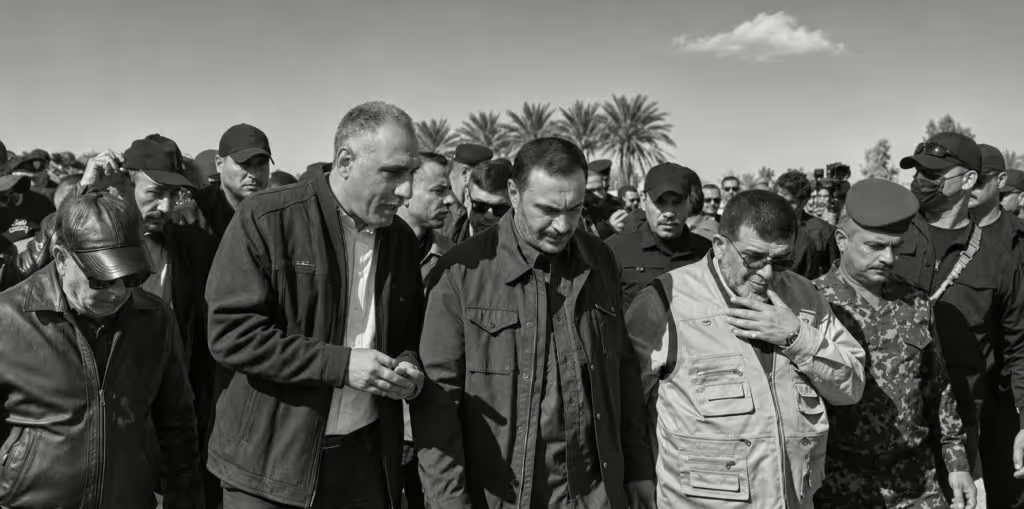
- On the ground: Al-Mada reported that military units moved toward the area to secure a government committee’s entry to inspect sites listed in an intelligence report, before political mediation suspended the operation. Footage showed a large force at the entrance as committee members met security and faction commanders.
- Alert level: The movements coincided with a “C” alert in units under the commander-in-chief, among the highest readiness levels, involving raised preparedness and suspended leave. No official explanation was issued on the reasons for the alert or how long it would last.
- The trade-off: Sources told the 964 network, in remarks followed by Al-Mada, that Kataib Hezbollah rejected the committee’s original composition. After Zaidi met Popular Mobilization chief of staff Abdul Aziz al-Muhammadawi, the panel’s leadership passed to PMF security director Ali Mayah al-Zaidi.
- Narrowed mandate: In exchange, the prime minister demanded more participating institutions at a lower military rank, while the sites open to inspection were fixed in advance instead of granting free movement across all locations named in the intelligence report.
- What the panel found: Sources said members spent hours inside Jurf al-Sakhar reviewing tanker traffic and fuel supply records and collecting samples, but were barred from field interviews and could not reach every listed site. Small oil-related facilities were inspected without determining their purpose.
- Reports and denial: Zaidi rejected a single report under the committee chair, ordering each representative to file separately alongside the joint one — roughly ten reports. Framework member Oday Abdul Hadi denied the smuggling accusations, calling them a plot against the Popular Mobilization Forces.
Background:
Jurf al-Sakhar, south of Baghdad, has been under armed-faction control for years. Analyst Aed al-Hilali said the file is no longer about smuggling suspicions alone but about the state’s monopoly on force across Iraqi territory.
Between the lines:
Researcher Aqeel Abbas assessed that Zaidi has advanced further than predecessors by moving in one of the factions’ hardest strongholds, crediting American support and reduced Iranian capacity to intervene, but expected a political settlement. Political scientist Iyad al-Anbar judged the measures tactical pressure lacking a multi-stage strategy, likely followed by deals returning the crisis to its starting point.
What’s next
The committee is drafting its final report inside the commander-in-chief’s office. Watch whether it documents violations without naming a smuggling network, whether the threatened dismissals materialize, and whether the suspended operation resumes.