Key Points
- Jake Auerbach's documentary on his late father Frank draws on footage from three periods of the artist's life.
- Frank Auerbach, who died in 2024, lived in Albert Street and painted Camden Town and Primrose Hill.
- The film corrects biographical claims the director says lazy journalism has repeated for years.
The latest:
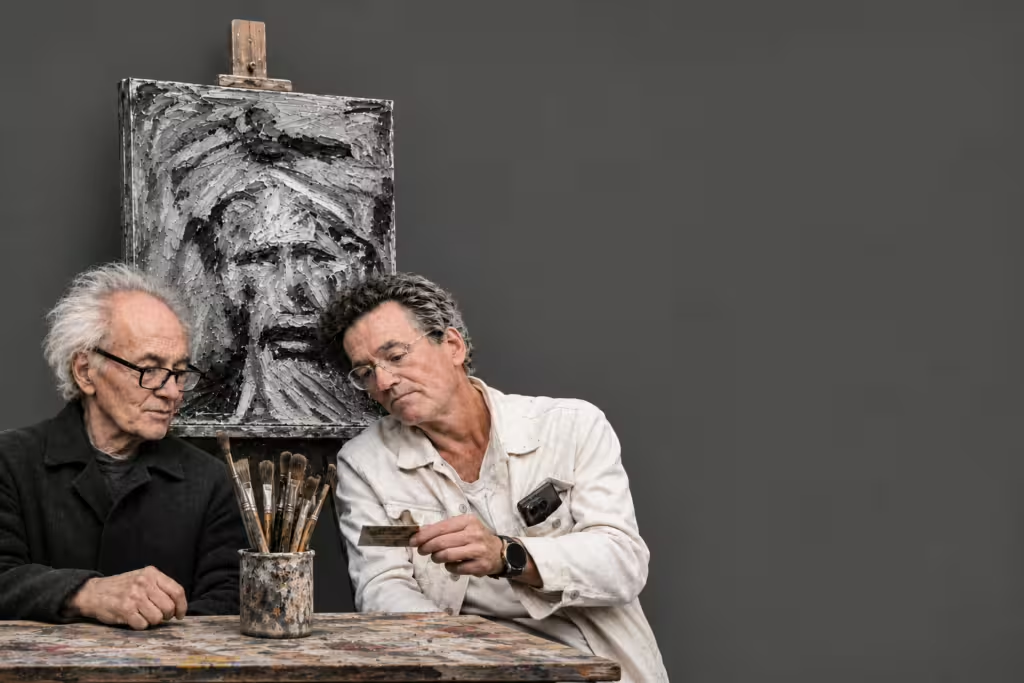
A new documentary by Jake Auerbach turns the camera on his father Frank, the Camden Town painter who died in 2024, and rebuts long-repeated accounts of his life. Frank Auerbach: Life and Death, certificate PG, draws on footage shot across three separate periods and lets the artist take apart his own method. Our reviewer rates it four stars.
Details:
- The subject: Frank Auerbach lived in Albert Street, Camden Town, and painted the streets he walked out into — Mornington Crescent scenes, views of Primrose Hill, Camden High Street. His work, the review argues, stands alongside Lucian Freud and Paula Rego as a landmark of British art.
- The claim: Watching the film suggests Auerbach, more than any other figure, epitomises London art in the second half of the 20th century, according to the review — an original whose semi-abstract, semi-realist canvases remain instantly recognisable decades on.
- The method: Jake Auerbach’s footage captures his father deconstructing his own approach. Hearing the painter talk through a work set on Camden High Street, the review says, makes the style far clearer to an untrained eye and functions as a lesson in how to look at a picture.
- The record: The film pushes back on a frequently repeated biographical claim. Frank Auerbach left Germany as a child and his parents were murdered at Auschwitz, but he was not sent to England on the Kindertransport, contrary to accounts that have circulated for years.
- The irritation: Jake Auerbach also voices exasperation at art critics who reduce his father’s work to layers and layers and layers of oil, a description the film treats as lazy shorthand rather than serious analysis of the paintings.
- The relationship: Beyond the art, the review reads the documentary as a letter from a son to a father — unconsciously so. The film-maker is intrinsically involved in and protective of his subject, which the review frames as the source of the film’s access rather than a flaw in it.
- The limitation: That closeness means the film cannot avoid being coloured by the bond between director and subject. The review accepts the trade-off, arguing the family prism delivers a story no outside film-maker could have obtained.
- The direction: Jake Auerbach is a talented film-maker in his own right, the review says, and his father’s deadpan, raw-yet-complicated aesthetic is visible in the son’s directing choices.
- The verdict: Four stars. The review calls the result warm, insightful and fascinating: a case of setting the record straight while paying respects to an artist whose work holds every scene he painted.
Background:
Frank Auerbach spent his working life painting a narrow patch of north London, returning repeatedly to the same streets and sitters. He died in 2024, leaving a body of work closely identified with Camden Town and its surroundings.
Between the lines:
The film’s two corrections — the Kindertransport claim and the layers-of-oil shorthand — point in the same direction: a reputation flattened by repetition. A son with access to three periods of footage is unusually placed to challenge that, though the review concedes the same proximity shapes what the camera chooses to show.
What’s next
Screening dates and distribution for Frank Auerbach: Life and Death, and whether its correction of the Kindertransport account holds in future writing about the painter.