Key Points
- Google reports its Antigravity /teamwork multi-agent system helped resolve long-standing problems in math, chemistry and systems engineering.
- Work ran on Gemini 4 models with human experts at Google, CUHK, USC and CMU, using Lean 4 verification.
- Google is releasing the agents externally, extending AI from writing code to producing machine-checked proofs.
The latest:
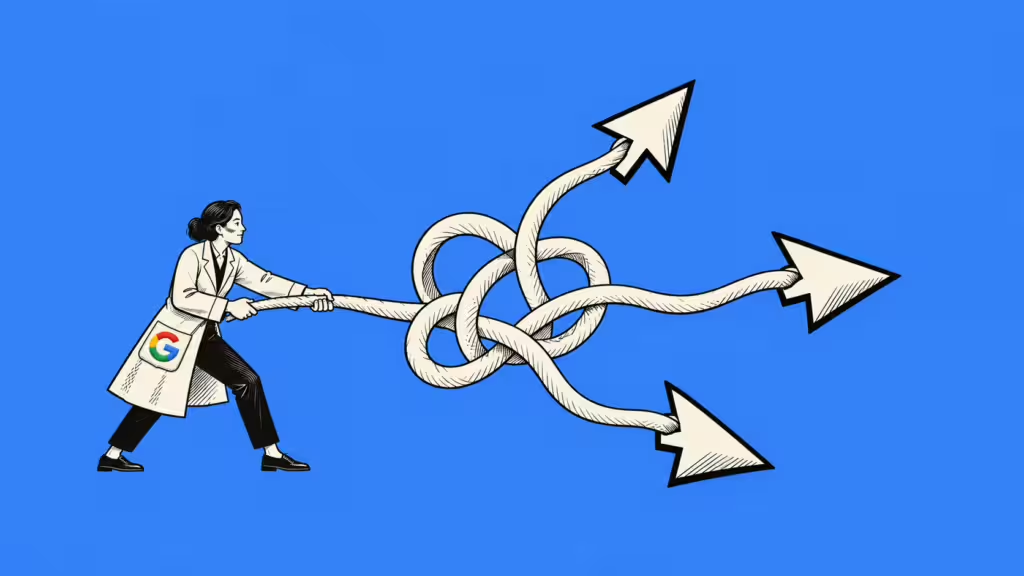
Multi-agent AI systems helped close mathematical questions that had stood open for as long as 90 years, Google Research said in a post by Google Fellow and VP Vahab Mirrokni. The work, run on Gemini 4 Argon, Carbon and Hydrogen models through the Antigravity /teamwork harness, spans information theory, formal verification, molecular structure and kernel optimization. Google said every result came in collaboration with human experts.
Details:
- The conjecture: Researchers from Google, CUHK, USC and CMU used /teamwork’s Long Proof pattern to prove the 2013 Courtade–Kumar conjecture in full generality, Google said. The result confirms no single-bit compression of a noisy bit string preserves more information than a function copying one input bit.
- The scale: Google said the proof was formalized in Lean 4 across 50 million lines of code. The CUHK team reduced the conjecture to a 14-variable optimization problem, after which Gemini partitioned the parameter space and extended the proof from balanced to unbalanced functions without human input.
- Formal verification: The /teamwork-LEAP framework autonomously produced a machine-checked formalization of the Weil conjectures, about 1.8 million lines of Lean across 28,800 subagent invocations, Google said. A further 919,000 lines produced the first formalization of a recent proof of Hilbert’s tenth problem over general rings of integers.
- Millennium problem: Google said the system independently reproduced an end-to-end formalization of a recent proof of finite-time blowup for the 3D Navier–Stokes equations with smooth forcing, part of one of the seven Millennium Prize Problems and open for roughly 90 years.
- Older conjectures: The framework also generated the first formalization of the Birkhoff conjecture, open since 1927, and of the 3D Bochner–Riesz conjecture, open more than 50 years. Google said the system found and fixed a gap in a recently released informal proof of the latter.
- Algorithms: Other reported results include a deterministic algorithm resolving the main open question from STOC 2024 on Boolean matrix multiplication, a near-optimal single-pass streaming algorithm for cut sparsification left open by FOCS 2022, and progress on Tarjan’s 1985 Deque Conjecture, verified in Lean 4.
- Peer review: Ahead of STOC 2027, authors of 578 submissions — over a third of the total — opted into Deep Review feedback. In an ongoing survey of 70 respondents, 90% rated the feedback mostly or almost all factual, over 30% said it caught substantive proof bugs, and 14% said it found gaps taking over an hour to fix.
- Chemistry: Google said 30 specialized agents in a self-correcting loop with a physics-informed spectral simulator reached 95% top-1 exact match and 100% top-3 accuracy on complex benchmark molecules in determining structure from nuclear magnetic resonance data, nearly doubling single-agent performance.
- Benchmarks: Twenty-nine agents running on Argon over 11.5 hours converted 13 public tables into a 50-task causal inference benchmark, Google said. Reviewer and auditor agents caught shortcuts, flagged wording hints and vetoed hallucinated scripts, with each failure turned into a permanent test.
Background:
Google says two limits shaped the design: single model attempts are unpredictable, and models lose track of detail over multi-day tasks as context windows grow. /teamwork pairs parallel exploration with falsifiers such as the Lean 4 proof checker, and gives each agent only the files it needs.
Between the lines:
The verification layer is doing the heavy lifting in Google’s account. Lean 4 compiles a proof only if every logical step holds, which is why the company can report 50 million lines on one conjecture and 1.8 million on another as checked rather than claimed. The Deep Review survey numbers are self-reported by opted-in authors, a group already inclined toward the tool.
What’s next
STOC 2027 submissions will test whether Deep Review feedback changes accepted work. Google said more /teamwork features will reach external Antigravity users in the coming weeks, through the researcher access program.