Key Points
- Beijing ordered an employment-impact system to track AI’s effects and reduce disruption to jobs.
- Citi estimates 70 million Chinese jobs, nearly 10% of the total, face high displacement risk.
- Policy constraints could limit how aggressively companies convert AI productivity gains into workforce reductions.
The latest
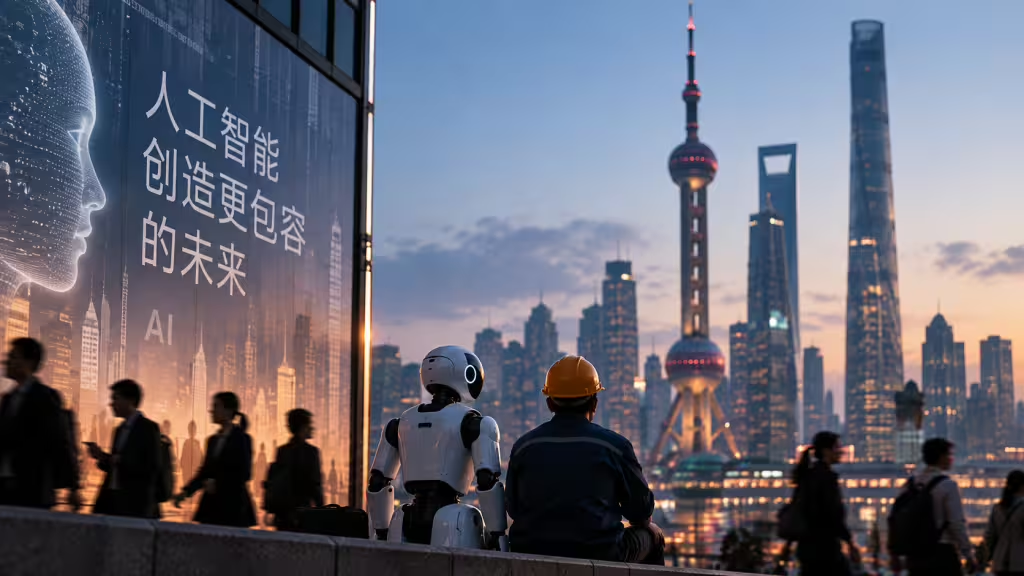
China’s human-resources ministry and three other government agencies ordered an AI employment-impact assessment system in July, as Beijing tries to capture productivity gains without deepening labor-market pressures. The plan will study how technology changes jobs, direct innovation resources toward fields with stronger employment potential and expand worker training. Its stated goal is to reduce AI’s “impact on employment,” even as authorities push adoption across factories, logistics, healthcare, finance, public services and everyday life.
Details
- Labor pressure: Official unemployment among 16- to 24-year-olds, excluding students, rose to 17.9% in July, an 11-month high. A record 12.7 million university graduates are entering the market this year, many seeking entry-level white-collar roles increasingly exposed to generative AI. Citi estimates 70 million Chinese jobs, nearly 10% of all positions, face high displacement risk, with workers in their 20s particularly exposed.
- Quiet reductions: Some technology companies track employees’ AI use and incorporate it into performance reviews. Others are reducing contractors, graduate recruitment or production teams, while allowing head count to fall through attrition rather than announcing large AI-related layoffs. Customer service, advertising, entertainment, basic programming and other office functions are among the fields where businesses are replacing tasks instead of adding staff.
- Productivity trade-off: Alibaba, Tencent, Baidu and JD.com can potentially produce more without adding workers, or maintain output with fewer employees. Large layoffs, however, would intensify labor-market pressure and could weaken household confidence and spending. Labor economist Cai Fang welcomed AI’s “unprecedented creative potential” but said its “unprecedented destructive potential” must be controlled and managed as far as possible.
- Worker protections: JD.com is investing in warehouse automation, robotics and AI, while founder Richard Liu has said it will protect front-line workers displaced by machines and retrain them for other jobs. Chinese courts have also ruled against employers in several cases involving workers dismissed and replaced by AI.
- Abuse crackdown: On Sept. 2, China’s internet regulator said its campaign had removed more than 5.6 million pieces of illegal or harmful information, penalized or closed 49,000 accounts, and acted against about 2,400 websites and apps. Targets include AI-generated falsehoods, impersonation, fraud, harmful content and abuses involving minors. Police investigated more than 170 AI-generated online-rumor cases in the first half of 2026.
Background
China’s earlier internet regulation often followed rapid industry growth and mounting social costs. Gaming and private tutoring demonstrated how abruptly Beijing could intervene. With AI, policymakers are promoting adoption while preparing for consequences in employment and online content, potentially reducing regulatory shocks while constraining some corporate efficiency gains.
What’s next
Government agencies will now build the employment-impact assessment system, steer innovation funding toward job-creating fields and expand AI training. Key indicators will be youth unemployment, graduate hiring and whether major companies continue relying on attrition and contractor cuts rather than broad layoffs.