Key Points
- Emirates unveiled a premium-economy seat with an electrically controlled, full-height privacy divider between neighbors.
- Such dividers are standard in business and first class but nearly absent from premium economy cabins.
- The move pushes a wealth-coded cabin feature down into a mid-tier fare class.
The latest:
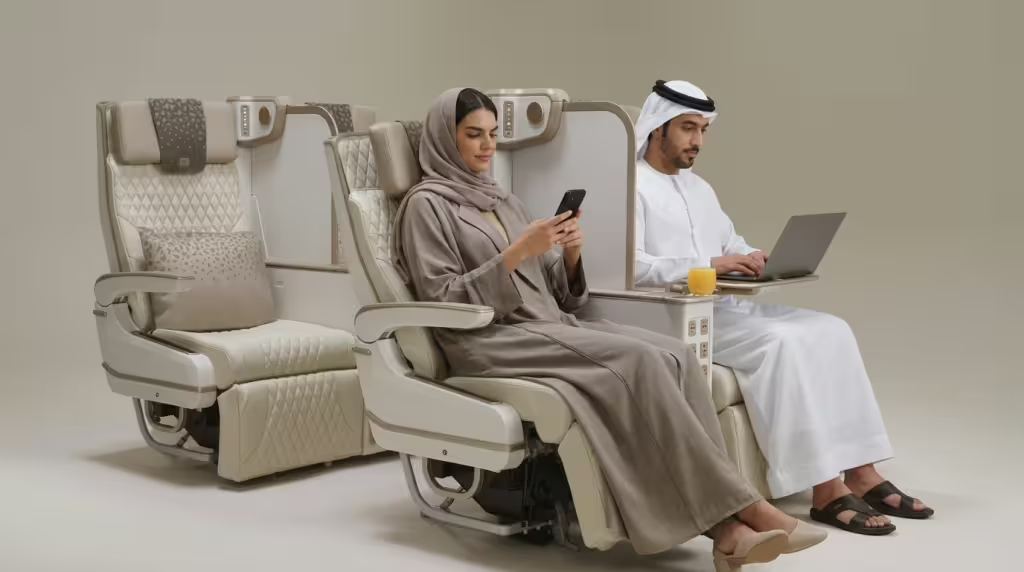
A privacy divider that rises to the full height of the seat is coming to Emirates’ premium economy, in a seat the airline unveiled Thursday. The divider is raised and lowered by electric controls, which also operate the recline and legrest. Emirates said the seat will appear on newly delivered Airbus A350 aircraft.
Details:
- The seat itself: Emirates said the new premium-economy seat reclines into a cradle position, which shifts the passenger downward and forward rather than pushing the seatback into the knees of the row behind. Recline, legrest and the privacy divider are all electrically operated rather than manual.
- The screens: Each seat carries a 13.3-inch 4K seatback screen, wireless charging, and a tray table with an integrated phone holder that lets passengers run a second screen alongside the main one, according to Emirates.
- The headrest: The seat includes the U-Dream headrest Emirates showed for economy at July’s Farnborough Airshow. It has two side wings that fold down and inward to hold the neck. Emirates President Tim Clark said in the press release the design means “no more neck pillows needed.”
- The cabin layout: The A350 premium-economy cabin holds 28 seats in a 2-3-2 configuration, Emirates said. Seats are 20 inches wide with a 39-inch pitch, the distance between one point on a seat and the same point on the row behind.
- The competition: Japan Airlines was first to bring electric controls to premium economy, but Emirates has extended them to the privacy divider. United Airlines added a divider to its Premium Plus cabin last year, though it does not reach the seat’s full height.
- The trade-off: Electric controls ease operation for passengers but carry a higher risk of malfunction than manual mechanisms, raising maintenance costs for the airline.
- The timing gap: Emirates did not say when the seat will enter service beyond saying it will be on board soon, and did not name which routes will get it first.
- The starting point: Emirates was relatively late to premium economy, adding the cabin to its flagship Airbus A380 fleet only in early 2021. Its privacy record runs longer: the airline introduced sliding doors on its first-class suites in 2003.
Background:
Full-height dividers became near-standard in business class over the past two decades, while premium-economy passengers were typically given only a small panel extending from the headrest, or nothing separating them from their neighbor.
Between the lines:
The divider is the clearest sign yet that privacy, not legroom, is becoming the currency that separates cabin classes. Emirates introduced first-class doors in 2003 and premium economy only in 2021; pushing a business-class feature into the newer cabin narrows the visible gap between the two, at the cost of adding electric mechanisms that fail more often than manual ones.
What’s next
Watch for Emirates to name an entry-into-service date and the first routes, and for the seat to appear on newly delivered A350s. Also watch whether rival carriers extend their own premium-economy dividers to full height.