The latest:
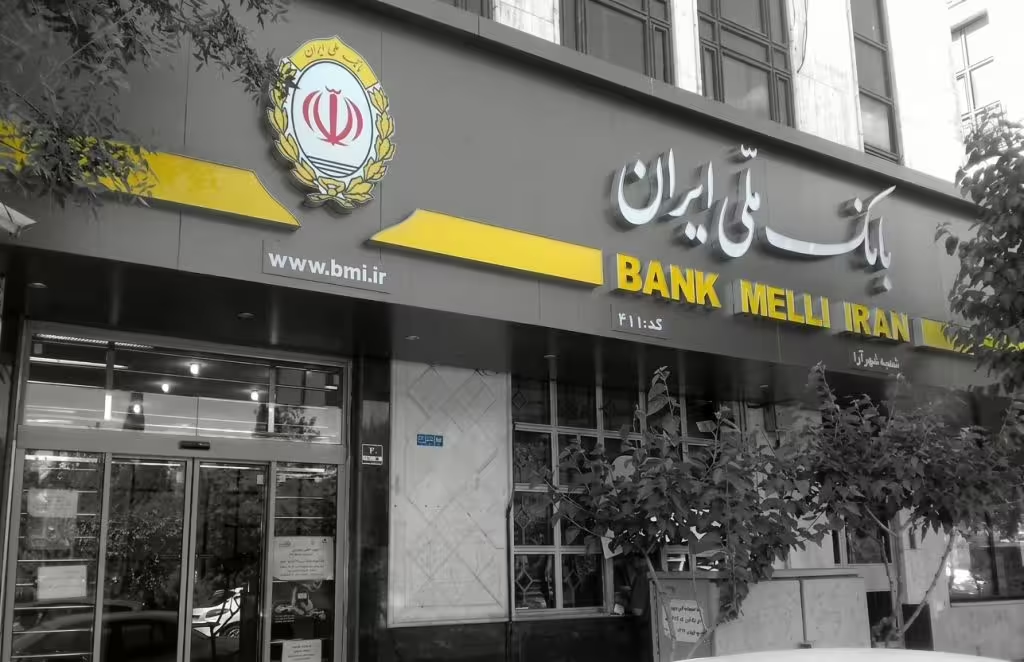
An Iranian state-owned bank is still operating in London 11 months after Britain sanctioned it, kept alive by a temporary UK Treasury licence that expires on October 22. Melli Bank plc retains a full British banking licence, a board and audited accounts, even as its assets sit frozen and new customers are barred. Renewing or letting that licence lapse is Britain’s answer to Washington.
Details:
- The US demand: US Treasury Secretary Scott Bessent announced Operation Economic Outcast on August 24, listing more than 60 entities, individuals and vessels in the first round. He singled out Melli, saying every overseas branch must be shut and kept isolated, and warned any party facilitating money laundering for Iran would lose access to the dollar system.
- Two legal tracks: Britain listed the London branch under its Iran nuclear sanctions regime, a narrower charge than Washington’s money-laundering allegation; Melli’s UK filings contain no money-laundering finding. Two governments reached the same bank by different legal routes.
- A British company: Melli Bank plc is registered in England, licensed by the same regulators that supervise Barclays and HSBC, and wholly owned by Bank Melli Iran. It has operated in Britain since 1967, and until April 2026 its London chairman simultaneously served as chief executive of the Tehran parent.
- The business model: Its 54-page 2025 accounts, filed with Companies House in June, describe Iran as its niche market and roughly 92% of revenue earned in euros through what it calls the eurozone–Iran trade corridor. The 363-million-euro institution rests on 258.8 million euros of Iranian state capital.
- The numbers: Deposits total about 98 million euros, 88 million of it due but unpayable, most owed to sanctioned Iranian financial institutions. Some 71 million euros of the bank’s own funds are stuck at correspondent banks; roughly 30 million is accessible. Claims on Iran reach 259.9 million euros, near three quarters of assets.
- The collapse: Britain, France and Germany triggered UN snapback in August 2025; the reimposed measures took effect September 28, and Britain and the EU sanctioned Melli the next day. Trade-finance fee income had risen 71% in 2025 before the halt. Profit fell 92% to 181,000 euros.
- Winding down: The auditor flagged material uncertainty over the bank as a going concern. Hong Kong staff left in January after a payroll licence arrived late, London layoffs began in December, and four board members departed within roughly a year, leaving three. Board pay still rose to 905,000 euros in 2025.
- What the licence allows: The UK Treasury general licence permits only four payment types: UK-resident staff and director salaries and severance, pensions, IT bills and accountancy fees, each reported to the Treasury monthly, line by line. Legal costs jumped 57% to just over 1 million euros, five times the year’s profit.
- Britain’s stance: UK Treasury Secretary John Healey welcomed Economic Outcast on August 25, noting Britain has imposed more than 240 sanctions on Iran since Labour took office in 2024 and pledging cooperation with Washington on economic pressure.
- Tehran’s response: Iranian Finance Minister Ali Madanizadeh predicted on Tuesday that many countries would reject Bessent’s demands, formally or informally, telling state television that Iran has its own tools. Former US Treasury intelligence official Matthew Levitt assessed that Melli’s reach has shrunk but that subsidiaries and uneven enforcement keep illicit financing alive.
Background:
The EU sanctioned Melli Bank plc in 2008. The 2015 nuclear deal lifted those measures in 2016 and the bank returned to financing Iranian trade, posting its best year since 2014 in 2024. Iraq withdrew Melli’s operating licence in 2024 under sanctions pressure.
Between the lines:
Everything imposed since 2025 is reversible by agreement, as 2016 showed. Closure is not: surrendering the licence, distributing the 258.8 million euros in capital and dispersing staff leaves nothing to restart. The bank’s own accounts show it expected renewal, appointing a new director and signing a Hong Kong lease after sanctions landed, with no wind-down plan and no stated fate for the 98 million euros in deposits.
What’s next
October 22 is the decision point: the UK Treasury either renews the licence or lets it lapse. Insolvency would put Melli Bank plc before a British court to rule on frozen Iranian deposits and state capital.