Key Points
- Nvidia is expanding physical AI for robots, cars and drones, with China emerging as a major customer.
- The business generates about $10 billion annually, and Jensen Huang expects tenfold growth within a decade.
- China’s manufacturing scale gives Nvidia access to robot developers and real-world applications beyond data centers.
The latest
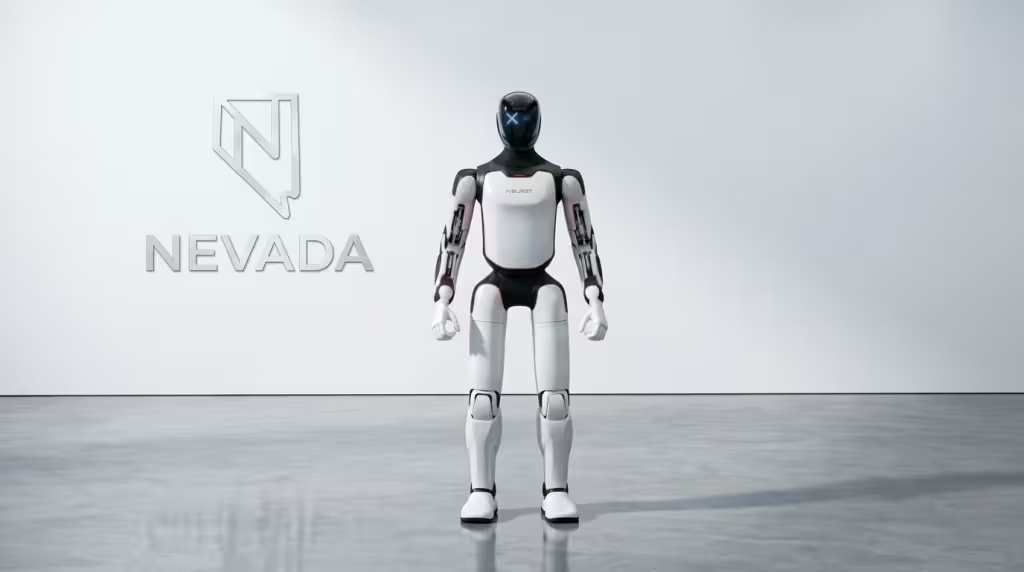
Nvidia is pairing specialized chips with software, developer computers and open-weight models to deepen its role in machines that operate in the physical world. Its GR00T and Cosmos models can be downloaded and modified by robot developers, extending a hardware-and-software strategy previously built around CUDA. Huang has framed the opportunity as translating AI-generated images of physical movement into actions performed by robots. The push spans factories, warehouses and vehicles, with self-driving cars identified as the first robotics application capable of reaching a sufficiently large market and delivering real economic value.
Details
- Revenue outlook: Physical AI contributes around $10 billion in annual revenue, still a fraction of Nvidia’s $303 billion across the four quarters ended in July. Huang expects the business to become 10 times larger within the next decade. Radiant Intel Chief Executive Michael Frank said the field offers Nvidia a route from data centers into the broader physical economy.
- China’s scale: China is the world’s largest industrial-robot market and shipped around 90% of humanoid robots worldwide in the first half of 2026. Counterpoint Research analyst Brady Wang called the country critical to Nvidia’s road map, citing Chinese companies’ strengths in manufacturing and commercializing new technology and the resulting real-world use cases.
- Technology reliance: Chinese robot makers currently rely on Nvidia silicon and software to train and operate machines. Nvidia laboratories in the U.S. and China have used humanoid robots from Unitree, Agibot and Fourier to gather data and run experiments. Unitree has also used Nvidia’s latest Thor chips, while Nvidia has expanded robotics and self-driving teams in China.
- Trade boundaries: Washington bars Nvidia from selling its most powerful AI chips to China, while trade in its robot and automotive chips remains open. An Nvidia representative said the company works globally in accordance with U.S. law. Chinese developers are also testing products from Huawei, Black Sesame and Horizon Robotics in anticipation of potentially broader export restrictions.
- Developer ecosystem: Nvidia says its open models and open-source materials are intended to support a broad physical AI ecosystem. The approach echoes CUDA, released nearly two decades ago to let users write code directly for Nvidia chips. Competitors include Intel and Qualcomm. The entry-level Jetson Orin Nano 2, designed for programming and operating devices, was released on August 25.
- Customer base: Nvidia’s autonomous-driving customers include Alphabet’s Waymo and Tesla, alongside Chinese automakers and robotaxi companies. Madison Huang, who oversees marketing for the physical AI division, visited LG Electronics’ robotics data factory in Seoul and the World Robot Conference in Beijing in August. Spencer Huang serves as a director of product management.
What’s next
Following the August 25 launch, the next concrete indicator will be developer uptake of Jetson Orin Nano 2 and any U.S. decision extending export controls to robot or automotive chips.