Key Points
- Santander will manage part of the Gelman Collection and relocate protected Mexican masterpieces to its new Spanish museum.
- Ten Kahlo paintings will secure a loan of at least $150 million to developer Marcelo Zambrano.
- The arrangement has intensified a dispute over cultural sovereignty, public access and Mexico’s heritage protections.
The latest
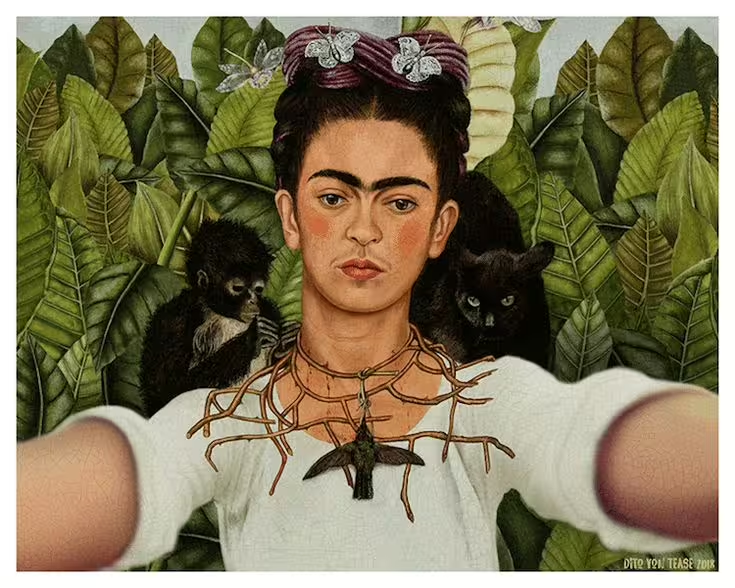
Two Frida Kahlo masterpieces left Mexico for Spain after a temporary exhibition at Mexico City’s Museum of Modern Art, as Santander assumed long-term management of part of the Gelman Collection. The transfer of “Diego on My Mind” and “Self-Portrait With Monkeys” has fuelled an uproar over protected artworks in a leading private collection of 20th-century Mexican art.
Details
- Financing arrangement: Santander announced in January that its portion includes 10 Kahlo paintings sold in 2023 to Marcelo Zambrano, a Monterrey real estate developer. Under an agreement with his family, the works will collateralise a loan worth at least $150 million and have a “permanent, but dynamic” presence at the Santander Foundation’s new museum in Spain.
- Legal protection: Kahlo produced around 200 works, roughly half of them in Mexico; only a handful belong to the state. A 1984 presidential decree designated those remaining in Mexico as artistic monuments, barring permanent export but allowing temporary travel. The Santander Foundation said the arrangement fully complies with Mexican law.
- Gelman legacy: Jacques and Natasha Gelman built the collection after fleeing wartime Europe and making a fortune producing films during Mexican cinema’s golden age. It grew to hundreds of paintings and drawings, including nearly 20 Kahlos and works by Diego Rivera, Rufino Tamayo and José Clemente Orozco. Natasha’s will directed that it remain intact and publicly accessible in Mexico.
- International circuit: After Natasha died in 1998, executor Robert Littman acknowledged responsibility for exhibiting the complete collection at a Mexican institution. It instead entered mostly international exhibitions, generating revenue for a foundation he established. Disputes over Natasha’s mental fitness and execution of her wishes were resolved in Littman’s favour; his lawyer did not respond to requests for comment.
- Government agreement: One day before Santander approved the loan, the head of Mexico’s National Institute of Fine Arts and Literature signed a renewable five-year agreement with the bank and Zambrano family to oversee international displays. Berzunza argues repeated temporary export permits could keep protected works abroad despite the ban on permanent export.
- Collection questions: The rest of the collection’s whereabouts are unknown. Berzunza connects the controversy to arts and culture budget cuts and the state’s retreat from cultural patronage. The International Committee for Museums and Collections of Modern Art expressed “serious doubts” about Mexico’s ability to conserve heritage and guarantee access.
Between the lines
Berzunza urges Mexican civil society to provide institutions and resources to keep nationally important art accessible at home. He argues Kahlo’s global stature does not diminish her primary place in Mexico’s heritage.
What’s next
Mexican officials and Santander say the paintings will return to Mexico in 2028. Subsequent export permits and any decision to renew the five-year agreement with Santander and the Zambrano family will determine how long the works remain in Spain and when they return to Mexican audiences.