The latest:
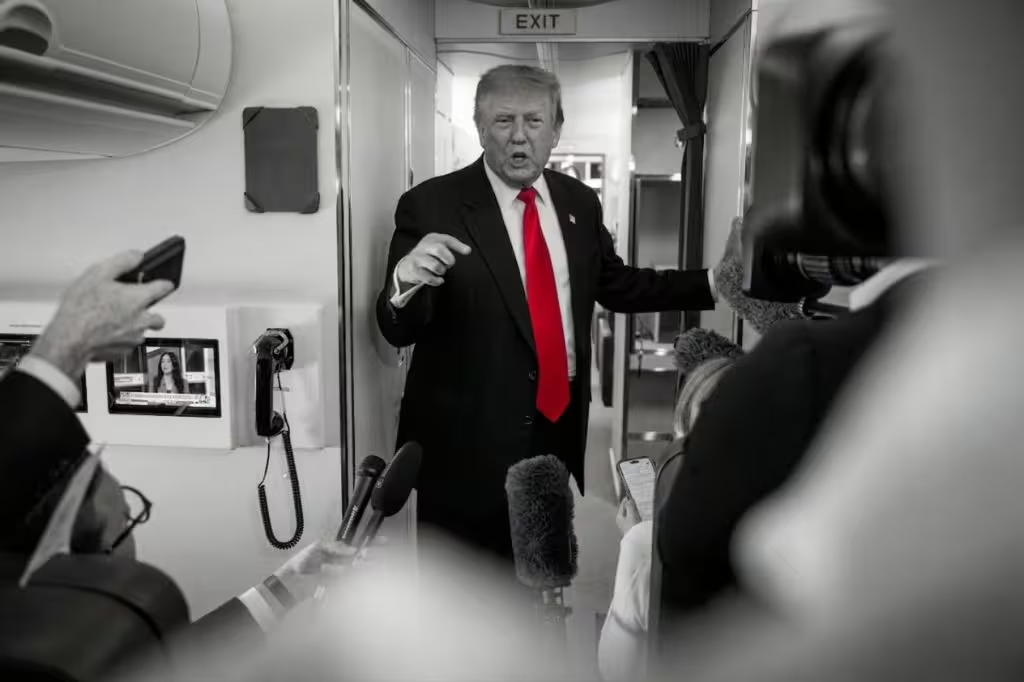
More than 65 billion barrels of proven Venezuelan reserves now fall under majority US control, President Donald Trump said in a Friday night social media post, calling it the largest oil deal in world history and one carried out at no cost to American taxpayers. He said the arrangement more than doubles US reserves and will sharply lower pump prices. Venezuela’s interim president Delcy Rodríguez called the agreement historic.
Details:
- The structure: A White House official told سي إن إن the negotiated deal gives Washington 55% of the actual production of a new private joint venture, described as the world’s second-largest private oil company by reserves. The official said the stake combines equity ownership and a guarantee to buy oil at cost.
- The concessions: The same official said Rodríguez, with US backing, granted a private company 100-year concessions over the oil fields, and that this company is a joint venture between the US government and an operator active in Venezuela. Neither Trump nor the State Department named the private partner.
- Caracas figures: Rodríguez said in a statement the deal covers development of 17 oil fields, more than 100 billion dollars in investment, and an expected 209 billion dollars in taxes for the Venezuelan government. She said the aim was to put the country’s vast reserves in the service of national development.
- Washington’s framing: Secretary of State Marco Rubio called it a major victory for both the American and Venezuelan people, saying it would bring close to 100 billion dollars in private investment and support thousands of high-paying jobs. A State Department official described it as an unprecedented step in investing in another country’s oil fields.
- The price backdrop: US gasoline averaged about 4.09 dollars a gallon on Friday, up 27% from a year earlier, according to AAA. Crude fell 4% this week, its first weekly loss in three, but remains more than 24% higher since the start of the US war with Iran.
- Reserve depletion: Energy Department data published earlier this month showed volumes in the Strategic Petroleum Reserve at their lowest since the 1980s. The White House official said stable cost-price supply from the Western Hemisphere would help refill the SPR and cover US military supply needs.
- Hormuz disruption: The war with Iran has choked traffic through the Strait of Hormuz. According to IMF PortWatch data, only a handful of vessels have transited daily in recent weeks, against roughly 100 a day a year ago. CNN reported the conflict disrupted a fifth of global oil supply for six months.
- Legal groundwork: Under US pressure weeks after Maduro’s capture, Venezuela’s National Assembly passed a sweeping amendment to oil legislation granting foreign companies greater control over their operations, unwinding much of the 2007 nationalization that anchored the Chávez movement.
- Chevron next: Trump’s announcement came as Chevron, the second-largest US oil company, held advanced talks to expand significantly in Venezuela, according to people familiar with the negotiations. That deal is expected to be announced as early as next week; The Wall Street Journal reported the talks earlier.
- Missing text: Details were scarce and the text of the agreement was not immediately available. Venezuela is generally believed to hold the world’s largest proven reserves, and Rodríguez took office after the January operation that sent Maduro and his wife to New York on criminal charges.
Background:
US forces seized Maduro in January in a large military operation, turning a longtime adversary into something closer to a client state. Rodríguez, his ally and successor, faced US threats of a similar fate and has since held frequent meetings with senior Trump administration officials.
Between the lines:
The New York Times noted past US leaders avoided suggesting control of another country’s resources was a policy goal, fearing an international backlash and questions of legitimacy. The politics are also domestic: with gasoline up 27% and midterms two months away, cheaper pump prices are the payoff Trump is selling. Whether supply arrives fast enough to move prices before November is unresolved, given Hormuz traffic still near zero.
What’s next
Chevron’s expansion deal is expected as early as next week. Watch whether the agreement’s text is published, whether the private partner is named, and whether crude and pump prices extend this week’s 4% decline.