Key Points
- General Intuition is finalizing a round that would value the world-model startup above $6 billion.
- Its models learn from human videogame play, connecting controls with consequences before moving into robots.
- Backers want world models to give robot control the versatility language models brought to writing and coding.
The latest
General Intuition is finalizing an investment round that would value the New York-based world-model startup at more than $6 billion, positioning it as the most valuable AI laboratory of its kind. The financing push comes as engineers and investors pursue “large action models” designed to move AI beyond text generation and into physical work. Although the technology remains early, some systems can already navigate three-dimensional spaces and manipulate objects autonomously from simple instructions.
Details
- Training model: Unlike language models trained on literature, code and images, world models learn through videogames and simulations. General Intuition captures every game frame alongside each button press and control-stick movement, allowing its system to connect human actions with their consequences rather than learning from video alone. Its sister platform, Medal.tv, supplies millions of hours of human gameplay.
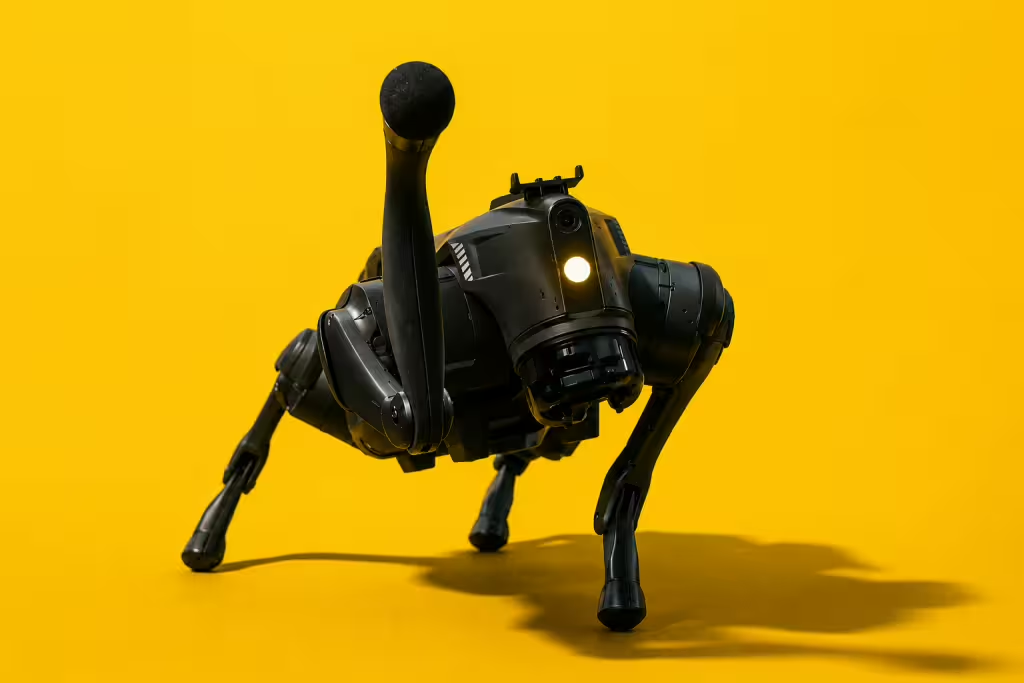
- Real-world control: With limited fine-tuning, General Intuition’s model can pilot a real robot as though controlling a videogame character. The system processes a live camera feed, identifies its location, body type and goal, then selects the next movement. Engineers demonstrate the technology on a quadruped around the company’s New York and Geneva offices.
- Current limits: The setup works with quadrupeds, wheeled vehicles and flying drones that provide live video and accept inputs from a game controller, mouse or keyboard. Those requirements cover many mainstream robots but exclude most two-legged humanoids. Investor Moritz Baier-Lentz says adapting the model can take only minutes. He compares the technology’s current maturity with GPT-2, released by OpenAI in 2019.
- Versatility goal: Roboticists already use physics-based simulations to control advanced machines, but those systems are painstakingly coded and highly specialized; software designed for one robot often does not transfer to another. Startups are aiming for a single, versatile control architecture comparable to the range language models offer across writing and software.
- Investor race: Earlier systems, including Google DeepMind’s Genie models, emphasized generating new environments for robot training. Newer models perceive an environment and choose what to do next. Former Google world-model leader Jack Parker-Holder co-founded London-based Emulate, which is discussing a raise of more than $500 million and employs six other former Google staff.
Background
Kent Rollins, General Intuition’s chief product officer and a former Fortnite ecosystem director at Epic Games, argues that text is a “lossy representation” of reality. Animals have spent about half a billion years evolving brains that model surroundings and plan actions, while human language dates back roughly 100,000 years.
What’s next
General Intuition’s funding round and valuation are the immediate milestones, alongside the outcome of Emulate’s talks with investors over a potential raise exceeding $500 million.