The latest
The United States and its Gulf partners announced a new round of coordinated sanctions against Hezbollah’s financial network, targeting five entities and 16 senior officials involved in managing the group’s finances.
The measures were announced by the Terrorist Financing Targeting Center (TFTC), whose members include the United States, Saudi Arabia, the United Arab Emirates, Bahrain, Kuwait, Qatar and Oman. Established in Riyadh in 2017, the center coordinates intelligence sharing and joint sanctions against terrorist financing networks.
Details
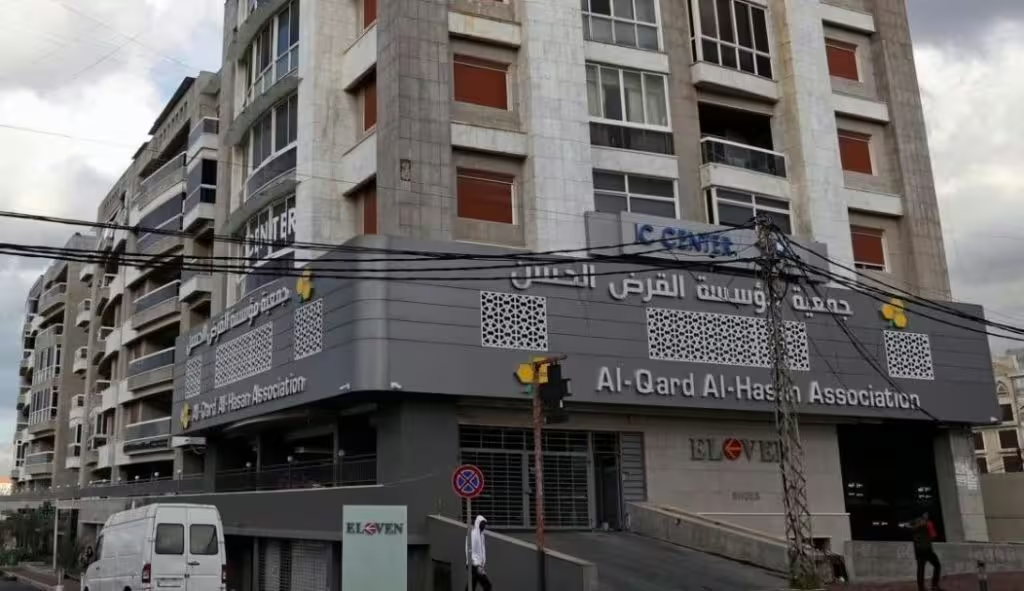
- The sanctions target Al-Qard Al-Hassan Association and Bayt al-Mal, two institutions the U.S. Treasury says play central roles in Hezbollah’s financial operations, along with three additional businesses providing financial and administrative services.
- The designations also include Ibrahim Ali Daher, head of Hezbollah’s Central Finance Unit, Ahmed Mohammed Yazbek, financial director of Al-Qard Al-Hassan, and other senior officials overseeing the group’s financial network.
- The U.S. Treasury said every individual and entity announced by the TFTC had already been sanctioned by Washington. The latest move expands those restrictions through coordinated regional enforcement rather than unilateral U.S. action.
- Beyond sanctions, the TFTC serves as a platform for intelligence sharing, anti-money laundering cooperation and joint efforts to disrupt terrorist financing across the Gulf region.
Why this matters
The announcement is more significant than a routine sanctions update. It signals renewed alignment between Washington and Gulf capitals on confronting Hezbollah’s financial networks after years in which U.S. sanctions often stood alone.
The timing is also notable. Hezbollah is facing mounting pressure inside Lebanon as debates continue over the group’s weapons, state authority and long-delayed economic reforms. At the same time, the United States is intensifying efforts to curb the influence of Iranian-backed groups across the Middle East.
Equally important is the message sent by the TFTC itself. Because all six Gulf Cooperation Council states participated alongside the United States, the sanctions reflect a coordinated regional position rather than a purely American initiative. That makes it harder for Hezbollah to rely on financial channels within the Gulf to move or protect funds.
What to watch
The coordinated measures are likely to increase compliance requirements for banks and financial institutions across the region. They could also pave the way for additional joint sanctions if authorities identify new Hezbollah financing networks or attempts to bypass existing restrictions.