The latest
The U.S.-backed Peace Council is pressing ahead with preparations for post-war governance in Gaza despite stalled negotiations over Hamas’s disarmament, signaling Washington’s determination to keep its “day after” plan alive even without a comprehensive political agreement.
Officials from the council are meeting in Cyprus this week to finalize operational plans for Gaza’s future administration, while a Palestinian technocratic committee continues preparing in Cairo to assume responsibility for governing the enclave once political and security conditions allow.
Details
- According to The Times of Israel, the Palestinian technocratic body, formally known as the National Committee for Gaza Administration, recently held technical workshops in Cairo to review plans for running ministries and restoring public services.
- The committee includes commissioners overseeing security, justice, finance, health, education, housing, economic affairs and public services, with additional appointments still being finalized ahead of any transition.
- Discussions in Cyprus are focused on security arrangements, governance structures, reconstruction priorities, funding mechanisms and the legal framework needed to launch the new administration.
- Former British Prime Minister Tony Blair and his Tony Blair Institute for Global Change have assumed a larger advisory role in the initiative, alongside representatives from the World Bank and other international experts.
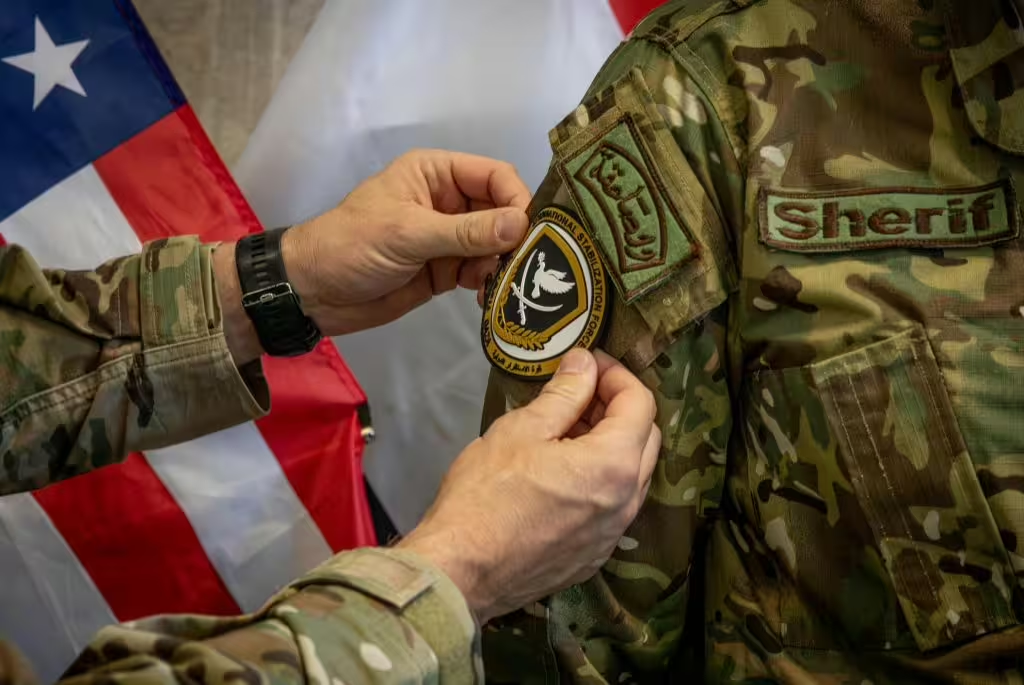
- The Peace Council is also working to establish a new Palestinian police force supported by an international stabilization mission. Egypt has agreed to train new recruits, but deployment still requires Israeli approval.
- Planning also includes temporary housing projects in Rafah and the introduction of a digital wallet system designed to reduce reliance on cash and modernize aid distribution and public finances.
The sticking point
Despite progress on governance planning, Hamas’s weapons remain the central obstacle.
According to Maariv, the main dispute between Israel and the Peace Council concerns whether Hamas’s remaining arsenal should be placed in internationally supervised storage or dismantled entirely.
Israel rejects any arrangement short of the complete dismantlement of Hamas’s military infrastructure, including light and heavy weapons, tunnels and military facilities.
Israeli officials also oppose allowing former Hamas civil servants or police personnel to participate in Gaza’s future administration, while some international officials argue that excluding thousands of experienced public employees would complicate governance and delay reconstruction.
For its part, Hamas has reportedly shown some willingness to discuss storing weapons but insists that any agreement must be linked to an Israeli military withdrawal, the start of reconstruction and implementation of the ceasefire framework.
Growing U.S. pressure
At the same time, Israeli media report growing U.S. pressure to advance the broader Gaza plan.
Israel’s public broadcaster reported that Washington has presented Israel with a document outlining expectations that include restoring essential infrastructure, water and electricity services, transferring civilians into areas administered by the technocratic government and approving facilities for both the new administration and the proposed international force.
The reported demands suggest the Trump administration is seeking to preserve the ceasefire framework and launch reconstruction efforts even if negotiations over Hamas’s disarmament remain unresolved.
Background
The Peace Council emerged in early 2026 as a U.S.-led initiative coordinated with Arab and European partners to design Gaza’s post-war governance framework.
The proposal envisions replacing Hamas with an independent Palestinian technocratic administration responsible for civilian governance and reconstruction, supported by a newly trained Palestinian security force and an international stabilization mission operating alongside a gradual Israeli withdrawal.
However, the initiative’s success continues to depend on reaching an agreement over Hamas’s future military capabilities—a question that has remained unresolved despite months of mediation.
What to watch
The Cyprus meetings show that administrative planning has entered an advanced phase, but implementation still depends on political breakthroughs.
Unless negotiators bridge differences over Hamas’s weapons, Israel’s security demands and the future role of Hamas-linked civil servants, Gaza’s post-war governance plan is likely to remain ready on paper rather than in practice.