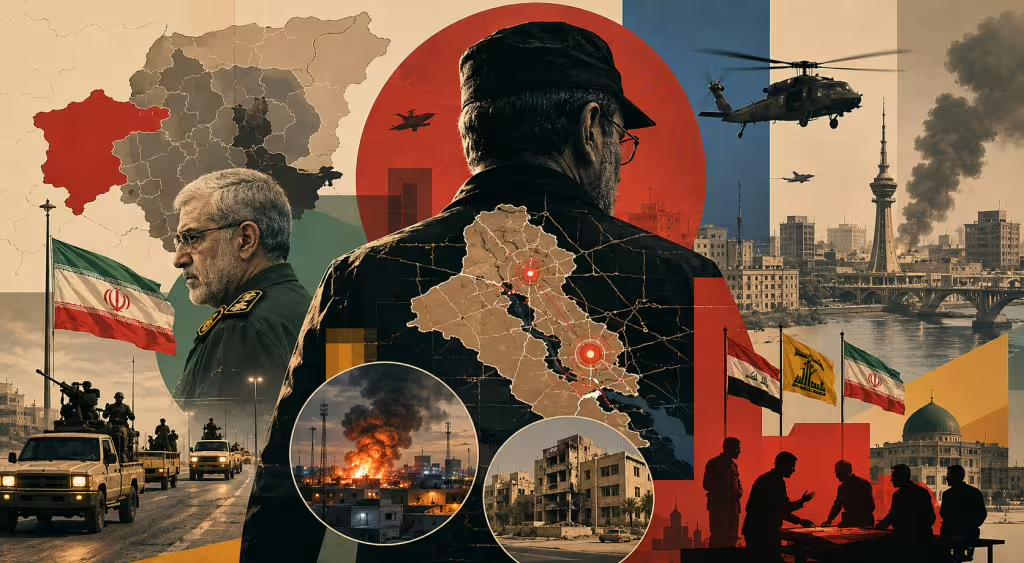
The name “Hajj Hamed” was not publicly circulated. But according to information obtained by +ontime from informed Iraqi sources, he is strongly present inside the security environment of the factions and the Popular Mobilization Forces.
The internally circulated name refers to “Hamed Abdollahi,” also known as “Mustafa Abdollahi,” an Iranian security official from the Quds Force. The sources say the man does not appear in faction meetings, and many do not know his current location, but his name is used as a reference point in security-related orders.
Abdollahi was listed in U.S. Treasury data on October 11, 2011, among five people linked to the plot to assassinate former Saudi ambassador to Washington “Adel al-Jubeir.” His name appeared in those records as “Hamed Abdollahi” and under the alias “Mustafa Abdullahi,” with the description that he was a senior Quds Force officer who participated in coordinating aspects of the operation and supervised other officials, including “Abdul Reza Shahlai.”
A source from Harakat al-Nujaba told +ontime that he hears the name “Hajj Hamed,” but has not met him personally. He added that nearly all sensitive security orders are issued in his name or attributed to him, noting that he doubts the man is still present inside Iraq after a series of assassination attempts that pushed him into hiding.
Details
• From Abu Taqwa to Abdollahi’s departure
The information says Abdollahi left Iraq for Iran after the assassination of “Abu Taqwa al-Saadi,” the Harakat al-Nujaba commander killed by a U.S. strike in Baghdad on January 4, 2024. His departure, according to the sources, was not a routine measure, but part of a security review inside the Quds Force and faction network after movement routes and sensitive headquarters were exposed.
• An undeclared return
Abdollahi later returned to Iraq, but the date of his return is unclear. He did not appear on an official visit and was not seen in public meetings. His return, the sources say, took place through a closed security track, at a time when the factions were reorganizing their sites, depots, and centers after a series of strikes.
• The first survival: Jurf al-Naddaf
According to +ontime information, “Hajj Hamed” survived an assassination attempt while visiting the “Jurf al-Naddaf” site near Baghdad. The site is known on the Popular Mobilization map as a sensitive point southeast of the capital, containing headquarters, depots, and a logistical environment near Bismayah and the Diyala Bridge.
The information indicates that his presence there was not an administrative detail, but a visit to a site linked to the PMF’s technical and security infrastructure. The site had publicly emerged after an explosion inside a PMF headquarters on November 4, 2025, in an incident that showed the sensitivity of “Jurf al-Naddaf” within the factions’ logistical map.
• The second survival: Jadriya
The second attempt, according to the sources, occurred during the targeting of a headquarters in Jadriya on March 17, 2026. The strike targeted a sensitive meeting and caused the deaths of figures linked to the IRGC and the factions. The sources say Abdollahi survived the strike, but disappeared afterward and moved to an unknown location.
• Disappearance does not mean absence
After Jadriya, “Hajj Hamed” no longer appeared in faction meetings. His deputies and representatives moved on his behalf. This pattern, according to a faction source, made his presence more mysterious, but did not end his influence. Security orders continued to be conveyed in his name, as if the man had become a background reference point that did not need direct appearance.
Qaani and the assessment of the Jadriya breach:
+ontime information says Quds Force commander “Esmail Qaani” visited Baghdad after the Jadriya targeting and listened to a detailed briefing from some faction leaders about the security breaches that led to the meeting being exposed and targeted.
Qaani’s most prominent visit to Baghdad took place on April 18, 2026, after the temporary ceasefire between the United States and Iran on April 8, 2026. Later information then spoke of a new undeclared visit on May 10 and 12, 2026, coinciding with the formation of “Ali al-Zaidi’s” government and mounting U.S. pressure over the factions’ weapons file.
The briefing, according to the sources, was not only political. It was security and intelligence-focused: How did the information arrive? Who monitored the meeting? How was the site exposed? Did the breach come only from U.S.-Israeli surveillance, or from local leaks and broader regional networks?
This visit placed the factions and the PMF file before the Quds Force as a security priority, not merely as an internal Iraqi political file.
From Maliki and Sudani to Ali al-Zaidi
According to +ontime information, Qaani met leaders in the PMF and asked Faleh al-Fayyad to inform “Nouri al-Maliki” and “Mohammed Shia al-Sudani” that Iran would not approve either of them being passed through for the premiership, nor would it approve the proposed names known for their clear closeness to Iran.
The reason, according to the sources, was that the stage no longer allowed for an exposed political front. Iran needed an uncirculated figure, one who did not appear directly affiliated with the factions, but at the same time did not pose a real threat to the PMF’s weapons or Quds Force influence.
At this point, the information says, contact was made with Supreme Judicial Council head “Faiq Zaidan” to nominate a politically unspent name. A name with no visible relationship to the factions, but acceptable within the network of interests. This is how “Ali al-Zaidi” suddenly appeared on April 27, 2026, and was passed through at an unusually fast pace inside Coordination Framework circles.
+ontime sources say Zaidan undertook the task of passing reassurance messages to the U.S. administration, saying that Zaidi was a businessman with no direct party affiliation, and that he was acceptable to several sides because of a wide network of financial interests linking him to various forces. Zaidan later appeared publicly with Zaidi on May 17, 2026, after the latter assumed the premiership.
But the core of the choice, according to the sources, was different: Zaidi is not a faction man on the front line, but he is suitable as a tool to prevent escalation against the PMF, dilute the demand to restrict weapons to the state, and present the government as more balanced in Washington’s eyes.
Iraq after Syria’s fall.. Iran’s western foot
An Iraqi source who served as an adviser to a former prime minister told +ontime that the fall of the Syrian regime in December 2024 changed Iraq’s position inside Iran’s security thinking.
Before that, Syria had been the traditional bridge between Iran and Lebanon. After the fall, and after the blows Hezbollah received, part of Iran’s intelligence and logistical weight shifted to Iraq. Iraq became, as the source described it, “Iran’s western foot.”
This shift gave PMF leaders a dual role:
• The first role: regional financing
Iraq became a financial and logistical center for supporting regional arms, including the Houthis. The source says the Houthi presence in Iraq has become semi-public, their movements have become normal, and some of their headquarters are known within the faction environment. The nature of this presence, according to the source, is primarily coordination and financial.
• The second role: the Iraq-Lebanon route
After the Syrian route declined, part of the movement between Iran and Lebanon shifted to Iraq through private aircraft linking Baghdad and Beirut. The source says this route benefited from the influence of forces close to Iran inside sensitive Iraqi institutions, including sectors connected to transport and aviation.
Separate Iranian centers inside Iraq
According to the former Iraqi adviser, Iran does not operate in Iraq from one center. There are several Iranian centers operating separately, some focused on the Iraqi factions file, others on Lebanon, others on financial and logistical support, and others on direct security files.
The source adds that a number of Hezbollah leaders who expect to be tracked by Israel have moved or operated within this new Iraqi environment. These figures, according to the source, do not appear as public leaders, but as part of a support, coordination, protection, and repositioning network.
This point makes Iraq not only a sphere of Iranian influence, but a redistribution center for a network that has retreated in Syria and Lebanon and is searching for a less exposed depth.
Abdollahi’s Iranian network
“Hajj Hamed,” according to the map of open sources and private information, does not move alone. His name is linked to a number of Iranian officers and operatives, or individuals working within the Quds Force’s external units, especially “Unit 400” and its extensions.
• Abdul Reza Shahlai
One of the most prominent names that appeared with Abdollahi in the October 11, 2011 file related to the plot to assassinate “Adel al-Jubeir.” Shahlai is described as a senior Quds Force officer, and his name has also been linked to Iraq and Yemen files.
• Mansour Arbabsiar
The civilian operational front in the 2011 attempted assassination of al-Jubeir. His role in the U.S. case was the contact link that revealed part of the Quds Force’s method of operating through non-military intermediaries.
• Ali Gholam Shakuri
Another name that appeared in the al-Jubeir case, described as linked to the Quds Force and to the financing and communication track of the operation.
• Majid Alavi / Mohammad Pour Naeimi
He is presented in Quds Force maps as one of the senior special operations officials in “Unit 400,” and as linked to Abdollahi’s circle. The importance of this name is that he represents the planning and operating layer, not the political appearance.
• Mohammad Ali Minaei / Mohammadi
His name appears as one of the most prominent figures linked to the Iraq track inside the special units network, and he is presented in monitoring maps as a field link operating between “Unit 400” and “Unit 840.” This name is highly important in linking Abdollahi to Iraq, especially if it intersects with headquarters or movements inside Baghdad.
• Seyed Hedayat Hosseini Fard
His name is linked to Iraq and Syria tracks inside Quds Force networks, and he appears as an element that could connect different field stations after the retreat of the Syrian route.
• Hossein Rahban / Hossein Rouhban
His name appears in external operations files for “Unit 400,” including attempts to target outside Iran. His importance is that he reveals the unit’s method of operation: small teams, proxies, local cover, and direction from background officers.
• Mohammad Reza Arablou, Mohsen Rafiei Miandashti, Farhad Fashaei, Ali Feyzipour
Names linked to external operational files attributed to “Unit 400.” Including them here does not mean a direct link to Iraq, but it clarifies the structure of the circle in which Abdollahi is presented as one of its heads.
• Alireza Tajik and Hossein Rahmani
Their names appear in the context of recruitment and operational teams linked to “Unit 400,” especially in files involving the use of non-Iranian proxies in external operations.
• Mahmoud Hosnizadeh
His name is linked to financial files and front networks attributed to the Quds Force. His importance in the Iraq file is that he opens the financing angle: companies, transfers, commercial cover, and front activity — an angle that appears central to the network’s repositioning after Syria’s fall.
These names do not mean that all of them are operating inside Iraq now. But they draw the layers surrounding Abdollahi: operations officers, assistants, fronts, operatives, and financial networks. In this type of file, the value of a name does not lie in its public appearance, but in its position inside the chain.
From arrogance to exposure
The adviser says the PMF lived through a phase of arrogance after its participation in suppressing the Syrian revolution and its control over areas in western Iraq and Nineveh. This situation, according to the source, pushed some of its leaders into excessive and poorly calculated movement.
The result was the exposure of security sites, depots, and undeclared headquarters, not only to the United States and Israel, but also to Gulf intelligence services.
The source speaks of precise strikes that targeted sensitive headquarters, including undeclared sites in Diyala run directly by IRGC personnel. In his assessment, the accuracy of some strikes showed that the monitoring network was broader than the factions had assumed.
The bait scenario
The adviser expects the PMF to offer the United States “bait” by having one faction announce the symbolic handover of its weapons, so that Zaidi’s government appears serious about the file of restricting arms to the state.
But the real objective, according to the source, is not to dismantle the PMF structure, but to absorb U.S. pressure and give the new government room to maneuver.
This scenario, according to the source, was disrupted by the arrest of “Mohammad Baqer ‘Soleimani’ al-Saadi,” and by Iranian orders asking some parties to send drones toward Saudi Arabia and the UAE and target sensitive sites, with the aim of breaking the deadlock caused by the U.S. blockade imposed on Iranian ships.
Why Hajj Hamed?
Abdollahi’s importance does not come from his appearance, but from his ability to remain outside the picture.
The man, according to +ontime information, has four qualities that make him central:
• An Iranian security official linked to the Quds Force.
• Known inside the faction environment as “Hajj Hamed.”
• Survived two assassination attempts at two sensitive sites: “Jurf al-Naddaf” and Jadriya.
• Disappeared after Jadriya, but security orders continued to be attributed to him through his deputies.
Conclusion
What happened after Abu Taqwa’s assassination on January 4, 2024, then the “Jurf al-Naddaf” explosion on November 4, 2025, then the Jadriya strike on March 17, 2026, then Qaani’s visit on April 18, 2026, and then Ali al-Zaidi’s emergence on April 27, 2026, does not appear to be a series of separate events.
The picture drawn by +ontime information is that Iran is re-engineering its Iraqi influence under the pressure of war, security breaches, and the fall of the Syrian route. At the heart of this engineering appears “Hajj Hamed” as a shadow man who survived twice, then disappeared, while his name remained present in security orders.