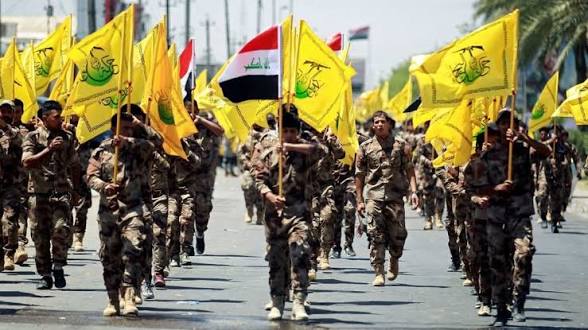
• The article argues that this moment threatens not only the factions, but the future of the PMF itself. In the author’s view, the PMF is no longer merely a military institution created under exceptional security conditions. It has evolved into an entity that grants itself a political and ideological role that goes beyond the state. This is the foundation of the comparison he draws between the PMF and Iran’s Islamic Revolutionary Guard Corps.
• The author stresses that the similarity between the two does not stop at the possession of arms or presence on the battlefield. It extends to the role each assigns itself inside the political system. Just as the IRGC in Iran expanded from a security mission into a force that protects the regime and shapes its direction, the author argues that the PMF has moved beyond a military role and become part of the mechanism that protects the political order that secures the dominance of Shiite Islamist forces aligned with Tehran inside Iraq.
• The article cites several episodes to support this conclusion, including the suppression of the October 2019 protests, when some PMF factions were involved in repression, pursuit, and assassinations, and the 2022 confrontation in the Green Zone with supporters of Muqtada al-Sadr. For the author, these cases show that the PMF no longer acts only against external threats, but has become directly involved in the internal struggle over power and the political system.
• One of the article’s central arguments is that, much like the IRGC, the PMF has shown clear resistance to any attempt by the executive authority to impose effective oversight. The author points to previous government complaints about the lack of precise control over personnel numbers and spending, as well as the existence of internal channels of legal and financial protection that grant the PMF wide autonomy from state oversight and judicial institutions.
• The article also expands on the ideological and organisational dimension of this similarity. According to the author, the PMF did not remain confined to a military function, but worked to build a distinct ideological and mobilisational identity through religious indoctrination, broader social presence, public events, and networks of influence inside society. This path recalls the IRGC’s model of combining security work with social mobilisation and cultural penetration.
• Dr Harith Hasan also highlights the economic dimension, arguing that it is essential to understanding the PMF’s transformation. Just as the IRGC built a broad economic empire that strengthened its autonomy and influence, the PMF has also begun constructing its own economic arms while expanding its indirect presence inside state institutions. This means, according to the article, that the PMF is no longer simply a body funded by the state, but part of a growing network of interests operating from within it.
• Here the article presents one of its most sensitive conclusions: that the Iraqi state is now funding, through its own budget, an armed ideological and political apparatus whose logic and function closely resemble those of the IRGC, while also remaining tied to an external centre in Iran. For that reason, the author rejects simplistic readings that reduce the issue to direct Iranian influence, and instead proposes understanding the PMF as part of a broader transnational project embodied in the Axis of Resistance, a cross-border network with its ideological and political centre in Tehran.
• The author insists that ideology alone is not enough to explain this phenomenon. What matters, in his view, is how that ideology was turned into institutions, structures, practices, and networks of interest capable of reproducing themselves. This is what makes the PMF more complex than an armed faction, and what makes dismantling it or subordinating it to the state far harder than dealing with a conventional military force.
• In this context, the article links the rise of the PMF with the weakening or erosion of other Iraqi security institutions that do not share its political or ideological loyalties, such as the Counter Terrorism Service and intelligence bodies, alongside the broader penetration of the army. In that sense, the author does not see the PMF’s strength as coming only from its weapons or numbers, but also from the fragility of the alternatives within the state itself, and from the weakness of institutions that might otherwise balance or limit its influence.
• Dr Harith Hasan concludes that the issue no longer concerns the factions alone, or even the PMF as a stand-alone institution, but the future of the Iraqi state itself. As the grey zone that for years allowed Baghdad to balance between Washington and Tehran shrinks, Iraq faces a harder test: whether it can preserve a state with its own sovereignty and decision-making capacity, or whether the institutionalisation and expansion of the PMF will entrench an Iraqi version of the IRGC, but one funded by the Iraqi state itself.
• The article’s final conclusion is that understanding the PMF requires more than describing it as an armed force or a political extension of Iran. It demands a deeper reading of how ideology becomes institution, institution becomes entrenched influence, and influence becomes part of the governing order. That is what gives the article its importance: it reads the PMF not as a temporary military formation, but as a phenomenon that reveals the deeper struggle over the Iraqi state and its future in a deeply unstable regional moment.
– Dr Harith Hasan is an Iraqi researcher and writer specialising in Iraqi affairs and in the political and social transformations of the Iraqi state after 2003. His work focuses on structures of power, the relationship between the state and armed actors, crises of identity and representation, and the overlap between the domestic and the regional in shaping Iraq’s political landscape.
-He is known for sober analytical writing in the Arab press and in research circles, where he approaches Iraq through a combination of political sociology and institutional analysis, with particular attention to how centres of power are formed inside the state, and how armed groups and parties reshape the political field.-
– His writing is marked by a sustained focus on the deeper structure of Iraq’s crisis rather than only its visible developments. For that reason, he often reads events as expressions of wider transformations within the state and the political order, not as isolated incidents or passing crises.
-In this article, Harith Hasan continues along that line, reading the PMF not simply as a military force, but as a political, ideological, and institutional phenomenon, and linking it to a trajectory that in several respects resembles the experience of Iran’s Islamic Revolutionary Guard Corps.