2- Tripoli is not operating alone. It leads a force that also includes USS New Orleans and USS San Diego, along with the 31st Marine Expeditionary Unit. U.S. Central Command describes the package as comprising around 3,500 sailors and Marines, while the 31st MEU itself is estimated at about 2,200 Marines and sailors.
3- Tripoli matters because it is a large amphibious assault platform capable of carrying fighter aircraft, helicopters, and landing assets, making it well suited for deterrence scenarios, close air support, and operations near sensitive coastlines and islands.
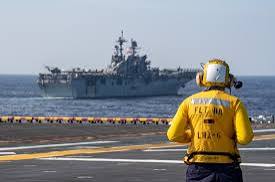
The amphibious assault ship Tripoli has now arrived in the Middle East theater of operations, in a move that reflects the transfer of a major U.S. naval asset from its forward positioning in Asia to a more volatile environment. According to U.S. Central Command and U.S. military monitoring outlets, the ship entered CENTCOM’s area of responsibility on March 27, after a voyage that began this month from its forward homeport in Sasebo, Japan.
Tripoli carries the designation LHA-7 and is the second ship in the America-class. It entered service in 2020. This class was designed to function less like a simple landing ship and more like a mobile naval strike base: a large flight deck, the ability to operate F-35B fighter jets, MV-22 Osprey aircraft, and multiple helicopters, as well as the capacity to support Marines in assault, support, and rapid deployment missions.
Detail
Tripoli’s move to the Middle East did not come alone. The ship leads the Tripoli Amphibious Ready Group, alongside USS New Orleans and USS San Diego, in addition to the 31st Marine Expeditionary Unit. Together, the group and its embarked unit include about 3,500 sailors and Marines, along with transport assets, air-strike capabilities, and tactical landing capacity.
The embarked combat force drawing the most attention is the 31st Marine Expeditionary Unit. This unit is generally known as a rapid-response force, and its size is estimated at around 2,200 Marines and sailors. That figure has been repeated as the approximate size of the unit that arrived aboard the ship group. The Marine Expeditionary Unit is designed for rapid movement from sea to shore, combining infantry, aviation capabilities, logistical support, and high flexibility in missions ranging from evacuation and crisis response to limited combat landings and pressure operations around islands and maritime chokepoints.
Technically, Tripoli is about 844 feet long, has a displacement of around 45,000 tons, and can carry more than 1,600 Marines in its standard configuration, in addition to the ship’s crew and its defensive and operational systems. This class has also gained particular importance in U.S. strategic discussions because of its ability to operate as a light carrier for F-35B fighters when needed, giving Washington a flexible tool positioned between a traditional amphibious ship and a larger aircraft carrier.
What next?
Tripoli’s arrival raises the ceiling of U.S. options in the maritime theater. The ship is useful when Washington wants to keep several tracks open at once:
• maritime deterrence,
• close air support,
• positioning near coastlines,
• or demonstrating the ability to move Marines quickly to sensitive points if escalation widens.
That is why news of its arrival is an indicator that the United States has added to the region a platform that is both flexible and heavy in operational weight.