Key Points
- A 1902 Edvard Munch woodcut, Melancholy III, surfaced at a private estate in north Kent.
- It sold in Norway in 1969 for 42,000 kroner, roughly £3,300 at recent exchange rates.
- The print carries a £50,000 to £80,000 estimate ahead of an October auction in London.
The latest:
A woodcut by Edvard Munch held by the same family for more than half a century is heading to auction in London with an estimate of £50,000 to £80,000. Melancholy III, made in 1902, was found at a private estate in north Kent, still accompanied by the receipt from its purchase in Norway in 1969. Catherine Southon Auctioneers has listed it for sale on 28 October.
Details:
- The sale: Catherine Southon Auctioneers, based in Chislehurst, will offer the print in London on 28 October with a guide price of £50,000 to £80,000. The firm described the work as an early impression of one of Munch’s best-known themes, out of a private family collection.
- The paper trail: The woodcut was discovered with its original 1969 receipt from Norway, typed on ageing paper. The document lists the artist’s name and the title Abend – Melancholi, recording a price of 42,000 Norwegian kroner plus artist tax for a total of 43,260 kroner, around £3,300 at recent exchange rates.
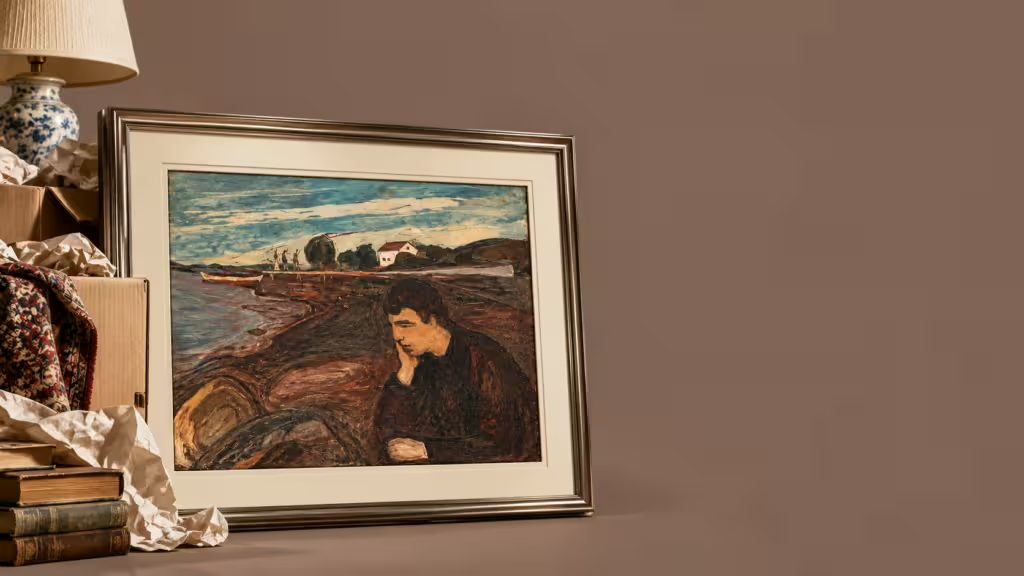
- The image: The print shows a solitary figure on a shoreline, head resting on one hand, while in the distance a couple walks toward a small rowing boat beside a cluster of buildings. The auction house said the isolated figure contrasts with the apparent intimacy of the pair.
- The setting: The scene is set on the shoreline at Asgardstrand, the Norwegian coastal town where Munch spent many summers. The composition is built from broad horizontal bands standing in for sky, sea and land, in dark blue-grey and white with strong contrasts and simple carved lines.
- The technique: Southon said the method makes the work especially interesting. Munch used two oak blocks: one carried the carved design, while a separate colour block was cut into sections for the sky, the sea and the shore. The print is signed and framed in a wide cream mount and dark wooden frame.
- The auctioneer: Southon said it was always exciting to find a work of this calibre in a private collection, particularly one that had stayed with the same family for more than 50 years. She said the surviving receipt offered “a wonderful glimpse into the work’s history” and the moment it entered the family’s care.
- The artist: Munch built his reputation on images of anxiety, loneliness, jealousy and despair, concentrated most famously in The Scream. Southon said that while The Scream remains his best-known expression of anguish, Melancholy III presents a quieter vision, turning on loneliness and unrequited love.
- Unanswered: The auction house did not name the owning family, nor explain how the work travelled from Norway to north Kent. It also did not say how many impressions of Melancholy III are known to exist.
Background:
Melancholy is a recurring Munch subject that he returned to in paint and print across years, with the shoreline at Asgardstrand as its repeated setting. The 1902 woodcut belongs to that sequence, which the auction house counts among the artist’s best-known themes.
Between the lines:
The estimate implies a figure many times the 1969 purchase price, though that gap reflects decades of currency movement as much as any judgement on the print itself. The documented chain from a dated Norwegian receipt to a signed impression is the kind of unbroken provenance that reassures buyers, and the auction house has made the paperwork central to how it is presenting the sale.
What’s next
The 28 October sale in London will test whether bidding clears the £80,000 upper estimate. Watch the hammer price against the guide range, and whether the 1969 receipt is treated as part of the lot.