Key Points
- The Royal Academy opens Painting the French Riviera next week, covering roughly 1880 to 1960.
- It gathers Cézanne, Matisse, Picasso, Monet, Braque, Signac and Dufy works from museums worldwide.
- The Financial Times calls it London's most rhapsodic autumn exhibition and a study of geography shaping modernism.
The latest:
Painting the French Riviera opens at the Royal Academy next week, tracing how the Mediterranean coast became a defining site of modern art between about 1880 and 1960. The Financial Times, in a review by Jackie Wullschläger, describes the show as London’s most rhapsodic autumn exhibition and an argument about how geography shaped the history of modernism.
Details:
- The arc: The show runs from Berthe Morisot’s Beach at Nice (1882), which the Financial Times says hits fresh notes of airy brightness, to Picasso’s vast curtain for Diaghilev’s ballet Le Train Bleu in the final gallery — roughly eight decades of painters working the same strip of coast.
- Dedicated rooms: Individual rooms go to Monet, to Picasso, and to the Mediterranean garden Bonnard created and painted at Le Cannet. Also hung are Soutine’s turbulent Landscapes at Cagnes (1923), Chagall’s bridal pair floating above Nice, Signac’s St Tropez, le quai (1899) and Dufy’s Golfe Juan (1927).
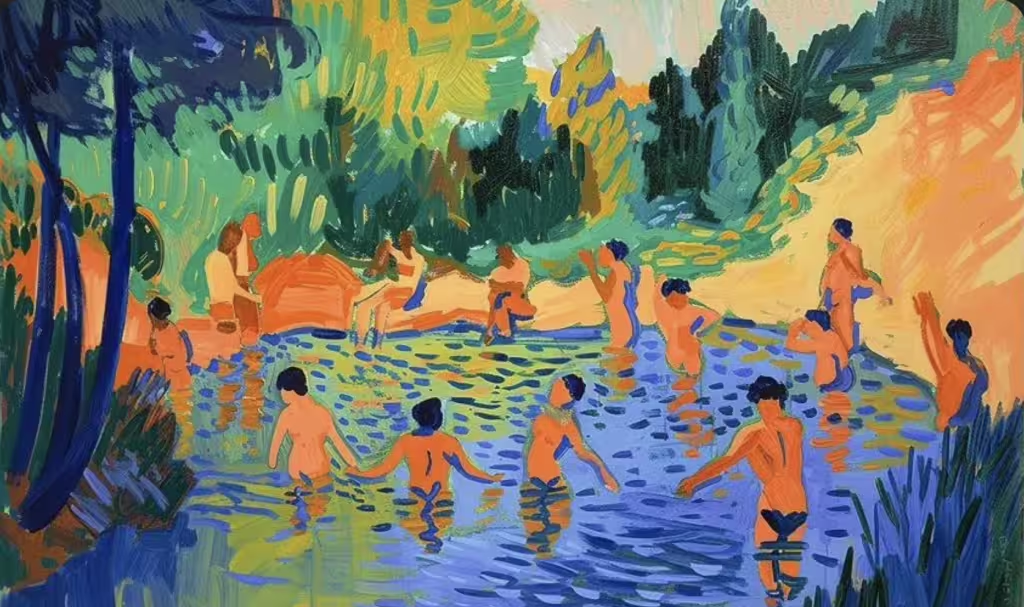
- The Cézanne core: Four L’Estaque paintings and three Bathers are on show. The review argues Cézanne’s move to flat patches and simplified shapes — the cylinder, sphere and cone underpinning cubism — depended on steady, intense Mediterranean light rather than northern conditions.
- Matisse’s gamble: To buy one of Cézanne’s Bathers in 1899, Matisse pawned an emerald ring his wife had received as a wedding present, according to the Financial Times. He later developed the Arcadian theme into 1904’s Luxe, Calme et Volupté; MoMA has loaned the rare working oil sketch.
- Fauvism’s birth: Paintings made at Collioure in 1905 by Matisse and Derain, including The Red Beach and View of Collioure, mark the point colour was finally freed from realism. Braque followed, choosing L’Estaque in homage to Cézanne for his own experiments.
- The Braque loans: Works from L’Estaque and nearby La Ciotat, made in 1906-07, are loaned from Madrid, Paris, Washington, New York and New Orleans. The review presents them as evidence Braque was already a proto-cubist constructor of forms as well as a lyrical colourist.
- Two rivals: After the first world war Matisse settled in Nice, producing models framed by windows, balconies and shutters in Interior at Nice, Le Divan and Seated Woman between 1917 and 1922. Picasso competed on annual summer visits with massive neoclassical figures, beginning with Three Bathers, Juan les Pins in 1920.
- Picasso’s late turn: Picasso moved permanently to the Côte d’Azur in 1946 and drew Greco-Roman pastoral motifs — Shepherd and Goat, Faune jaune et bleu, the ceramic Chouette avec tête de faune — which the review reads as hopes for peace after wartime Paris. His 1950 Winter Landscape at Vallauris is bleaker.
- The theft: Two paintings worth a combined total of more than £7mn were stolen this month from the Musée Renoir at Cagnes-sur-Mer, the artist’s last home, where he moved in 1908. The Financial Times opens its review with the robbery.
Background:
Renoir was among scores of painters who left northern France in the early 20th century for the south, drawn by the light and colour but also by the chance to build landscapes of pleasure away from the authority of Paris. Van Gogh predicted in 1888 that the future of new art lay there.
Between the lines:
The review’s implicit case is that the Riviera was not a backdrop but a working condition: Cézanne’s geometry is tied to a specific quality of light, and Braque chose L’Estaque deliberately, in homage. Wullschläger cites Robert Hughes’s argument that the second world war killed the Mediterranean as a state of mind, then counters that the art itself manufactured the myth of the coast.
What’s next
Painting the French Riviera opens at the Royal Academy in London next week. The Musée Renoir theft at Cagnes-sur-Mer remains unresolved, with no recovery of the two works announced.