Key Points
- Ink dramatizes Rupert Murdoch's 1969 purchase of The Sun and its newsroom reinvention under editor Larry Lamb.
- Danny Boyle directed the film from James Graham's play; it screened at Venice and Toronto.
- Netflix release lands in January, putting a tabloid-origins story before a global streaming audience.
The latest:
Ink follows Rupert Murdoch’s 1969 acquisition of The Sun and hands its real narrative engine to Larry Lamb, the editor tasked with finding the paper a voice and a readership. Danny Boyle directs from James Graham’s stage play, with Jack O’Connell as Lamb and Guy Pearce as Murdoch. The British-American production reaches Netflix in January after festival runs in Venice and Toronto.
Details:
- The premise: Murdoch bought The Sun not to rescue it from collapse but to build a different paper aimed at readers Britain’s major titles ignored, and to overtake The Mirror, then the dominant seller by a wide margin. Lamb is handed the paper and told to find it an audience.
- The casting: Jack O’Connell plays Lamb with the drive of a man proving himself against an establishment that dismissed him. Guy Pearce avoids caricaturing Murdoch as the author of every shocking decision, at moments appearing more cautious than the editor he hired.
- Boyle’s method: The camera moves between desks and printing presses, and the rapid cutting makes each new edition feel like a race against the clock. Paper, ink and machine noise supply the film’s excitement rather than serving as period decoration.
- The central argument: The film ties small editing choices to the paper’s eventual direction: the more provocative headline, the image worth enlarging, the story granted space because it will sell. Each looks minor on the day and defines the title over time.
- The turn: The rhythm shifts with the real kidnapping of Muriel McKay, the wife of a Murdoch executive, seized after the abductors believed she was the proprietor’s wife. The case pushes the story into darker territory and forces Lamb to weigh proximity against a bigger scoop.
- The weak spot: Boyle trusts his pacing and his actors to expose the contradiction, then returns to spell it out in dialogue, saying aloud what the scenes had already delivered — a recurring problem for works about subjects still live today.
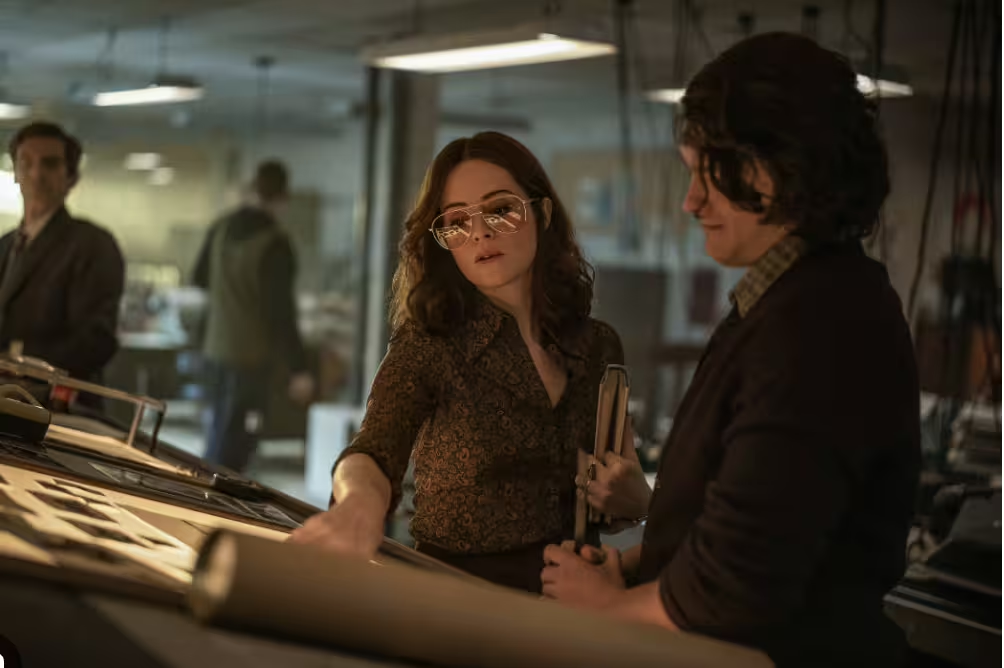
- The underwritten role: Claire Foy plays Jules Davies, one of the few women in the newsroom, at the moment the paper turns images of women into a circulation tool. The script keeps her close to pivotal decisions without giving her the space it grants the two men.
- The AI question: Limited use of artificial intelligence in some moving images and visual details drew critical discussion after the Toronto screening, given a film preoccupied with the limits of the media image. The technique is not central to the story.
- The verdict: At its strongest the film makes The Sun’s success both comprehensible and unsettling, explaining why readers were drawn in and why staff loved the speed, before showing how every issue had to outdo the last.
Background:
The Sun was acquired by Murdoch in 1969 as a challenger to The Mirror, Britain’s circulation leader at the time. Ink originated as a James Graham stage play; Graham also wrote the screenplay.
Between the lines:
Centering Lamb rather than Murdoch is the film’s sharpest structural choice. Had the transformation been reduced to the owner, it would read as a single decision taken from above rather than a daily accumulation of newsroom judgments. Pearce’s more hesitant Murdoch reframes the question: not which man began the descent, but what happens when an institution builds a permanent incentive to escalate.
What’s next
Netflix releases Ink in January, the first wide test of the film beyond Venice and Toronto audiences, and the point at which debate over its AI-assisted visuals meets a mass viewership.