The latest:
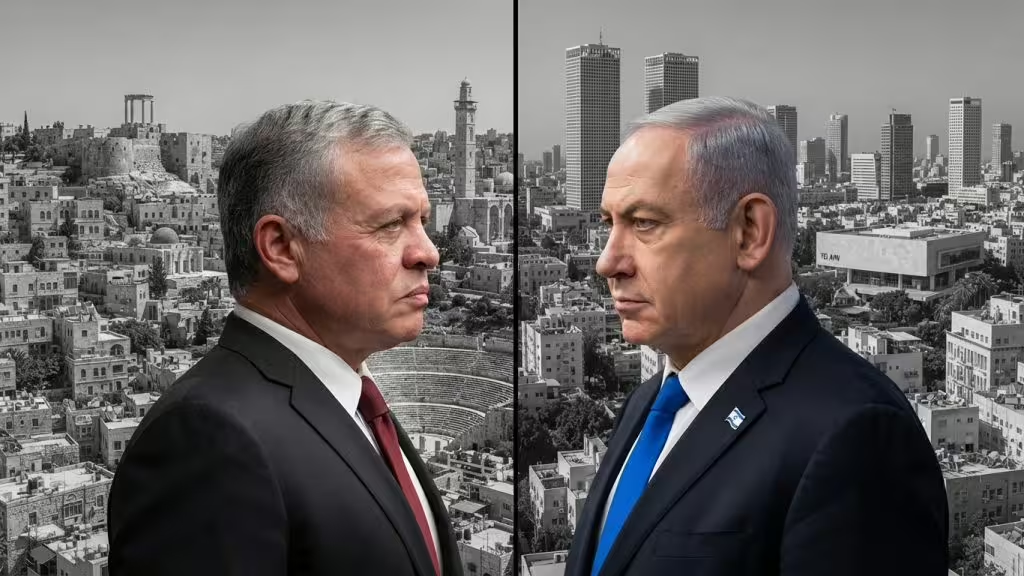
Jordan’s King Abdullah II used his address to the UN General Assembly on Tuesday to accuse the Israeli government of war crimes and expansionist appetites, including in southern Syria. Israel’s response came not from the prime minister’s office but from the foreign ministry, which turned the argument back on the Hashemite monarchy’s own record in the West Bank.
Details:
- The Israeli reply: The foreign ministry said in an official statement that it was ironic to hear King Abdullah II speak with such enthusiasm about international law and Palestinian rights in the West Bank, pointing to King Hussein’s 1988 decision to sever Jordan’s administrative and legal ties with the territory. It closed by telling Amman to tell the world more about international law.
- Israel’s argument: The ministry claimed the 1988 disengagement itself stripped Palestinians of rights and of their Jordanian citizenship, framing Jordan’s UN criticism as selective. It named no measures against Amman and announced no diplomatic steps in response to the speech.
- Netanyahu’s silence: Prime Minister Benjamin Netanyahu has issued no direct, detailed political response. In a video published a day later he opened by referring to Jordan defaming Israel from the UN podium, then pivoted to attacking Yisrael Beiteinu leader Avigdor Lieberman over his proposal to involve Jordan in administering parts of the West Bank.
- The accusations: Abdullah said Israel was pushing Palestinians into an ever smaller patch of Gaza and destroying civilian infrastructure, describing the measures as no longer temporary military steps. He accused Israel of trying to erase Palestinian life and impose a new geographic reality in the territory.
- West Bank claim: The king argued that settlement expansion, land seizures and violent incidents are not separate events but a designed policy of displacement, which he labelled forced transfer and a war crime. He said the aim in both Gaza and the West Bank is to make a viable Palestinian state impossible.
- The Syria warning: Abdullah said the Israeli government’s appetite for expansion has become a regional threat and called Syria a warning the international community is ignoring. He said Jordan would not tolerate any threat to its northern border or its water security.
- On Trump: The king credited US President Donald Trump with working hard for peace and seeking a way to end the war, while claiming the Israeli government keeps shifting its position. He also faulted world capitals for having sanctions, asset freezes, embargoes and diplomatic isolation available yet leaving decisions on paper.
- Cooperation persists: Jordanian Middle East commentator Daham Mithqal al-Fawz told the Israeli news site Ynet that Amman sees no contradiction, saying water, border and other cooperation stems from a reality imposed by the 1994 peace treaty, with water written explicitly into the agreement while the political dispute remains.
- Amman keeps pushing: Foreign Minister Ayman Safadi wrote on X that Israeli government policy and its unlawful actions had been exposed to the world, accused an Israeli propaganda machine of distorting history and targeting the UN and humanitarian organisations, and said Jordan would act to curb the government’s expansion and aggression.
- Arab framing: Coverage in Jordan and the wider Arab press presented the address as among the strongest the king has delivered on the conflict. One Egyptian outlet read it as an attempt to reframe the narrative dominant since 7 October 2023, arguing Abdullah refused to treat that day as a mandate for everything since.
Background:
Harsh rhetoric from Amman is not new. Since the start of the Gaza war, senior Jordanian officials, led by Safadi, have repeatedly attacked Israel, and Queen Rania has made forceful statements against it in interviews and public appearances throughout the period.
Between the lines:
The gap between the rhetoric and the response is the story. Amman escalated at the UN podium while keeping the water and border arrangements of the 1994 treaty intact, and Israel answered with a ministry statement rather than any action against Jordan. Al-Fawz’s reading suggests both sides are treating the political dispute and the treaty framework as separate tracks, at least for now.
What’s next
Watch whether Netanyahu eventually issues a direct response, whether Israel takes any concrete step toward Amman, and whether Lieberman’s proposal on Jordanian involvement in the West Bank draws further coalition reaction.