The latest:
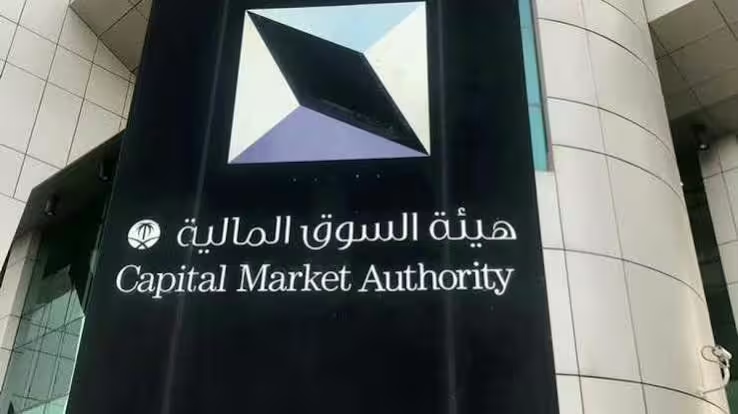
Institutional investors bidding in Saudi IPOs would have to prove they hold the cash to pay for the shares they order, under draft rules published by the Capital Market Authority. The regulator said the package is designed to lift transparency and confidence in Saudi capital markets. Public comment on the proposals runs until 22 October.
Details:
- The solvency test: The CMA proposed verifying that subscription requests reflect the real value of liquidity available to the investor, limiting orders that do not represent an actual financial ability to settle the shares subscribed for. The stated aim is to make orders more serious and ensure funds are in place on time.
- Cash only: Solvency checks on bookbuilding participants would be confined to cash or cash equivalents, according to the CMA, tying the assessment of financial capacity to liquidity that can actually be deployed in the offering rather than to broader asset holdings.
- Payment deadline: Participating entities would be obliged to pay the subscription value no later than the final settlement date set out in the prospectus, within the timeframe the document specifies. The regulator framed this as a guarantee that money is available to close the offering on schedule.
- Underwriter exposure: The underwriting agreement would have to take effect before bookbuilding starts, the CMA said, and once the process begins banks are committed to buying all offered shares. The regulator said the change clarifies underwriter responsibilities from the outset and reduces uncertainty over coverage.
- No listing, same bill: If the shares acquired by the underwriter do not meet listing conditions, the issuer’s shares will not be listed, the CMA said. Underwriters would nonetheless remain bound to purchase all offered shares.
- Forward guidance: Issuers would face expanded disclosure of forward-looking statements and projections, covering financial performance indicators for at least one year. The CMA said the requirement gives investors a clearer view of a company’s financial outlook when weighing an offering.
- The slump: The Saudi IPO market slowed sharply in 2026 as conflict in the Middle East escalated, and has struggled to recover from its post-pandemic surge. Motlaq Al-Ghowairi Contracting scrapped listing plans for what would have been one of the region’s largest IPOs this year.
- The numbers: Equity issuance across the Middle East and Africa reached 2.1 billion dollars in the first half of the year, down 71% year on year, according to London Stock Exchange Group data, the weakest level in years.
- The deadline: The CMA is seeking public feedback on the proposals until 22 October. The authority did not name a date for issuing the rules in final form.
Background:
Bookbuilding is the process by which an institutional investor or underwriter sets the price of a security, collecting orders before the final offer price is fixed. The CMA said its package targets the efficiency of that process alongside subscription practices.
Between the lines:
The two central provisions pull in the same direction: cash-only solvency checks and an underwriting commitment that binds once bookbuilding opens both move execution and funding risk away from issuers and toward institutions and banks. That is a costlier proposition for underwriters at the exact moment issuance across the region has fallen 71%.
What’s next
Public comment closes 22 October, after which the CMA would decide whether to adopt the draft as written. Watch whether shelved listings return once the final framework is published.