
Summary:
Key Points
- Brent and WTI are heading for their largest weekly gains since mid-July.
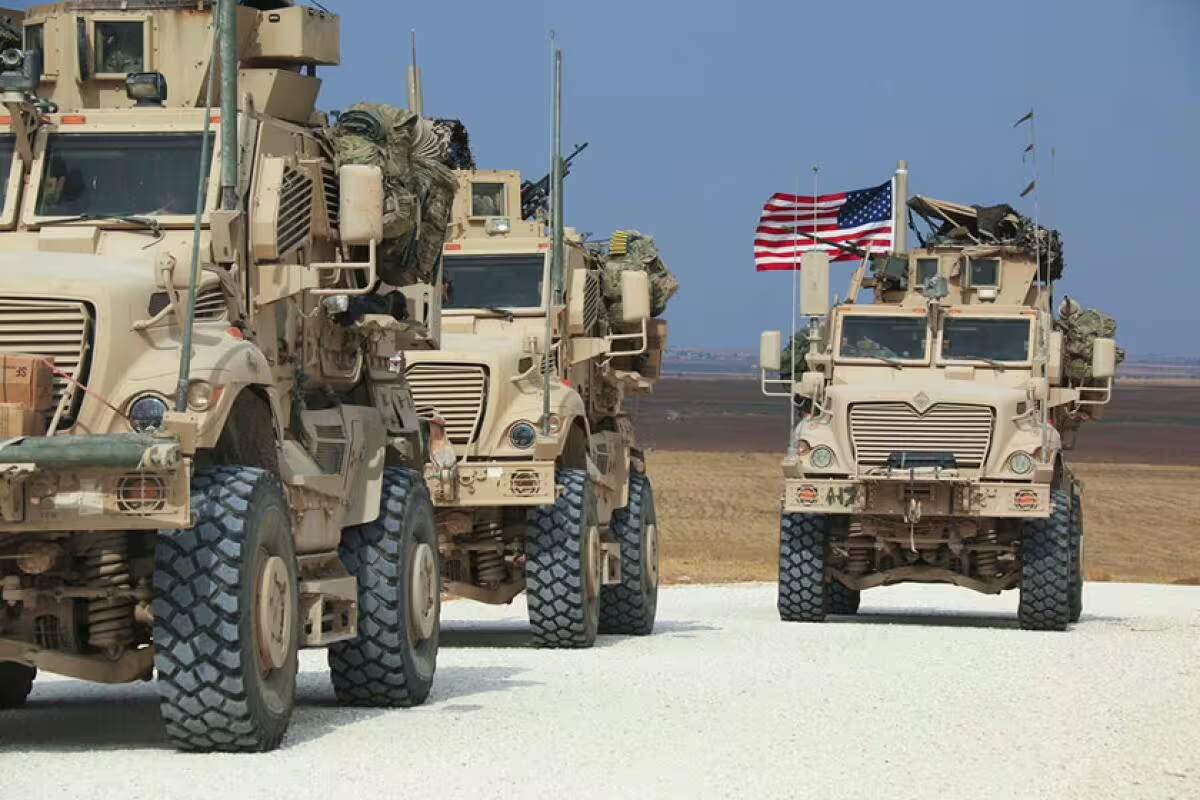
- Renewed U.S.-Iran hostilities raised fears Persian Gulf flows could stay constrained into next year.
- Analysts say inventory buffers that cushioned the first supply shock are now shrinking.
The latest:
Crude is closing the week with its strongest run since mid-July, with Brent up 8.6% and WTI up 9.8% over the five sessions, according to Dow Jones Newswires. The move followed a flare-up in hostilities between the United States and Iran that revived concerns Persian Gulf flows could be restricted into next year.
Details:
- The benchmarks: Brent crude ticked 0.2% higher to $95.75 a barrel in early European trading, while WTI futures rose 0.3% to $91.58 a barrel, Dow Jones Newswires reported. Both contracts were extending gains rather than driving them, with the bulk of the week’s move already priced in.
- The weekly move: Brent is up 8.6% on the week and WTI 9.8%, the largest weekly advance for the benchmarks since mid-July. The scale of the move places this week among the sharpest repricings of crude since the middle of the year.
- The trigger: A flare-up in hostilities between the United States and Iran during the week drove the rally, fueling fears that flows through the Persian Gulf might be constrained into next year. No specific disruption to shipments or export volumes was cited alongside the price move.
- The analyst read: Analysts at ANZ said the market is entering what they described as “a delicate adaptation phase,” arguing that high inventories absorbed the initial supply crisis but that the task now is keeping the market balanced as those buffers shrink.
- The inventory factor: ANZ’s framing points to stockpiles as the mechanism that contained the first shock, meaning the cushion is finite. The bank did not quantify how much inventory remains or set a timeline for when the buffers would be exhausted.
- Intraday reversal: Later quotes showed Brent at $94.70 a barrel, down $0.82 or 0.86%, while the continuous crude contract stood at $90.32, off $0.98 or 1.07%, indicating the early European gains had faded during the session.
- Forward horizon: The concern shaping the rally is not this week’s supply but next year’s, with traders pricing the risk that Persian Gulf constraints persist beyond the immediate escalation. No forecast for 2026 volumes accompanied the assessment.
Between the lines:
Two figures in the same session point in opposite directions: an 8.6% weekly gain for Brent alongside an intraday drop of 0.86%. That gap suggests the rally is built on forward risk to Persian Gulf flows rather than a present shortfall, consistent with ANZ’s reading that inventories are still absorbing the shock.
What’s next
Watch whether U.S.-Iran hostilities escalate further, whether any actual disruption to Persian Gulf shipments is reported, and how quickly the inventory buffers ANZ flagged draw down in coming weeks.