Key Points
- Five films in five days ended in fatigue and numbness, not the expected emotional purification.
- Bleak Week brought cinema of despair to London amid a heatwave and screenings across Britain and America.
- The experiment tested whether tragic art builds empathy or turns suffering into troubling pleasure.
The latest
I entered Bleak Week: Cinema of Despair expecting five sad films in five days to leave me purified, more sympathetic or at least satisfyingly miserable. Instead, I emerged tired, numb, irritable and slightly spaced out. The annual festival, organised by the American Cinematheque in Los Angeles, reached more than 50 independent US cinemas and venues in Edinburgh, Glasgow, Newcastle, Leeds, Oxford and Bristol. London’s Prince Charles Cinema hosted it for a second year, turning a basement near Leicester Square into a refuge from the heat and a gathering place for viewers choosing tragedy over sunshine.
Details
- Hopeful opening: Abbas Kiarostami’s 1997 Palme d’Or winner Taste of Cherry followed Mr Badii through Tehran’s dusty foothills as he searched for someone to help him die. Its philosophical encounters, unexpected humour, amber beauty and ambiguous ending left room for hope. It scored only two out of five for bleakness.
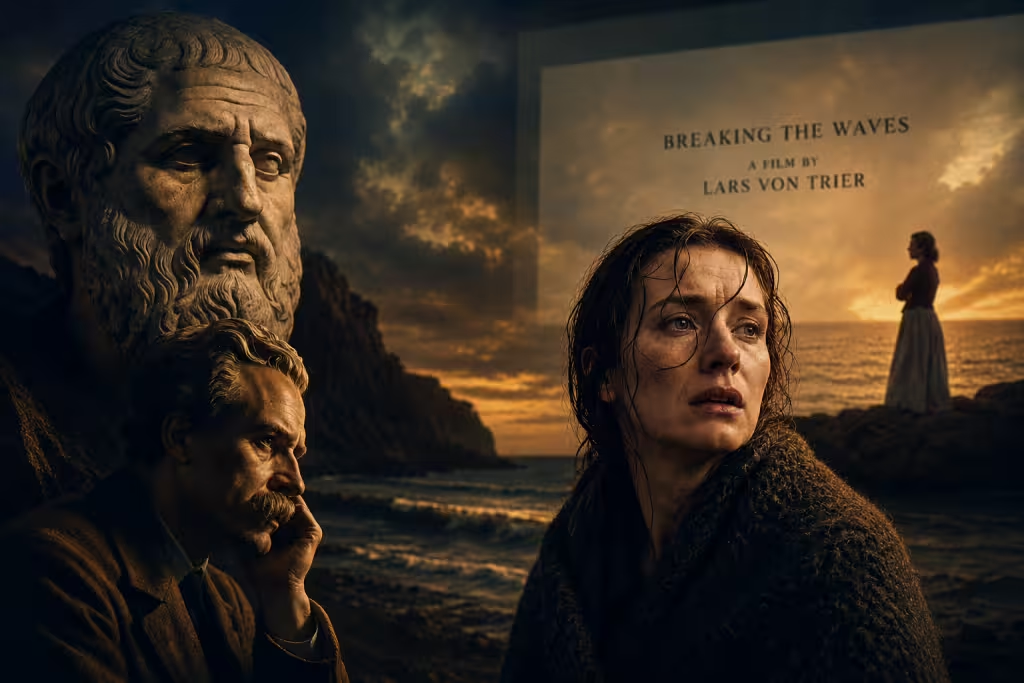
- War’s double pull: The 181-minute final cut of Francis Ford Coppola’s Apocalypse Now mixed Vietnamese war horror with exhilaration and black comedy. Its cavalry attack made violence appalling and thrilling at once, sharpening the clash between Aristotle’s idea of tragedy as moral purification and Nietzsche’s view that audiences enjoy the hero’s destruction.
- Nuclear shock: Threads, the BBC’s 1984 television film set in Sheffield, earned the full five-out-of-five rating. Ordinary domestic life gives way to nuclear fire, charred survivors, hunger, cold and a nuclear winter. Its calm broadcast-style narration made the devastation so immediate that London rooftops seemed vulnerable on the journey home.
- Perfect tragedy: Jerry Schatzberg’s 1971 The Panic in Needle Park was the week’s favourite. Written by Joan Didion and John Gregory Dunne, and starring Al Pacino and Kitty Winn, it follows two New York lovers through addiction and inexorable decline. Its utterly bleak ending felt terrible in precisely the satisfying way the festival promised.
- Exhausted finale: Lars von Trier’s 1996 Breaking the Waves closed the run on the hottest June day recorded in Britain. Emily Watson plays a young woman on a Scottish island who believes sex with strangers can save her paralysed husband. After four days of tragedy, its violence left exhaustion rather than catharsis.
Between the lines
The week’s central question was why sad art carries moral prestige. One viewer, Rupert, said bleak films helped him understand experiences beyond his relatively fortunate life. That echoed Aristotle’s belief that pity and fear can be purged through tragedy. Yet Apocalypse Now also supported Nietzsche’s darker account of pleasure in destruction. Across five screenings, empathy and excitement both appeared, but accumulation chiefly produced fatigue.
What’s next
At the next heatwave, the plan is settled: skip another basement programme of tragic films and head for the beach instead.