The latest:
Gulf governments have concluded the confrontation around the Strait of Hormuz will not be resolved in days or weeks but in months or years, Torm chief executive Jacob Meldgaard told the Financial Times, warning that markets are underestimating how long the stalemate can last. He compared it to Russia’s war in Ukraine, where early assumptions of a quick economic fix proved wrong.
Details:
- The core assessment: Meldgaard argued the most likely scenario is that neither side has an alternative to continuing, naming Trump and the US administration on one side and Iran and the Revolutionary Guard on the other. He said imagining a near-term return to the world of ten years ago is unrealistic, however much he would welcome it.
- The Ukraine parallel: He recalled that in 2022 many voices, especially in the United States, assumed the war would end quickly because it made no economic sense for Europe to forgo Russian energy. Those forecasts, he said, badly misjudged how long such a situation can persist.
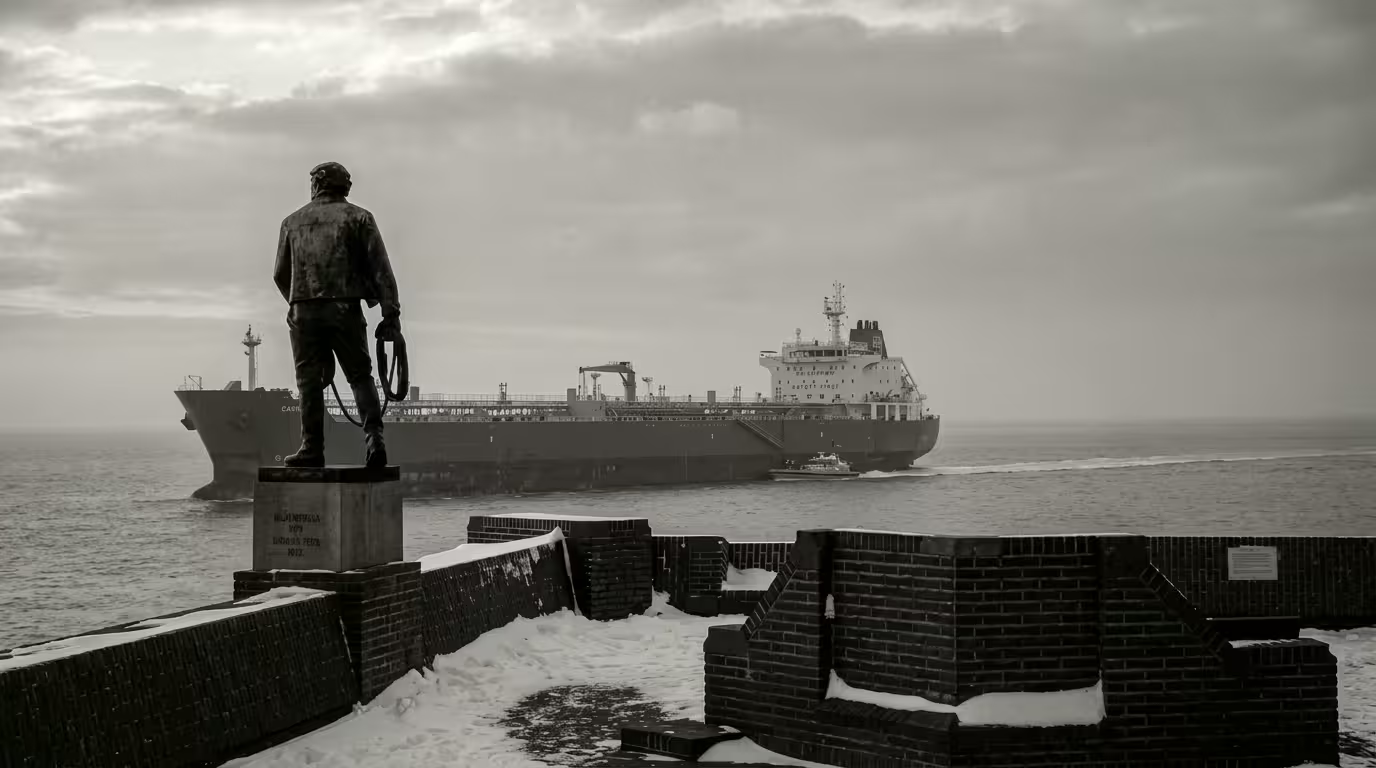
- Gulf fleet buildup: Gulf states have begun expanding their tanker fleets so national oil companies can keep moving crude and refined fuel through the strait despite Iranian attacks. Meldgaard described the decision as strategic: the companies have determined they will not submit to Iranian control.
- The math of disruption: Holding export volumes at pre-war levels under current conditions would require far more ships because vessel efficiency has fallen, Meldgaard said, possibly double the number of very large crude carriers and triple the number of large refined-product tankers.
- Market limits: He characterised the Gulf buying campaign as a response to a regional problem rather than a structural shift in the global tanker market. The change that persists, in his framing, is the inefficiency baked into the scenario.
- Crew safety: Asked whether his sailors feel safe, Meldgaard said no, describing it as the question he puts to himself each morning as an owner. He drew a distinction between private operators and national oil companies facing what he called an existential choice.
- Prices and freight: Oil prices fell this week on talks between Iran and Oman over resuming navigation through Hormuz, while Washington threatened tougher sanctions on Tehran. Freight rates between the Middle East and China remain at record levels.
- Earnings backdrop: Torm, which operates around 100 tankers carrying gasoline, diesel and other refined fuels, reported record second-quarter net profit of 338 million dollars, roughly six times the year-earlier level, after freight rates rose during the conflict.
- Diplomatic track: Qatar and Oman have been pushing to return the parties to negotiations, according to UAE News, after a Qatari-mediated temporary halt to hostilities in June. Control and freedom of navigation in Hormuz remain unresolved.
Background:
UAE News reported that Washington escalated naval pressure in July and announced a blockade of Iranian coasts, ports and oil terminals, sending Brent up about 10% in a single day. By late August both sides had settled into mutual deadlock, with pressure shifting from military to economic tools.
Between the lines:
The two accounts converge on the same reading: pressure is being redirected from the battlefield to trade routes and finance, without either side conceding first. That is why a tanker operator, not a negotiator, is the one describing the horizon in years — the freight rates holding at records while oil dips on talks suggest the shipping market is pricing risk that diplomacy has not yet removed.
What’s next
Watch whether the Iran-Oman talks yield a navigation arrangement for Hormuz, whether Washington follows through on tougher sanctions, and whether Middle East-China freight rates ease from record levels.