The latest:
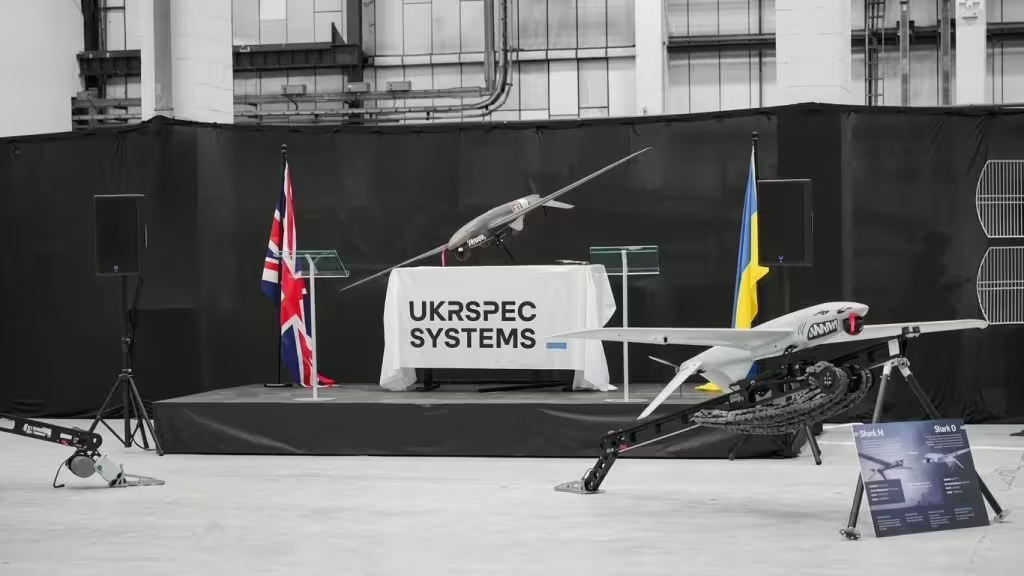
Russia has designated a British-Ukrainian drone factory and missile maker MBDA as legitimate targets, Andrei Fedorov, a senior adviser to Vladimir Putin and former deputy foreign minister, told the Mail on Sunday. He said the highest levels of the Russian government are weighing a hybrid attack such as sabotage or arson rather than a direct strike that would trigger a NATO response.
Details:
- The targets: The Mail on Sunday reported that the Kremlin’s list includes a drone plant owned by the British-Ukrainian firm Ukrspecsystems, sited next to RAF Mildenhall in west Suffolk. The location was disclosed in April alongside five other European companies making weapons and drones for Ukraine.
- The missile maker: Fedorov said many experts in Moscow consider MBDA a legitimate target. The British arms firm, headquartered in Stevenage, Hertfordshire, employs 4,000 people and builds the Storm Shadow missile, with a stated range of 350 miles, already used in strikes inside Russia.
- The stated grievance: Fedorov, 71, called the UK the number one evil, citing reports that British-made drones were used against Russian oil refineries. He said many Russian experts are calling for Britain to be punished with a strike and that most Russian citizens would back it.
- Why not a direct strike: Fedorov said Moscow will not launch a direct military strike on Britain because NATO membership could produce a collective military response against Russia. He did not say when or in what form a hybrid attack might come.
- London’s response: Defence Secretary Wes Streeting said on Saturday night that reckless rhetoric and intimidation attempts from the Kremlin in recent weeks reflect Putin’s weak position, and that Britain will not be intimidated. He said front lines have barely moved and Russian losses keep rising.
- The embassy memo: The Mail on Sunday said it saw a memo from Nigel Casey, Britain’s ambassador to Moscow, instructing Foreign Office staff to neither confirm nor deny whether UK-supplied weapons are used inside Russia. Casey wrote that Russia is losing its narrative and escalating hybrid warfare across Europe.
- The trigger: Fedorov said Putin and his circle were angered after Andy Burnham handed Ukraine plans for long-range Storm Shadow missiles. Russian foreign ministry spokeswoman Maria Zakharova warned last week that Britain and France are playing with fire and called on London to drop what she termed a hostile posture.
- The Washington channel: CIA Director John Ratcliffe travelled to Moscow last Tuesday and reportedly warned Russia against attacking any NATO member. The Washington Post reported he went after intelligence indicated the Kremlin views Washington as weakened by the conflict with Iran.
- The defender’s dilemma: Elisabeth Braw of the Atlantic Council said hybrid attacks leave a country like Britain stuck over how to respond, calling them the defender’s dilemma: “if it uses military means, that would actually cause World War Three”.
- Track record: An east London warehouse storing Ukraine aid was attacked in March 2024, an operation attributed to the Wagner group. In June, two men were jailed over arson attacks on properties and vehicles linked to Keir Starmer.
- The pushback in Europe: Finnish President Alexander Stubb told Bild he does not believe Russia will risk attacking NATO states and sees no evidence for it, saying no power would rationally test the world’s strongest military alliance. German officials expect Russia could be capable of attacking a NATO state by 2029.
Background:
Britain has supplied Ukraine with Storm Shadow cruise missiles used against targets inside Russia. Finland joined NATO in 2023, and Stubb told Bild that Ukraine is the best security guarantee against Russia for both Helsinki and Berlin.
Between the lines:
Fedorov’s own reasoning sets the ceiling on the threat: he rules out a direct strike precisely because NATO’s Article 5 machinery would engage, leaving sabotage and arson as the available tools. Braw’s defender’s dilemma explains why that choice is deliberate rather than cautious, and the Wagner-linked warehouse attack and the Starmer arson convictions show the method has already been used on British soil.
What’s next
Watch whether Britain shifts its neither-confirm-nor-deny line on UK weapons used inside Russia, further Zakharova statements, and any security alert issued to UK defence firms named as potential hybrid targets.