Key Points
- Bill Gates warns companies are advancing AI without preparing for disruption to jobs, safety and human well-being.
- He says entry-level and midlevel roles face early losses, with blue-collar work following within a decade.
- Proposed responses include AI taxes, stronger safety nets, protected human jobs and coordinated global regulation.
The latest
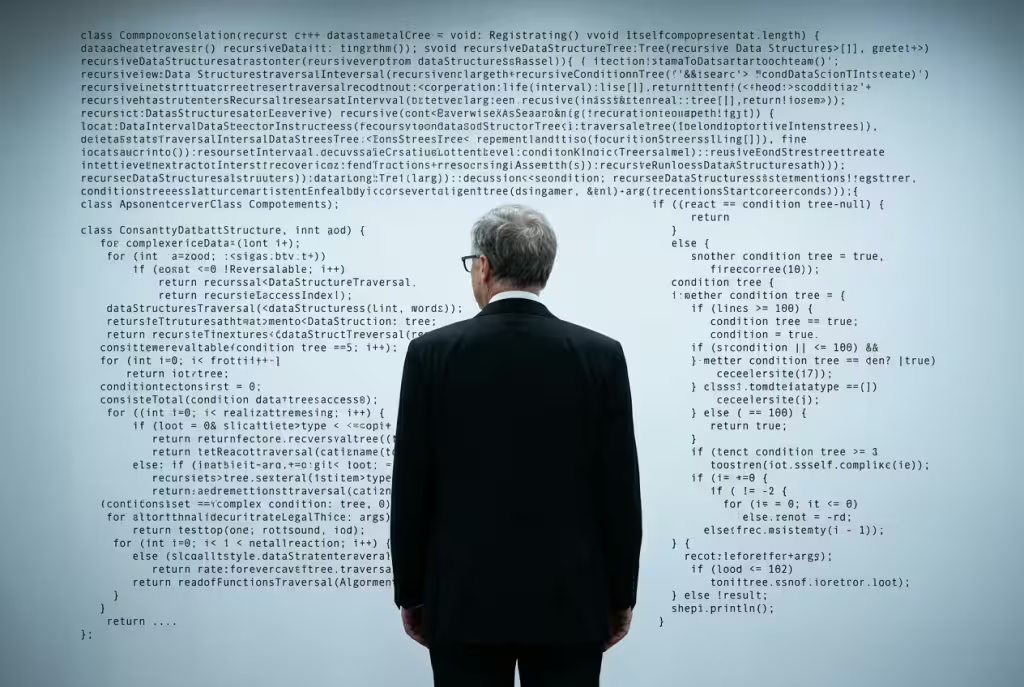
Bill Gates has warned that the transition to artificial intelligence could become one of the most turbulent periods in human history, arguing that businesses are pressing ahead without a broader plan for the upheaval. In a 12-page essay published Wednesday on his personal website, the Microsoft co-founder said leaders, experts and communities were not preparing adequately, despite AI’s potential to improve energy, medical care and agriculture.
Details
- Job disruption: Gates identified entry- and midlevel positions as most vulnerable to elimination, while predicting that blue-collar work will soon be affected. He contrasted AI with the generations-long shift from agriculture to office work, saying law, customer service, software and manufacturing could be transformed within a decade. Once AI delivers error-free work independently, companies will have an economic incentive to remove human checks.
- Safety net: A sharp increase in joblessness would require stronger social protection, Gates argued. He linked factory closures with higher opioid deaths in affected communities and asked policymakers to imagine similar pressure across white- and blue-collar workers nationwide. Retraining would need funding as income-tax receipts decline with employment, while governments still finance public services.
- Security threats: The essay highlighted possible cyberattacks against electricity grids, hospitals and banks, alongside widespread fraud and surveillance. Gates also warned that AI could allow governments to use deadly force without human input. He described chatbots as addictive, friction-free companions and echo chambers, with potentially profound consequences for children, relationships and independent judgment.
- Critical thinking: Personalized misinformation and deepfakes make the ability to distinguish truth from falsehood an essential life skill, Gates wrote. He said sustained reliance on chatbots could weaken critical thinking at the moment it is most needed, compounding the risks created by individually tailored deception and automated systems that reinforce users’ existing views.
- Taxes and rules: Gates proposed taxes on AI tokens and bots to slow the financial rush away from human labor and pay for retraining and social programs. He also urged societies to reserve certain jobs for people, either because displaced workers would be difficult to retrain or because the role depends on empathy and care. International rules, he said, require U.S.-China cooperation comparable to coordination on nuclear weapons, aviation and ozone protection.
Background
The warning marks a more sober tone than Gates’s 2023 essay, when he compared his excitement about AI with the arrival of personal computers and the internet. He said profits from his investments will go to the Gates Foundation, where AI will be used to accelerate work in health, agriculture and education.
What’s next
Gates plans to take his proposals to lawmakers in Washington, pressing for action before unemployment rises sharply, communities suffer and public trust erodes. The concrete policy tests will be whether officials pursue AI-token and bot taxes, reserve selected roles for humans and open regulatory coordination with China.