The latest:
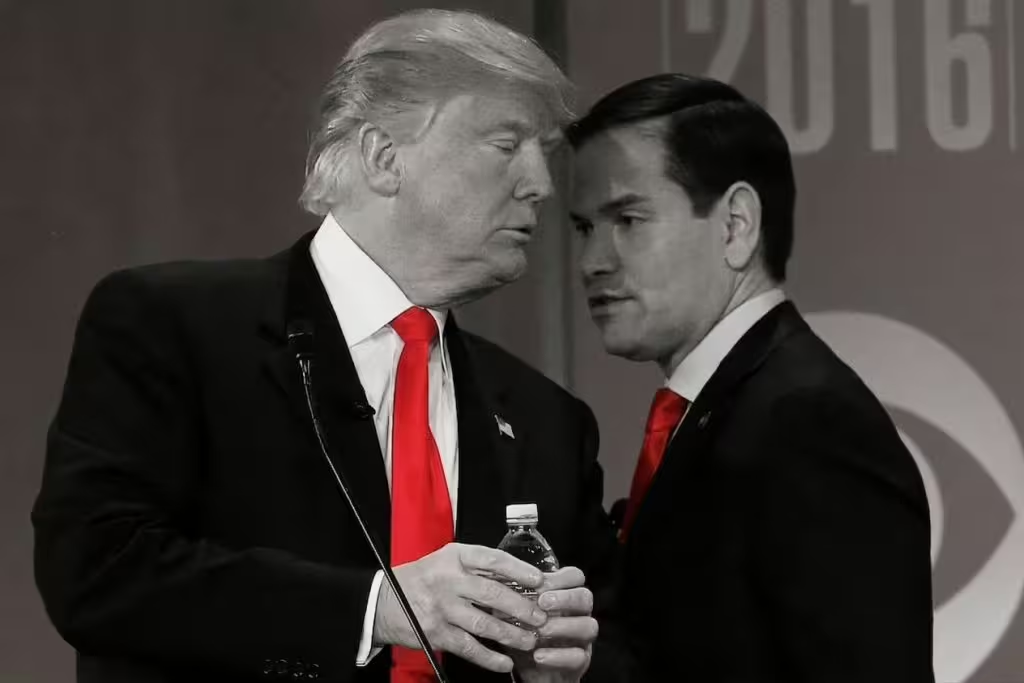
The United States does not intend to launch a new round of strikes on Iran at this stage, Secretary of State Marco Rubio told several international counterparts in recent days, Axios reported. Roughly six months into the war, the administration is moving the center of gravity from the air campaign to economic strangulation and the Strait of Hormuz. A US source said Rubio did not rule out a military response to an Iranian preemptive attack.
Details:
- The timeline: A second US source told Axios the policy is expected to hold at least until after the November congressional midterm elections, at which point the option of a renewed military campaign could be put back on the table. No date was set for any review of the approach.
- The new track: Instead of strikes, the administration is pressing on two parallel fronts, according to Axios: economic strangulation through sanctions and a naval blockade, and an increase in the volume of Gulf oil moving through Hormuz to global markets, to cut Tehran’s revenue and its leverage over the world economy.
- The sanctions: Treasury Secretary Scott Bessent announced a package on Tuesday, branded Operation Economic Outcast, hitting more than 60 individuals, companies and vessels Washington says help Iran generate oil revenue, obtain nuclear and missile technology and run cyber operations. Gold, aviation, shipping, technology and digital assets were added.
- The warning: Bessent said no country and no entity is above sanctions, warning that anyone laundering money for Iran risks being cut off from the dollar system. The New York Times reported Treasury said Iran uses those sectors to prop up a struggling economy and fund regional destabilization.
- The Hormuz claim: President Donald Trump said he had received updated information that all mines laid in the strait’s international waters were cleared or detonated. US officials claimed Iran has lost control of the waterway and that Washington now controls it, citing almost no tanker traffic at Kharg Island for two weeks.
- Iran’s response: Foreign Minister Abbas Araghchi said Iran has already absorbed harsh sanctions and Trump’s maximum pressure campaign, calling the new package the same scenario under a different name. Parliament Speaker Mohammad Baqer Qalibaf said Iran’s trading partners do not take the threats seriously.
- The Oman track: Iran and Oman reported progress on Hormuz after Omani Foreign Minister Badr al-Busaidi visited Tehran. The announced framework covers a temporary joint shipping corridor and a joint mine-clearing project, with technical talks to follow on a permanent corridor, traffic management and security services.
- Tehran’s condition: Deputy Foreign Minister Kazem Gharibabadi said the understandings do not mean immediate reopening and that the strait stays closed while the war continues. He described a temporary corridor roughly 11 kilometers wide, with a permanent route to be negotiated within 30 to 60 days.
- The demands: Gharibabadi tied reopening to ending the war on all fronts, lifting the blockade and settling Yemen, claimed only Iran knows the mines’ exact locations, and warned US naval minesweepers entering the area would become primary targets. He also threatened to reveal new capabilities.
- The mediation: Pakistani army chief Asim Munir visited Tehran; Al Arabiya reported he spoke with Trump beforehand and presented a new initiative. The White House did not deny the call but said no talks are underway or planned. Envoys Steve Witkoff and Jared Kushner were due at CENTCOM for a briefing.
Background:
Iran’s president said in recent days that the country cannot continue the war indefinitely, a remark that exposed differences within the leadership over how to handle US pressure.
Between the lines:
Washington is treating the mine clearance and the southern tanker route as the war’s turning point, which is why US officials dismissed a possible Iran-Oman deal as practically pointless: if Hormuz already flows without Tehran’s consent, the corridor talks lose their value as leverage. Gharibabadi’s insistence that reopening requires ending the war reads as an attempt to restore that leverage.
What’s next
Watch the 30-to-60-day window for permanent corridor negotiations between Tehran and Muscat, whether Washington sanctions major Iranian trading partners such as China, and the November midterms as the marker for any return to strikes.