The latest:
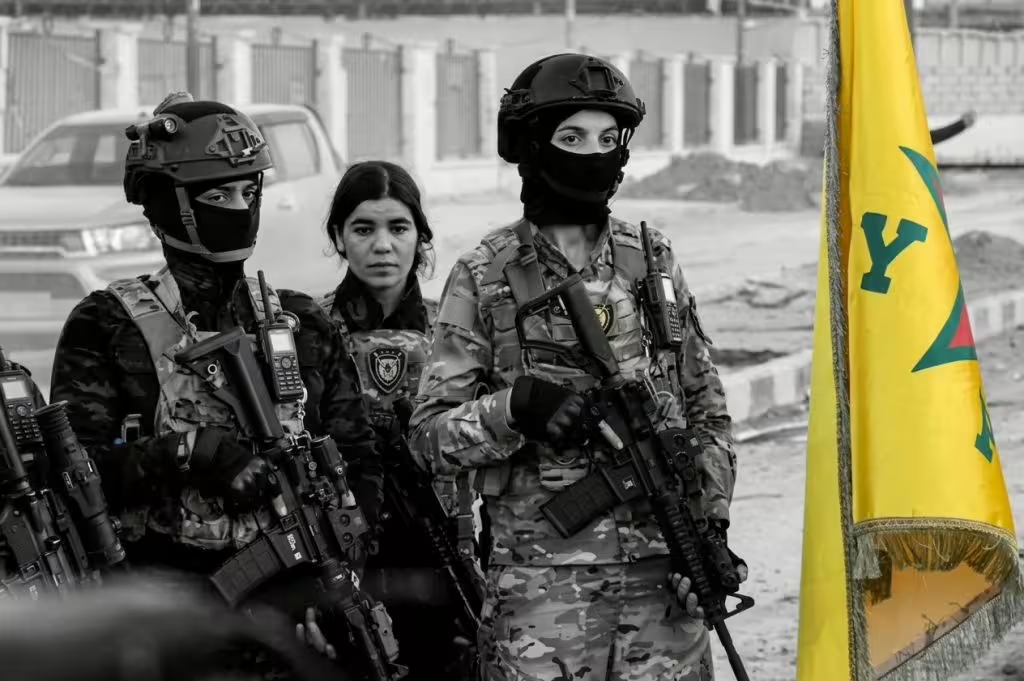
The Syrian Democratic Forces will cease to exist as an independent military force, commander Mazloum Abdi announced Tuesday from the presidential palace in Damascus, alongside the dissolution of the Kurdish self-administration and their full absorption into state institutions. State television carried his remarks. Abdi said the group’s mission had ended and framed the move as a transition from the era of weapons to the era of peace, according to Agence France-Presse and SANA.
Details:
- The announcement: Abdi told reporters: “Today we announce the end of the mission of the Syrian Democratic Forces, and we announce with full responsibility its dissolution as an independent military force.” He added that Kurds sought a genuine transition from arms to peace, according to Syrian state television.
- The agreement: Damascus announced a comprehensive deal with the SDF on 29 January 2026, including a ceasefire, the start of military and administrative integration, and guarantees for displaced residents to return. Washington, which maintains close ties with both sides, described the accord as a historic milestone, according to AFP.
- The military backdrop: The deal followed a Syrian army operation that recovered wide areas in the north and northeast, launched after Damascus said the SDF had violated an earlier accord reached in March 2025. The SDF pulled back from Arab-majority districts to Kurdish-majority areas in its Hasakah stronghold.
- Kurdish rights decree: Al-Sharaa issued a decree on 16 January recognizing Kurdish national rights and making Kurdish an official language, a step AFP described as unprecedented in Syria since independence in 1946. Abdi said al-Sharaa pledged to preserve Kurdish-language education and showed openness on mother-tongue instruction.
- Appointments: Under the accord, al-Sharaa appointed Nour al-Din Ahmed Issa, a Kurd from Qamishli, as governor of Hasakah the following month. In March, the Defense Ministry named prominent Kurdish commander Sipan Hamo as deputy defense minister for the Eastern Region.
- Assets transferred: Syrian authorities took over facilities previously under Kurdish control, most notably Qamishli airport and the oil and gas fields of the northeast. US forces moved more than 5,700 detained Islamic State members from Kurdish custody to neighboring Iraq.
- The US shift: Washington led the anti-IS coalition and was the Kurds’ main backer until the group’s territorial defeat in 2019. After Bashar al-Assad’s removal in late 2024, it became a principal supporter of al-Sharaa’s unification effort, and envoy Tom Barrack said the SDF’s counter-IS role had ended.
- The numbers: Founded in October 2015 by merging Arab and Kurdish fighters under coalition guidance, the SDF fielded close to 100,000 members before the old government fell, per Abdi. Researcher Fabrice Balanche put the remaining force near 50,000 after most Arab fighters sided with the new authorities.
- The unresolved file: Kurdish-language education topped Abdi’s talks with al-Sharaa and Foreign Minister Asaad al-Shaibani. An informed source said Abdi would seek full translation of curricula into Kurdish, while the government favors optional Kurdish instruction of one to three weekly classes, on the Turkish model.
- The delegation: A military, security and administrative delegation reached Damascus on Monday led by Abdi and Ilham Ahmed, co-chair of the self-administration’s foreign relations department, with Women’s Protection Units commander Nowruz Ahmed and eastern region deputy defense aide Samir Ousso.
Background:
Kurds number roughly 2 million of Syria’s 20 million people and faced decades of marginalization: bans on teaching their language, celebrating their festivals, and stripped citizenship for tens of thousands. After 2011 they avoided fighting Assad’s forces and built a self-administration over oil-rich, fertile territory taken from IS.
Between the lines:
Kurdish affairs expert Mutlu Civiroglu told AFP the dissolution is a major achievement for al-Sharaa, removing one of the main obstacles to central government authority and to the legitimacy of his presidency. The Kurds enter this stage without the autonomy they long sought and without their former US patron, holding instead a language decree, two senior appointments and a promise on schooling — commitments that now depend on a constitution not yet written.
What’s next
Watch the education formula: whether curricula are translated in full or Kurdish becomes optional weekly classes. Also pending are a meeting between Women’s Protection Units commanders and the Defense Ministry, and command assignments across Hasakah.