The latest:
The 30-year US-Saudi civil nuclear cooperation agreement reached Congress on Monday, a US administration official told Reuters, while insisting the president’s position is unchanged: it moves forward only if Riyadh normalizes relations with Israel. Lawmakers have 90 legislative days to review it. The Saudi embassy in Washington did not immediately respond to a request for comment.
Details:
- The mechanism: The submission formally triggers the review process under Section 123 of the Atomic Energy Act. Unlike treaties, so-called 123 agreements require no two-thirds Senate approval; the Senate Foreign Relations and House Foreign Affairs committees examine the text, and it can enter into force without an affirmative vote in either chamber.
- The veto math: According to Reuters, the agreement takes effect unless Congress passes a joint resolution of disapproval within 90 days in session. If Congress rejects it, Trump can veto, and overriding that veto would require a two-thirds majority. Congressional sources said committees were expected to take it up Wednesday.
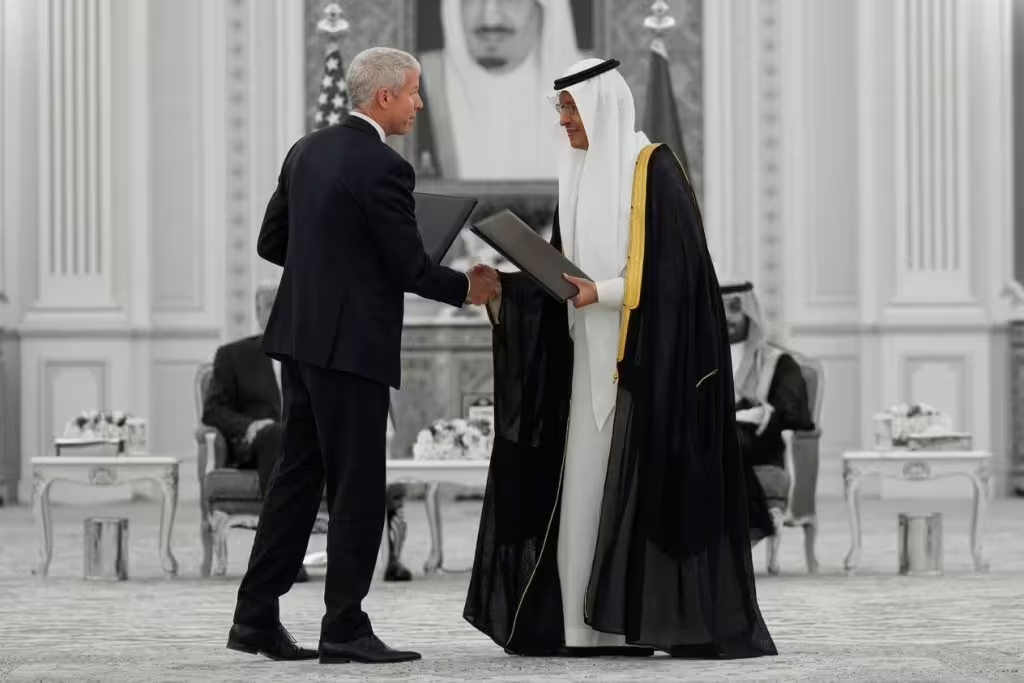
- The signing: Energy Secretary Chris Wright and Saudi Energy Minister Prince Abdulaziz bin Salman signed the accord on 22 July as part of a broader civil nuclear energy package. The two officials also signed what the administration described as a bilateral agreement on nuclear safeguards.
- The commercial stake: The 30-year agreement covers construction of AP1000 reactors, a project worth tens of billions of dollars that would benefit Westinghouse, jointly owned by Canada’s Cameco and Brookfield Asset Management. Washington presents it as a decades-long partnership giving US firms a central role and largely excluding foreign competitors.
- The enrichment gap: Some Democratic lawmakers and non-proliferation advocates said the text does not bar Saudi Arabia from enriching uranium or reprocessing nuclear waste, two potential routes to a weapon. The UAE accepted those restrictions, known as the gold standard, in its 2009 civil nuclear agreement with Washington. The administration says the deal includes proliferation safeguards required by law.
- The Democratic pushback: Senators Edward Markey and Jeff Merkley, with Representatives John Garamendi and Donald Beyer Jr., wrote last month that the deal amounts to a starting gun for a Middle East nuclear arms race and that Congress must reject it. They demanded Riyadh forgo weapons-grade uranium production and accept the strictest IAEA inspections.
- The contradiction charge: The four Democrats argued that waging war on Iran over its nuclear ambitions while negotiating a nuclear deal with Saudi Arabia is a fundamental contradiction in US policy, one they said makes American positions impossible to take seriously.
- The normalization condition: Trump imposed normalization as a condition days after the July agreement was approved, following concerns from Israel and its supporters that the administration had proceeded without an Abraham Accords requirement. An official told the Times of Israel at the time that the signed text contained no such clause.
- The Saudi position: Riyadh has demanded an irreversible path to Palestinian statehood before recognizing Israel, a condition Prime Minister Benjamin Netanyahu’s government has categorically rejected. That gap makes an immediate normalization breakthrough unlikely.
- The expert warning: Henry Sokolski, head of the Nonproliferation Policy Education Center, said Trump had opened the door for Congress to let the deal through without either the normalization or the non-proliferation conditions. He called the situation “not at all optimal” for anyone serious about blocking enrichment.
Background:
The Abraham Accords, brokered by Washington in 2020 and 2021, covered Israel, the UAE, Bahrain, Morocco and Sudan. Joe Biden also pursued a Saudi nuclear deal tied to normalization, and diplomats believed Riyadh was close in 2023 before the Hamas attack of 7 October and the Gaza war that followed.
Between the lines:
The submission creates a track that runs on its own clock. Because a 123 agreement enters into force absent a disapproval resolution, the review can complete without Riyadh moving on normalization, which is the risk Sokolski identified. Trump retains a veto over rejection, but nothing in the statutory mechanism enforces his stated precondition, and prior reporting indicated the signed text carries no normalization clause.
What’s next
Watch the 90 legislative days: whether the Senate Foreign Relations and House Foreign Affairs committees move a joint resolution of disapproval, and whether Riyadh or the Saudi embassy in Washington responds publicly to the normalization condition.