The latest
The United States has suspended its military campaign against Iran for now, according to a Pentagon official, while CNNreported that Vice President JD Vance was among officials who expressed reservations about broadening the operation. The pause comes as military leaders warn of declining stocks of interceptor missiles and precision-guided weapons.
Details
- Campaign paused: According to CNN, a Pentagon official said U.S. operations against Iran are currently “on hold.” The New York Times also reported that President Donald Trump has temporarily backed away from plans for a broader strike campaign.
- Internal concerns: CNN reported that JD Vance joined other officials urging caution over expanding the war, while senior military leaders warned that a prolonged campaign could undermine U.S. military readiness.
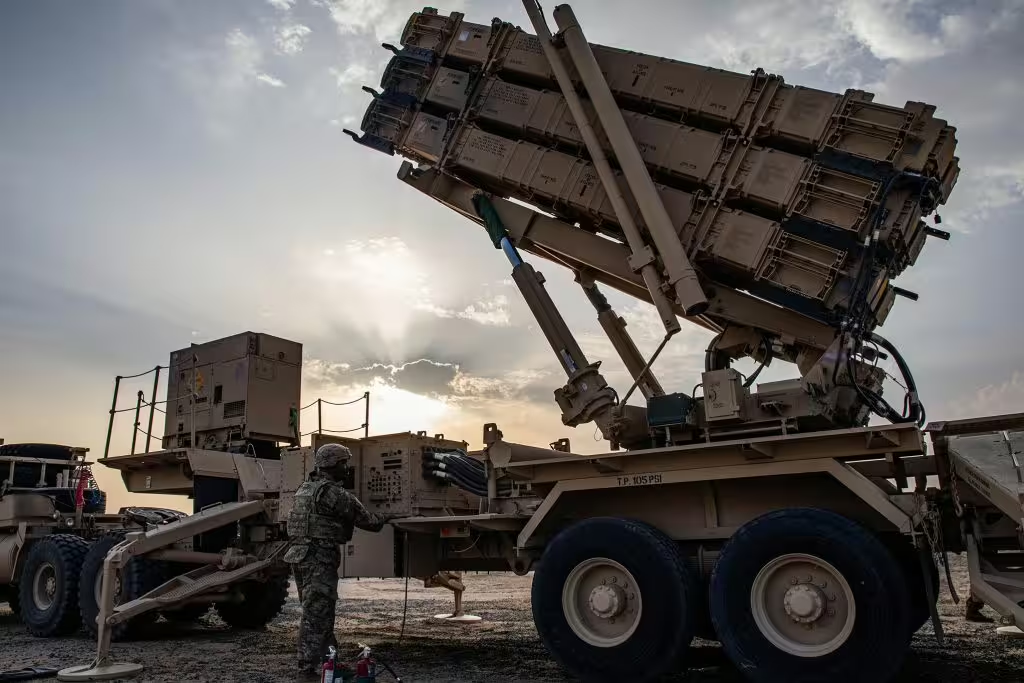
- Patriot stockpiles: CBS News reported that senior U.S. officials warned the military cannot sustain its current pace of Patriot and THAAD interceptor use indefinitely. Internal Pentagon estimates indicate that more than 1,200 Patriot missiles have been used during the war, with each costing more than $4 million.
- Military warning: According to the reports, Chairman of the Joint Chiefs of Staff Gen. Dan Caine warned in closed-door discussions that while the U.S. military could resume large-scale operations against Iran, doing so could significantly deplete interceptor missile inventories assigned to U.S. Central Command.
- Changing tactics: According to the Center for Strategic and International Studies (CSIS), the U.S. military has reduced its use of Tomahawk and JASSM cruise missiles in favor of shorter-range GPS-guided munitions. The report estimates that more than 1,000 Tomahawk missiles and roughly 1,100 JASSM missiles have been fired, and rebuilding those stockpiles could take about four years.
Background
For years, the United States has relied on large inventories of precision-guided munitions to support operations across the Middle East, Europe, and Asia. However, the wars in Ukraine, the Red Sea campaign, and the confrontation with Iran have sharply accelerated weapons consumption, prompting repeated Pentagon warnings about pressure on production capacity despite efforts by defense manufacturers to increase output.
Between the lines
The debate inside the Trump administration appears to be driven by more than political differences. It also reflects a growing recognition that the ability to replenish advanced munitions has become a strategic constraint, with industrial capacity increasingly shaping U.S. deterrence and military planning.
What to watch
Attention will now focus on whether Washington resumes military operations against Iran, seeks additional funding for missile procurement, or accelerates production of Patriot and Tomahawk systems in the coming months.