The latest
Matthew Gould, a former British ambassador to Israel and former deputy ambassador to Iran, argues that Western governments often interpret Tehran’s actions as messages directed at them, when the real motive may instead be an internal struggle for influence.
Drawing on his diplomatic experience in Tehran, Gould says Iran’s leadership is focused above all on preserving its hold on power. Decisions that appear irrational from the outside become more understandable when viewed as efforts to project strength and prevent rival factions from accusing the leadership of weakness or surrender.
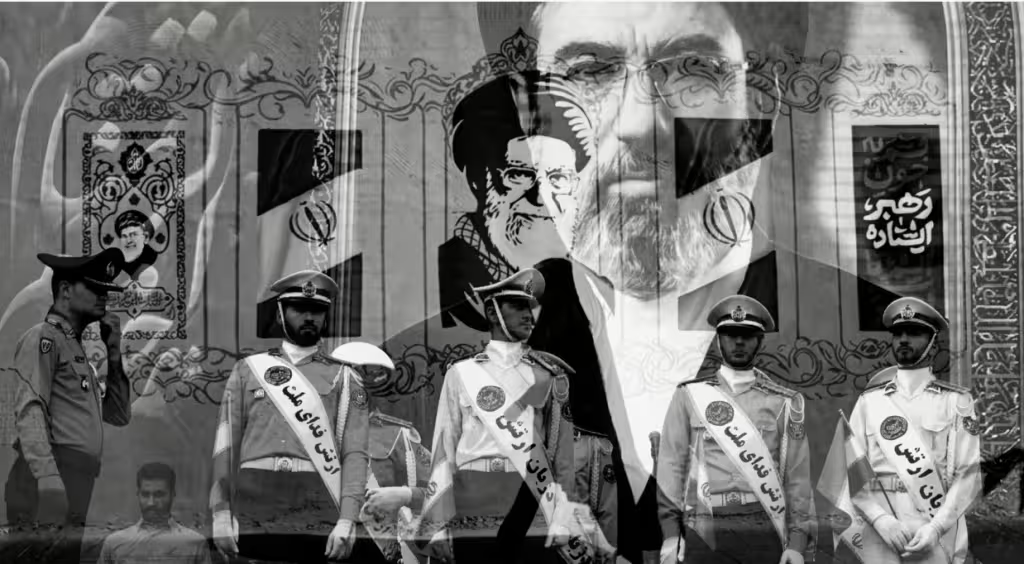
According to the article, the killing of Khamenei and other figures who acted as intermediaries between the Revolutionary Guard, clerics and politicians left the regime without a clear internal arbiter. As that balance weakened, competition among factions intensified and the Revolutionary Guard gained greater influence over Iran’s increasingly confrontational policy.
Details
- Power preservation: The author believes Iran’s leaders understand the depth of public hostility toward the regime and therefore place its survival above diplomatic or economic considerations.
- Horizontal escalation: Attacks on neighboring states and commercial shipping are used, the article argues, to build leverage without entering a full-scale direct confrontation.
- Internal rivalry: Iran’s system is not a single bloc. Informal power networks constantly shift and compete for legitimacy and resources.
- Loss of an arbiter: Khamenei’s death removed the figure who balanced conservatives and reformists and managed disputes within the regime.
- Revolutionary Guard influence: The resulting disorder strengthened the Guard, despite divisions within its ranks, and empowered more hard-line factions.
Between the lines
The analysis shifts the focus from Iran’s relationship with Washington to the regime’s internal structure. Rejecting an agreement or launching an attack may serve as a message to rival Iranian factions as much as a response to external pressure. That makes Tehran’s signals harder to read, since public actions may conceal messages aimed at the leadership’s internal audience.
What to watch
The author argues that effective U.S. and allied policy requires understanding Iran’s internal power balance before calibrating threats, strikes and incentives. The Revolutionary Guard’s ability to unify competing centers of power—or deepen their divisions—will remain a key factor in determining the course of escalation and negotiations.