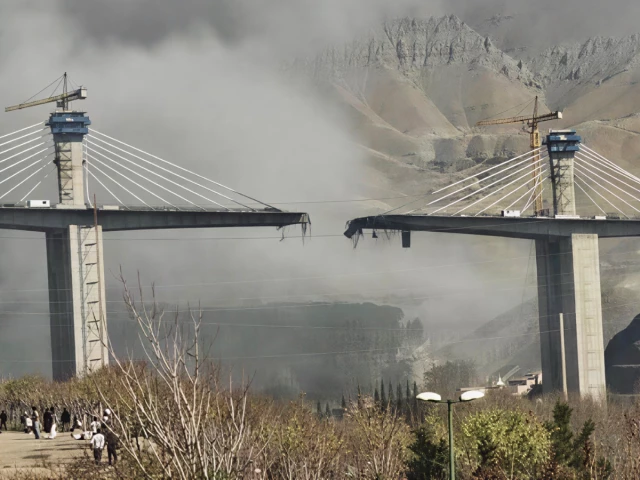
The Stone Age chapter that Trump has been threatening appears to have opened with a heavy symbolic step: Bridge B1.
After his White House address early this morning, in which he repeated that the war was nearing its end while also pledging to keep striking Iran hard over the next two to three weeks, he returned with a new post saying that the biggest bridge in Iran had collapsed and would never be used again, adding that much more would follow if Tehran did not make a deal before it was too late.
The strike Trump referred to hit Bridge B1 in Karaj, on the route linking Tehran to the west. Press reports said the bridge was hit by at least two strikes, with Iranian media reporting that two people were killed in the first strike and others were wounded, followed by a second strike while emergency crews were at the scene. Western reports also cited a senior U.S. official as saying that the goal was to cut a supply route used to move ballistic missile parts and drones into western Iran.
Detail
The American narrative had focused on destroying missiles, facilities, and military sites. Here, however, the target was a major bridge that can be justified militarily as a logistical corridor, but that is also part of the country’s public transport infrastructure. That is why the strike appeared, in American and Western coverage, to mark the first clear move toward hitting civilian or dual-use infrastructure after Trump’s public threat to send Iran back to the Stone Age. Axios described the operation as a strike on civilian infrastructure for the first time in this context, while The Wall Street Journal said the two strikes were aimed at disrupting military resupply inside the country.
This development comes amid reports of simultaneous or closely timed strikes inside Iran. The Associated Press and other monitoring outlets spoke of continued strikes on civilian and service infrastructure, while open reports pointed to explosions and attacks in multiple cities and locations such as Karaj, Isfahan, Ahvaz, Shiraz, and Bandar Abbas during this phase of the war. Economic pressure is also increasing as some major industrial facilities are paralyzed or damaged, with oil rising again and markets falling after Trump’s speech.
Tehran, however, has not given the impression that it is heading toward a rapid collapse. Iran’s army chief, Amir Hatami, was reported to have instructed field commanders to monitor enemy movements with the utmost caution and remain ready for any attack, while Iran continues to launch missiles and attacks across the region despite Trump’s claim that the Iranian threat is now nearly over. Washington is escalating and presenting images of collapsed bridges as proof of progress, but the battlefield reality still suggests that the war remains open to other outcomes.
What next?
If Bridge B1 is the first page in the Stone Age record, the next question is whether it will be followed by a second page targeting electricity, water, transport, and industry on a broader scale. Trump himself said what happened was not the end but the beginning, and the speech that came before it set out a short timeline backed by a heavy threat. The coming days therefore look like a test of whether Washington will use the bridge merely as a message of negotiating pressure, or as the start of a broader expansion of its target bank from explicit military facilities to the infrastructure on which the state itself depends to function.
Sources: Reuters, Associated Press, The Wall Street Journal, Axios, open-source monitoring reports.