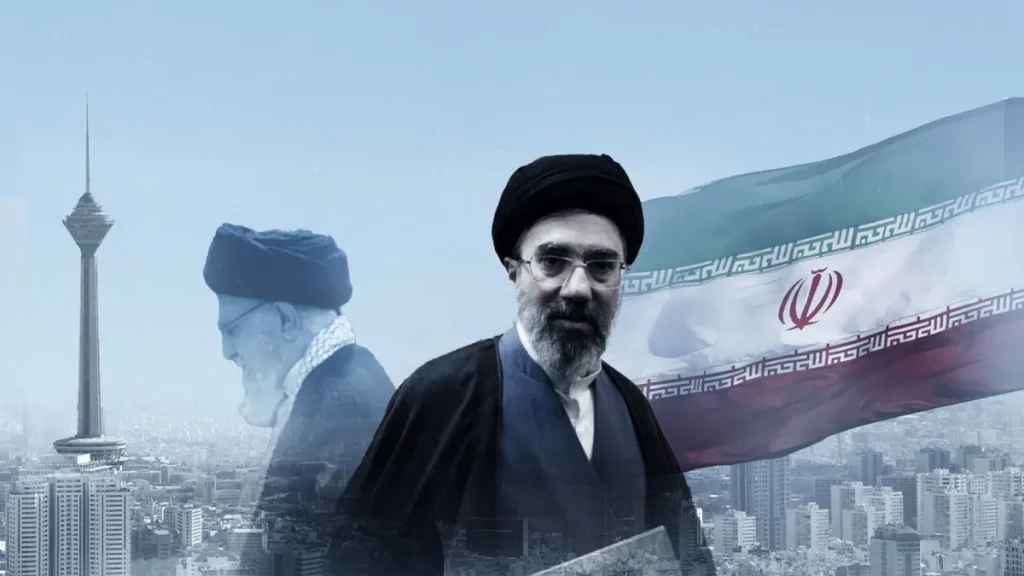
Iranian state media announced that Mojtaba Khamenei, the son of the late Supreme Leader Ali Khamenei, has become Iran’s new Supreme Leader following a decision by the Assembly of Experts, at the height of the war with the United States and Israel. Reuters said the appointment reflects backing from influential circles inside the military and political establishment, while the Associated Press noted that the decision came despite the sensitivity of hereditary succession inside a system that theoretically rejects it.
Detail
• Mojtaba is 56 years old, a mid-ranking cleric who has never held a major formal government post, but over the years he has built close ties with the IRGC and with influential religious and security circles.
• Reuters described his selection as the result of a long rise within the hardline camp, not a complete surprise imposed by war alone. His name had been discussed for years as a possible successor, but Ali Khamenei’s killing accelerated the final decision.
• Politically, the decision sends a message of continuity. The establishment chose a familiar name from within the regime’s hardline inner circle, not a transitional figure who could be marketed as a compromise.
• Externally, the problem is that Trump had already attacked this option in advance. According to Axios, and as later carried by Bloomberg, The National and PBS, he said Khamenei’s son was unacceptable to him and that Iran needs someone who can bring harmony and peace.
What next?
The most likely result of this choice is 3 immediate effects:
1. Domestically, greater reliance on the IRGC to manage both the succession moment and the war at the same time.
2. Externally, greater difficulty in presenting any quick negotiation with Washington as the start of a new chapter, because in the West he is seen as an extension of his father’s line rather than a break from it.
3. In propaganda terms, the regime will try to present the choice as continuity of the state, while its opponents will present it as political inheritance wrapped in religious cover. This is an analytical reading based on the nature and context of the decision, not an official description from either side.
(Analysis)
With Iran under fire, the system did not move toward a candidate who could soften the shock or open a political window. It moved toward a figure who is quickly understood as a continuation of the regime’s hardest core. That suggests the logic in Tehran right now is this: cohesion before flexibility, control before openness.
Mojtaba’s selection also says something else: the establishment does not want a vacuum at the top, nor a transitional experiment that could be read as weakness in wartime. That is why the decision looked more like fortifying the summit than redefining it.
But this choice carries a significant cost. The more he appears to be a familial and security extension of his father, the harder it becomes to convince both domestic and foreign audiences that Iran has entered a new phase.
That is why Trump’s earlier remarks matter. He did not reject the name alone. He rejected what the name represent