The US military posture in the region points to a shift from deterrence by presence to an expanded menu of executable options.
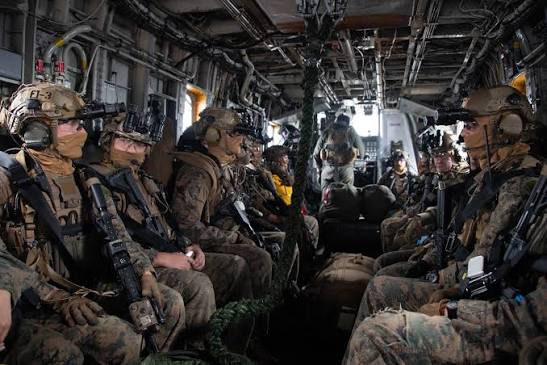
The United States is no longer relying only on conventional air cover. It has started injecting fresh capability through Marine forces and amphibious units. This move is widely seen as preparation for a phase that could require a foothold on the ground at carefully selected points.
Detail
The operational picture suggests the force now rests on three integrated layers:
• The standing mass: roughly 50,000 troops under US Central Command, backed by strategic bombers, stealth fighters, and missile defence systems including THAAD and Patriot.
• The rapid intervention force: the arrival of USS Boxer with its amphibious element and around 2,500 Marines, a force designed specifically for crisis response and limited operations.
• Air-sea integration: the addition of a Marine Expeditionary Unit equipped with F-35B jets and MV-22 aircraft, giving Washington a sustained sea-based air-to-ground capability.
What this diversified combat structure means is that Washington now holds a military scalpel capable of reaching coastlines and islands with high efficiency.
MEUs are built for fast secure-and-strike missions. They can seize a critical facility or secure a maritime corridor within hours.
What next?
The most dangerous and most realistic scenario here is a move into a war over critical points.
The likely use of these forces could focus on:
• a shock landing or temporary positioning on Kharg Island to cripple export or surveillance capability
• control of vital coastal points linked to navigation security in the Strait of Hormuz
• enforced safe passage through direct military protection if tankers come under physical threat
If the reinforcements remain limited to Marine units, the picture is one of targeted surgery. But if orders are issued to move armoured brigades or full airborne units, that would mark the major shift toward a much broader ground theatre.