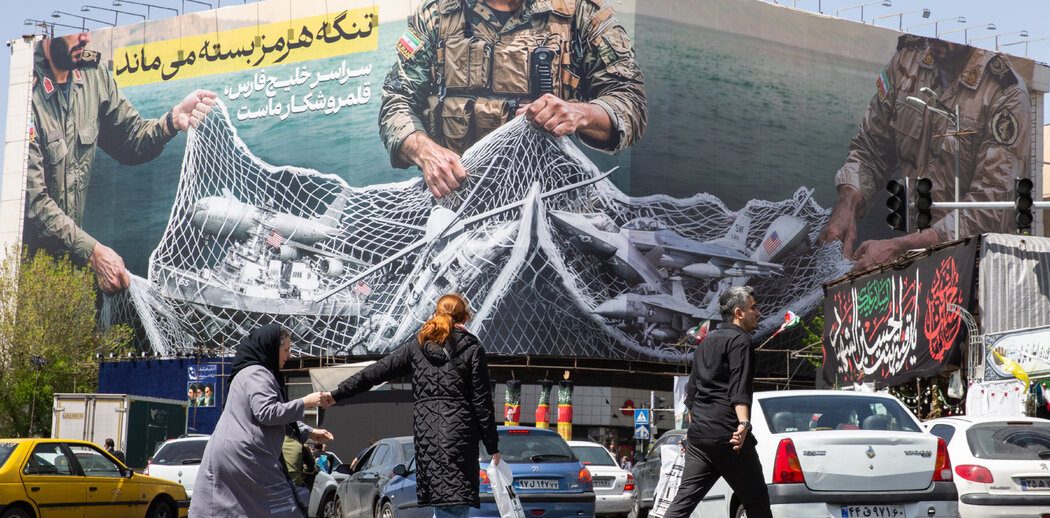
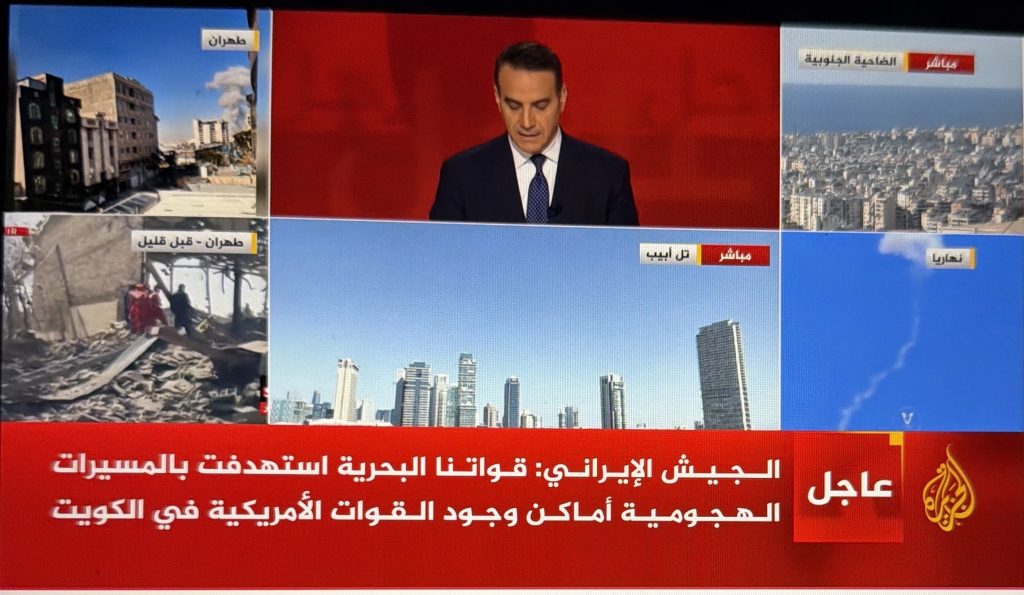
During Al Jazeera’s live coverage, an urgent ticker appeared carrying an Iranian statement claiming that Iranian naval forces had targeted locations of U.S. forces in Kuwait with attack drones. The phrasing, as displayed, read closer to amplifying an IRGC narrative than presenting a neutral update with the necessary context, competing accounts, and implications for Gulf security, including Qatar itself.
⸻
Detail
1) What was said on screen — and why it matters
The ticker presented the Iranian claim in a direct, report-like form, framing the attack as capability and effect rather than as a hostile act requiring immediate verification and a counter-statement. Neutrality does not begin with guests or airtime; it begins with the smallest editorial unit: the breaking ticker. When a belligerent’s claim is treated as a near-complete fact, language itself becomes an actor.
2) Where neutrality collapses: in the sentence itself
The baseline professional standard in wartime is straightforward:
• Describe the information as a claim from a party to the conflict.
• Seek or carry a response from the state concerned (Kuwait) or the U.S. side.
• Signal the level of certainty: confirmed independently or unverified.
• Add a single line of context: what does striking a third country’s territory mean for Gulf security?
When these elements are absent, the ticker becomes closer to “locking in a narrative” than “reporting a developing story.”
3) How wording turns into war propaganda
Propaganda does not need a long speech. A simple sequence is enough:
• A hostile claim is presented as an achievement.
• The natural question is removed: confirmed by whom, and what does Kuwait or Washington say?
• The audience absorbs the intended meaning: deterrence, capability, leverage.
When this runs on a major Arabic network, the effect shifts from reporting to shaping perception in favour of one side — even if alternative viewpoints appear later.
4) Where Qatar fits — and why the contradiction is obvious
As escalation spreads across the Gulf, Qatar is directly exposed by geography, regional security dynamics, and the U.S. military footprint. The contradiction is that a story affecting Gulf security is filtered through language that inflates the attacker’s narrative rather than placing Gulf risk and sovereignty at the centre.
5) Guests and analysts: cosmetic balance is not neutrality
Even when programmes are staged as debates, the direction is often set before discussion through three editorial choices:
• Guest selection: heavier weight for analysts who recycle the Iran-aligned frame, with weaker representation of Gulf legal/sovereignty voices that stress that striking a third country is a major escalation.
• Question design: questions that impose one interpretive frame, then argue within it, rather than testing the frame itself.
• Introductions and wrap-ups: even with multiple voices, the presenter’s framing and the programme’s on-screen headlines are what leave the final impression.
6) A practical test for editorial bias
Ask one question:
Could the network write the same ticker in the same tone if the attacker were Iran’s adversary?
If the answer is no, the problem is the wording and the frame — not the number of guests or hours of coverage.
(Analysis)
This example does not prove a total judgement on Al Jazeera across every file. But it exposes a consequential mechanism: neutrality collapses when breaking tickers are written like operational messaging for the attacking side. In wartime, wording is not a detail; it is part of the perception battlefield. When the mechanism repeats, the outlet becomes a producer of meaning, not merely a carrier of it.
Source