1News
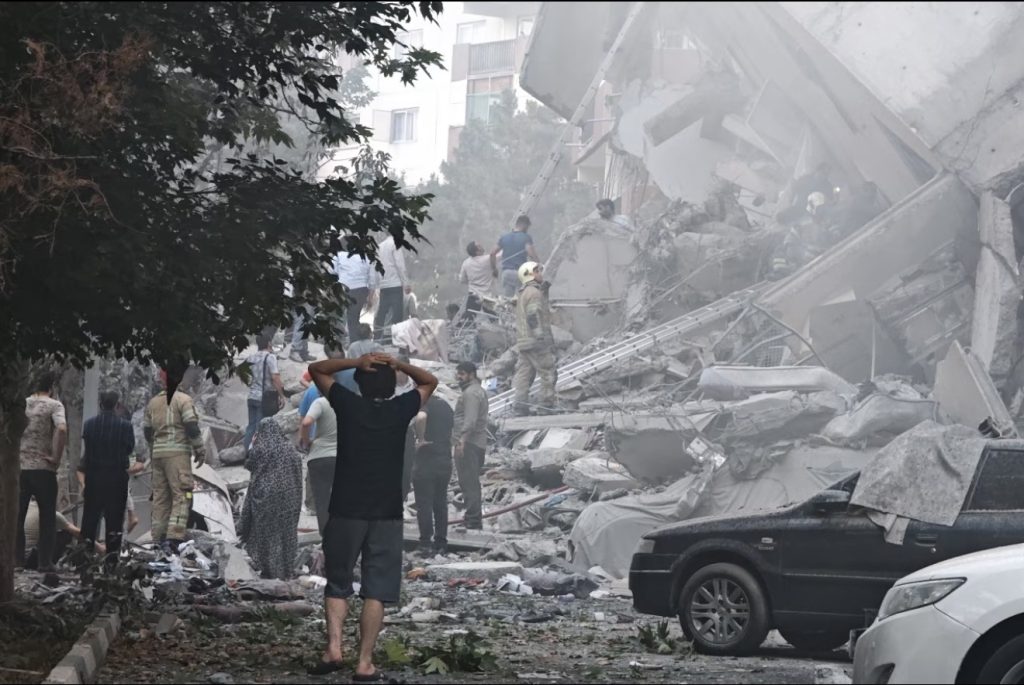
The war entered its seventh day with a sharper tempo over the Iranian capital itself. The Israeli military said more than 80 warplanes carried out overnight a broad wave of strikes on what it described as key military infrastructure of the Iranian regime in Tehran and central Iran. The targets included Imam Hossein University affiliated with the Revolutionary Guards, ballistic missile storage facilities, underground missile command infrastructure, and launch platforms in western and central Iran. In the Hebrew reading of the operation, additional reports said roughly 230 bombs were dropped on the designated targets.
What stands out is that the strikes are no longer being read merely as acts of deterrence, but as a systematic effort to erode Iran’s operational military structure inside Tehran. Persian opposition platforms described the seventh day as one of the harshest days of bombardment on the capital, with explosions continuing in western Tehran and severe disruption to communications and internet services, while Hebrew coverage focused on the fact that Israel is now striking deeper and more symbolic targets at the core of Iran’s military establishment.
Mehrabad Airport also emerged as an important indicator of the widening target bank. Cross-referenced reports pointed to strikes near the airport, while Persian reporting described major explosions in western Tehran as part of the same wave. This suggests not only a broader geographic spread inside the capital, but also Israel’s intent to demonstrate its ability to reach sensitive nodes within the city, some military and some adjacent to aviation and sovereign infrastructure.
Regionally, the war no longer appears confined to Tehran and Tel Aviv. Saudi Arabia raised its warning tone after intercepting new attacks, with Defence Minister Prince Khalid bin Salman saying Iran must avoid miscalculation after the Saudi defence ministry announced it had thwarted repeated missile launches at an airbase housing US personnel and intercepted drone attacks on a major oil field. This matters because the Gulf is no longer just a rear arena to the war, but has become a direct part of the pressure and deterrence equation.
This is where the real news mix comes into view: Israel is striking the centre of Iran’s military weight, while Iran is trying to shift the cost onto the Gulf and the wider regional economy. Reuters described the situation as an expanding Middle East crisis that has shaken markets and pushed oil prices higher, while The Wall Street Journal argued that Tehran had already prepared a more aggressive strategy based on widening the war across the region in the event of a major attack.
Under that reading, Iran is no longer relying only on a proportional and direct response against whoever attacks it, but on a broader model built around dispersing fronts, disrupting its adversaries and raising the political and economic cost for them. The Wall Street Journal referred to what it called a mosaic defence model, a decentralised approach that allows field commanders to keep fighting even if the top command is disrupted or communications are cut. This helps explain why the strikes on Iran are severe, yet Iran’s ability to create regional disruption has not fully collapsed.
(Analysis) The clearest meaning on day seven is that Israel appears to have moved into a phase of deepening attrition inside Tehran rather than merely deterring missile fire, while Iran is betting on something very different: survival, widening the geography of pain, and waiting for the moment of political fatigue in Washington and among its allies. If that reading is correct, this is not a war heading for a quick end, but one shifting from the shock of its opening phase into a test of endurance. This is an analytical inference drawn from the pattern of Israeli strikes, the expansion of Iranian attacks on the Gulf, and the Journal’s description of Iran’s strategic shift