News
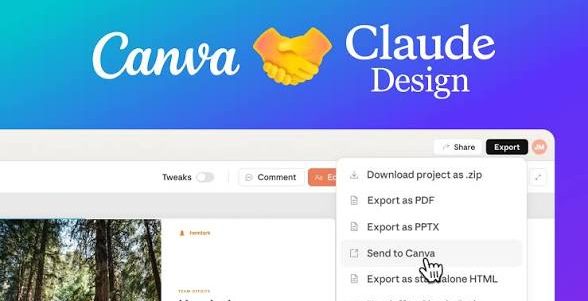
Canva and Anthropic announced a new step in their collaboration, centered on bringing Canva’s design engine and visual capabilities into the Claude Design experience launched by Anthropic.
The core idea is simple: the user starts a conversation with Claude to shape the idea or first draft, then turns the result directly into a fully editable design inside Canva, where they can continue editing, refine brand identity, collaborate with a team, and then publish or share the final output.
According to Canva, this new step makes the transition from an AI-generated idea to a final design much smoother. Anthropic, for its part, says Claude Design was built from the start to work with Claude on advanced visual outputs such as presentations, designs, prototypes, and one-pagers.
Direct impact
- Less reliance on starting from scratch when creating the first design draft.
- A faster and more direct shift from text conversation to an editable visual file.
- Teams can benefit from moving the work into Canva to apply brand identity and collaborative edits before publishing.
What next?
- Attention will now turn to how widely users adopt this new workflow for presentations and everyday visual materials.
- The market will also be watching whether this kind of integration pushes design tools and AI tools toward deeper practical convergence inside a single workflow. Based on recent official announcements, competition appears to be moving strongly toward linking generation with direct editing inside production tools.
(Analysis)
What matters most here is not just the announcement of a new technical feature, but a change in the starting point itself.
Previously, the user moved between a thinking tool and a design tool. Now, companies are trying to shrink that gap: the idea is generated inside the conversation, the visual draft emerges from that same context, and then it moves into the final editing space.
This does not mean the complete end of the “blank page,” because final quality still depends on taste, editing, brand identity, and the context of use. But it clearly means that the first draft is no longer the major obstacle it once was. This is an analytical conclusion based on the nature of the announced integration, not a literal description from the two companies.