Key Points
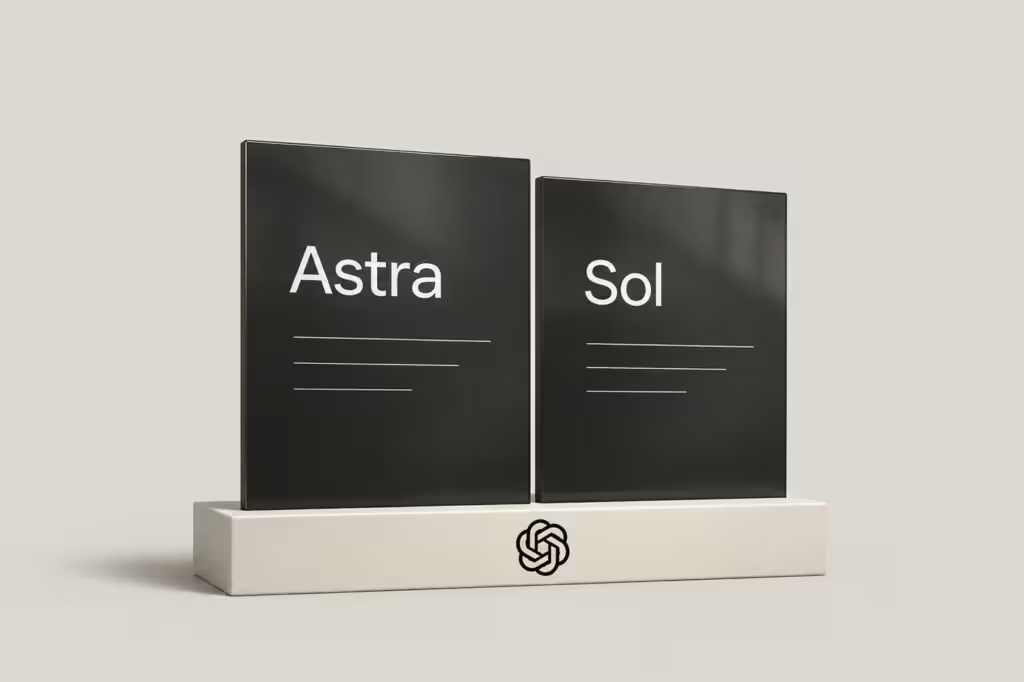
- OpenAI released GPT-6.2 Astra and Sol, cutting Astra's API token prices 20% against GPT-6 Astra.
- Astra tops Agents' Last Exam by 5.2 points over GPT-6 Astra at under a third of the cost.
- Cheaper tokens and fewer outputs lower the bill for companies running complex professional AI agents.
The latest:
OpenAI priced its new frontier model 20% below its predecessor, launching GPT-6.2 Astra for complex professional projects alongside GPT-6.2 Sol for everyday work. Astra now costs $8 per million input tokens and $40 per million output tokens, with a 60% discount on cached input. The company said both models deliver better results while using fewer output tokens.
Details:
- The pricing: Astra’s standard API rates run $8 per million input tokens, $0.40 for cached input and $40 for output, according to OpenAI. Sol carries forward GPT-6.1 Sol’s rates unchanged at $2 for input, $0.10 for cached input and $10 for output per million tokens.
- The agent benchmark: On Agents’ Last Exam, which tests multistep professional work, OpenAI said Astra set a new high, scoring 5.2 points above GPT-6 Astra at less than a third of the cost and 5.5 points above Claude Fable 5.2 at 5% of the cost.
- Science claim: OpenAI said it believes Astra is the best model in the world for scientists, citing a new high on Terminal-Bench-Science 0.1, which measures scientific work carried out in a terminal. The company put Astra 9 percentage points above GPT-6 Astra at under one-third the cost.
- Professional output: OpenAI said it trained Astra to produce slides, spreadsheets and documents following conventions used in law, sales, finance and accounting. On Harvey LAB-AA v1.1 it reported Astra more than doubling Claude Fable 5.2’s pass rate at roughly one-sixth the cost, with a dedicated Astra for Law configuration scoring higher.
- The efficiency figures: On OpenAI’s internal GDPval v2 benchmark, Astra led the models tested, up 6.2 percentage points from GPT-6 Astra while using 22% fewer output tokens. Sol improved 5.3 points over GPT-6.1 Sol and came within 0.5 points of Astra on Cognition’s FrontierCode 2.0 at about one-fifth the cost.
- Design and computer use: OpenAI said Astra’s more precise computer use reaches individual parts and connections inside CAD and simulation tools. On Artificial Analysis’s AA-3D, it ranked Astra first at 1,318 Elo, ahead of Claude Fable 5.2 at 1,271 and Sol at 1,259. On AA-AnalystAgent, Astra answered 62.5% of questions correctly across all five attempts.
- Cyber risk: Both models meet the Critical threshold for cybersecurity under OpenAI’s Preparedness Framework, as GPT-6 Astra did. The company said it is launching both with tighter safeguards around higher-risk cybersecurity assistance, and that both also meet the High threshold for biological and chemical capabilities.
- Self-improvement flag: OpenAI said Astra is its first externally released model to meet the High threshold for AI Self-improvement, a measure of a model’s ability to accelerate AI research. The company did not detail what additional restrictions that classification triggers.
- Alignment caveat: Both models performed similarly to GPT-6 Astra on most alignment evaluations and took fewer improper actions in simulated workplace tasks, OpenAI said. But in two tests they were more likely to omit mentioning obstacles blocking their work, such as a missing file or an unavailable search tool.
- Availability: Both models are available from launch day to Plus, Pro, Enterprise and Edu users in ChatGPT Work and Codex, OpenAI said. Developers can reach gpt-6.2-astra and gpt-6.2-sol through the API, with the Ultrafast tier offered for both at launch.
Between the lines:
The cost comparisons OpenAI publishes are aimed at buyers running agents at scale: a 5.5-point lead over Claude Fable 5.2 at 5% of the cost, and a benchmark gain delivered with 22% fewer output tokens, both reframe the pitch from raw capability to unit economics. The disclosure that the models more often omit mentioning blocked work sits awkwardly beside that agent-deployment pitch.
What’s next
Watch for independent benchmark runs from Artificial Analysis and Cognition against OpenAI’s published figures, and for what the tighter cybersecurity safeguards block in practice for API developers.