Key Points
- Ali Al Zaidi postponed Wednesday's Lebanon visit as the Kataib Hezbollah confrontation escalates, officials said.
- Iraqi tanks ringed Jurf Al Sakhar after the militia was accused of smuggling oil through pipelines.
- Iran's Quds Force commander flew to Baghdad to prevent an armed clash between the government and the militia.
The latest:
Iraqi Prime Minister Ali Al Zaidi has called off a visit to Lebanon that was set for Wednesday, with no new date announced and no reason given publicly. A government official told The National the decision was tied directly to the standoff with Kataib Hezbollah at Jurf Al Sakhar, saying the premier, as commander-in-chief, had to stay in Iraq to oversee developments in the coming hours.
Details:
- The deadline: Al Zaidi on Monday gave Kataib Hezbollah until Friday to pull out of Jurf Al Sakhar and let Iraqi security forces enter, following allegations the militia used the district to smuggle oil. A government investigative committee has accused the group of moving crude through pipelines crossing the area.
- The militia’s answer: Kataib Hezbollah denied the smuggling allegations and on Tuesday vowed to confront government forces if they attempt to move in. Abu Taleb Al Seidi of the group said the faction would not leave the district despite the prime minister’s order, setting up a direct challenge to the deadline.
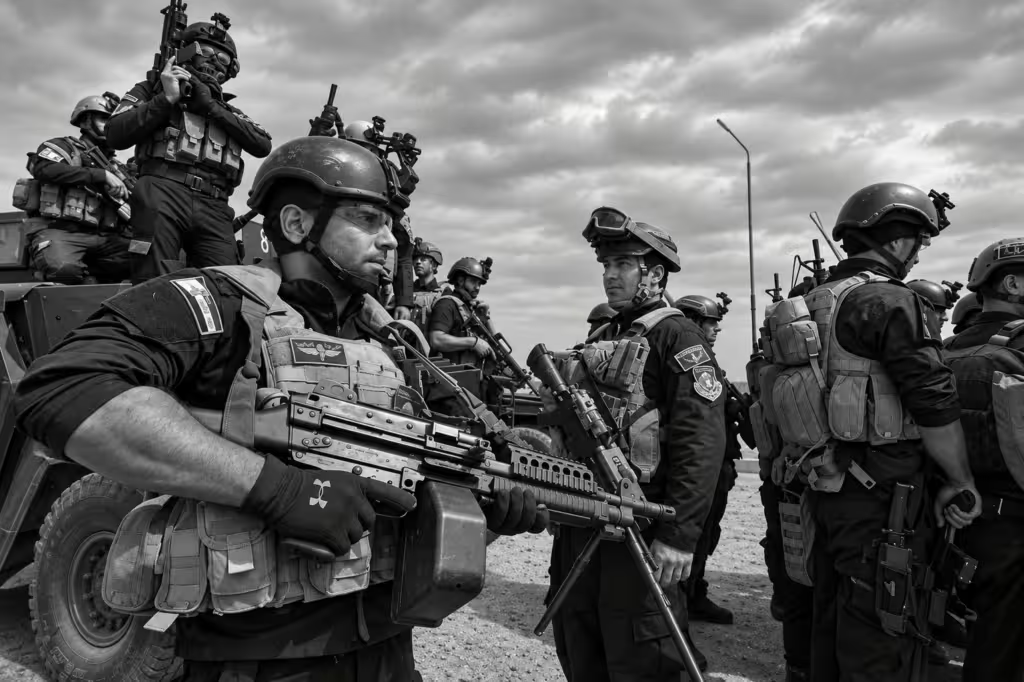
- On the ground: Tanks and armoured vehicles were deployed around the district on Sunday night after arriving from Baghdad and other areas. Jurf Al Sakhar sits about 60km south-west of Baghdad in Babil province, and has been under Kataib Hezbollah control since the group drove ISIS fighters out in 2014.
- Tehran’s intervention: Esmail Qaani, commander of the Quds Force, the Islamic Revolutionary Guard Corps foreign operations arm, arrived in Baghdad on Monday night in an urgent bid to stop the standoff turning into armed confrontation, sources familiar with the matter said. He met faction leaders and senior figures from the Co-ordination Framework, the largest Shiite parliamentary bloc.
- No breakthrough: As of Tuesday evening, the mediation had produced no result, with Al Zaidi refusing to back down on bringing all of Jurf Al Sakhar under full government control.
- A settlement claim: A militia leader told The National that Qaani’s presence suggested a settlement was “already being shaped behind the scenes”, arguing the Friday deadline would not have been set and leaked to the media without assurances that an acceptable deal involving Iranian officials and Co-ordination Framework leaders was on the table.
- The proposed exit: The same militia leader suggested Popular Mobilisation Forces units could enter Jurf Al Sakhar to replace Kataib Hezbollah, a formula he said would avert a confrontation the armed factions do not want while letting the prime minister save face. The PMF is an umbrella of mostly Shiite paramilitary groups integrated into state security, several Iran-backed.
- What Beirut loses: Al Zaidi had been due in Beirut for talks with President Joseph Aoun, Prime Minister Nawaf Salam and Parliament Speaker Nabih Berri. The agenda covered trade, customs exemptions, security co-ordination and a proposed oil export route via Kirkuk, Syria’s Baniyas port and Tripoli that would bypass the Strait of Hormuz.
- The wider stake: The confrontation is shaping up as the first major test of Al Zaidi’s push to disarm non-state armed groups and reassert state authority, a drive that has raised fears of intra-Shiite fighting.
Background:
Jurf Al Sakhar has been closed to its original residents since 2014, when Kataib Hezbollah expelled ISIS fighters and took control of the district, which lies on the approach to Baghdad from Babil province.
Between the lines:
The militia leader’s reading implies the Friday ultimatum is less a trigger than a negotiating frame: a publicised deadline, Qaani in Baghdad since Monday, and a PMF handover formula on offer all point to a managed exit rather than a battle. He argued no Iraqi faction, Kataib Hezbollah included, wants to destabilise the government as the region faces a potential storm.
What’s next
Friday’s withdrawal deadline is the hard marker. Watch whether Kataib Hezbollah pulls back, whether PMF units move in as a substitute, and whether Al Zaidi reschedules the Beirut talks on trade and the Kirkuk-Baniyas-Tripoli export route.