Key Points
- The Economist argues US lawmakers should refuse calls to outlaw Chinese distillation of American AI models.
- Anthropic and OpenAI ban the technique in their terms and have complained to Washington about Chinese rivals.
- The magazine contends distillation lowers prices, improves safety and keeps China dependent on American frontier labs.
The latest:
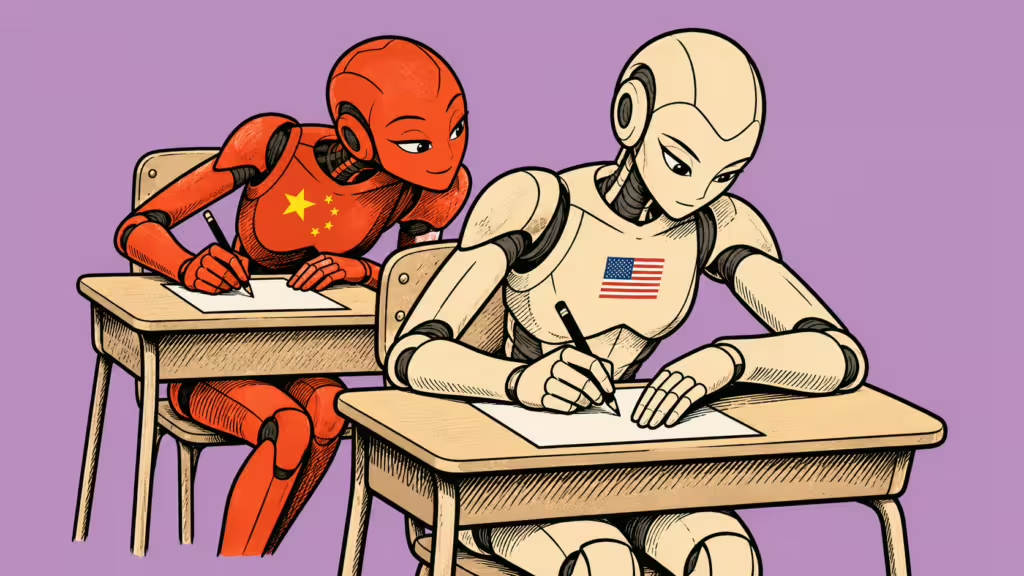
Banning the copying of American AI models would hurt consumers and weaken America’s own position, The Economist argued in a leader opposing Anthropic and OpenAI’s lobbying campaign in Washington. The magazine said distilled Chinese models deliver cheaper, more plentiful competition, and that China’s reliance on American output is a strategic asset the United States should preserve rather than close off.
Details:
- The technique: Distillation is described as a process in which weaker models learn by imitating the output of cleverer ones. The Economist said it explains how Chinese labs keep pace despite having fewer chips and less cash than their American rivals.
- The gap: Experts cited by the magazine put Chinese AI labs three to six months behind the American frontier. That proximity, it said, is what has rattled American labs and investors, even as the leading US firms continue to dominate the market.
- The labs’ demand: Anthropic and OpenAI forbid distillation in their terms of service and have both complained to the American government that Chinese rivals are stealing intellectual property. Anthropic wants penalties imposed, according to the leader.
- The bill: One proposal before the Senate would place sanctions on distillers, barring them from offering models in America and possibly beyond. The Economist did not name the bill’s sponsors or set out a timeline for a vote.
- The consumer case: Users gain when more and more capable models compete on price and performance, the magazine argued. It added that most distilled Chinese models are freely downloadable, forcing American labs to compete in poor countries as well.
- The strategic case: Copying leaves China dependent on American progress and ill prepared for an AI take-off in which models become self-improving, the leader said, potentially condemning it to permanent second place.
- The precedent: The Economist invoked the Soviet Union, which built chips from stolen American blueprints without overtaking its rival, as evidence that imitation does not guarantee catching up.
- The safety argument: Guardrails built into American models on risky subjects such as bioweapons already make Chinese models safer, the magazine said. It added that cutting off distillation would set China back only months, an option better saved for a crisis.
- The hypocrisy charge: Both firms built their empires on data scraped from the internet and defend that practice as fair use, the leader said. Outlawing distillation would leave Anthropic and OpenAI uniquely protected against their own data being used.
- The legal point: Machine-written output lacks a human author and so cannot be copyrighted, the magazine argued, meaning permitting distillation would not require overturning intellectual-property law.
Background:
The Economist framed the dispute as a revival of an older complaint in corporate America, where firms that moved assembly lines to China found imitators setting up next door. The two labs have raised hundreds of billions of dollars between them.
Between the lines:
The leader’s strongest move is to separate the labs’ commercial interest from the national one: because Anthropic and OpenAI dominate the market and have raised vast sums, it argues copying has not visibly deterred investment at the frontier. Its safety claim leans on the same dependence — if Chinese models inherit American guardrails on bioweapons, restricting US models restrains both sides at once.
What’s next
The Senate bill proposing sanctions on distillers is the concrete signal to track, along with whether Washington acts on Anthropic’s request for penalties against Chinese labs accused of copying American models.