Key Points
- Jordanian security forces seized three suspects in the Karak church attack after an armed standoff Monday.
- All three were wounded and arrested in an abandoned house; no security personnel were hurt.
- The arrests close the manhunt but open a government review of how young Jordanians were radicalized.
The latest:
All three men accused of carrying out the attack on a church in Karak governorate were captured at dawn Monday after they opened fire on security forces from an abandoned house and refused to surrender, Jordan’s Public Security Directorate announced. All three were wounded in the exchange. No members of the security force were injured, the directorate said.
Details:
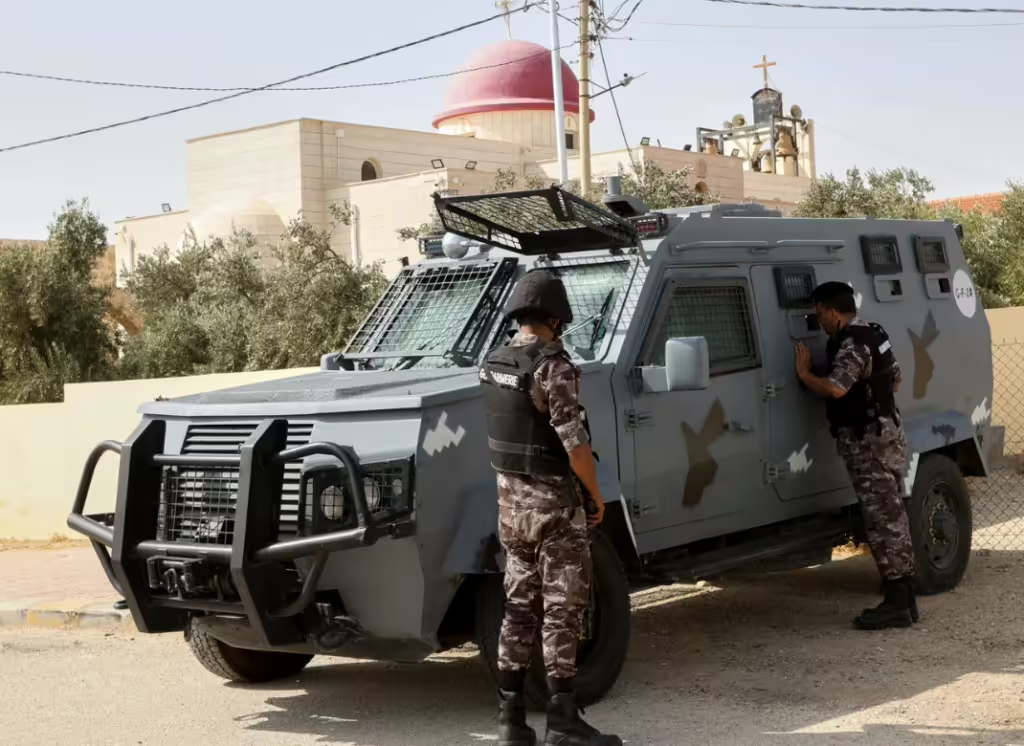
- The operation: The Public Security Directorate said in a statement carried by the state news agency Petra that specialized investigation and raid teams made the arrests after a joint operation, and that search and combing operations ran continuously from the moment of the crime until the suspects’ location was pinpointed before dawn Monday.
- The standoff: According to the directorate, the three fortified themselves inside an abandoned house in Karak governorate, refused to surrender and fired first at the approaching force. Rules of engagement were then applied until the site was secured and all three were taken into custody with gunshot wounds.
- The seizure: Firearms and ammunition were recovered when the location was searched, the directorate said. It did not specify the weapons’ type or origin, nor did it name the three men, state their ages or say whether they had been previously known to the security services.
- Interior minister: Mazen al-Faraya told Jordan’s Al-Mamlaka channel the attackers put up fierce resistance before being overpowered and arrested with severe injuries. He said the killers had been seized and described the country as engaged in a battle against extremism and terrorism.
- The review: In a post on X, al-Faraya said authorities are examining all the circumstances that led young men to extremism and will hold accountable anyone proven to have taken part, adding that the government intends to convert the tragedy into measures protecting citizens’ lives. He gave no timetable.
- Government message: Government Communication Minister Mohammad al-Momani wrote on X that Jordan is avenging the blood of its martyrs, and said the security agencies had made enormous efforts that ended in success.
- The funerals: Thousands of Jordanians buried the victims Sunday in the village of Hmoud in Karak. Public Security personnel carried the coffins, wrapped in Jordanian flags, on their shoulders at a ceremony attended by officials, with mourners stressing national unity in the face of terrorism.
- Prime minister: Jafar Hassan said during the funeral procession that all state agencies were working to capture those behind the Karak crime so they would receive the punishment their like deserve. The arrests were announced the following morning.
- The palace: King Abdullah II chaired a National Security Council meeting Saturday and received a security briefing on the attack, which targeted the Saint George Greek Orthodox church in Hmoud. He said there is no room for leniency where Jordanians’ lives are concerned, calling the assault a disgraceful act alien to Jordan.
Background:
The attack struck the Saint George Greek Orthodox church in the village of Hmoud, Karak governorate. The security statement did not detail the number of casualties or the victims’ identities, referring to those killed as martyrs buried Sunday.
Between the lines:
The official language has shifted in 48 hours from manhunt to accountability. The king’s National Security Council session, the prime minister’s funeral pledge and the interior minister’s promise to review how young men were radicalized point to a file extending past the three suspects — toward anyone proven to have taken part, in al-Faraya’s phrasing, and toward preventive measures the government has not yet defined.
What’s next
Watch for charges and the court venue for the three wounded suspects, any official account of their identities and affiliations, and whether the interior ministry’s promised review of radicalization produces named measures or further arrests.