Key Points
- Hanwha Systems destroyed three target drones with two laser weapons at Yangpyeong on October 14, 2026.
- The 20 kW Cheongwang Block-I entered service in December 2024; a 30 kW vehicle-mounted prototype joined it.
- Seoul is shifting from fixed point defense toward mobile, low-cost counter-drone systems against North Korean incursions.
The latest:
Two South Korean laser weapons destroyed three target drones during the Army’s TIGER+ Future Warfare Integrated Combat Exercise in Yangpyeong on October 14, 2026, watched by 500 attendees including Army Chief of Staff General Kim Gyu-ha. The demonstration, supervised by the Defense Acquisition Program Administration and the Korea Research Institute for Defense Technology Planning and Advancement, paired the in-service Cheongwang Block-I with a 30 kW vehicle-mounted prototype.
Details:
- The systems: Hanwha Systems fielded the operational Cheongwang Block-I, rated at 20 kW, alongside a 30 kW vehicle-mounted laser developed under KRIT supervision. The two weapons destroyed all three targets, one of which caught fire and fell. Individual interception results, engagement distances and target speeds were not disclosed.
- The wider exercise: The Yangpyeong drill combined laser engagements with electronic jamming and K21 infantry fighting vehicle gunfire, a layering that assigns jamming to targets with vulnerable communications or navigation links, lasers to suitable visible targets, and conventional weapons where laser engagement is restricted.
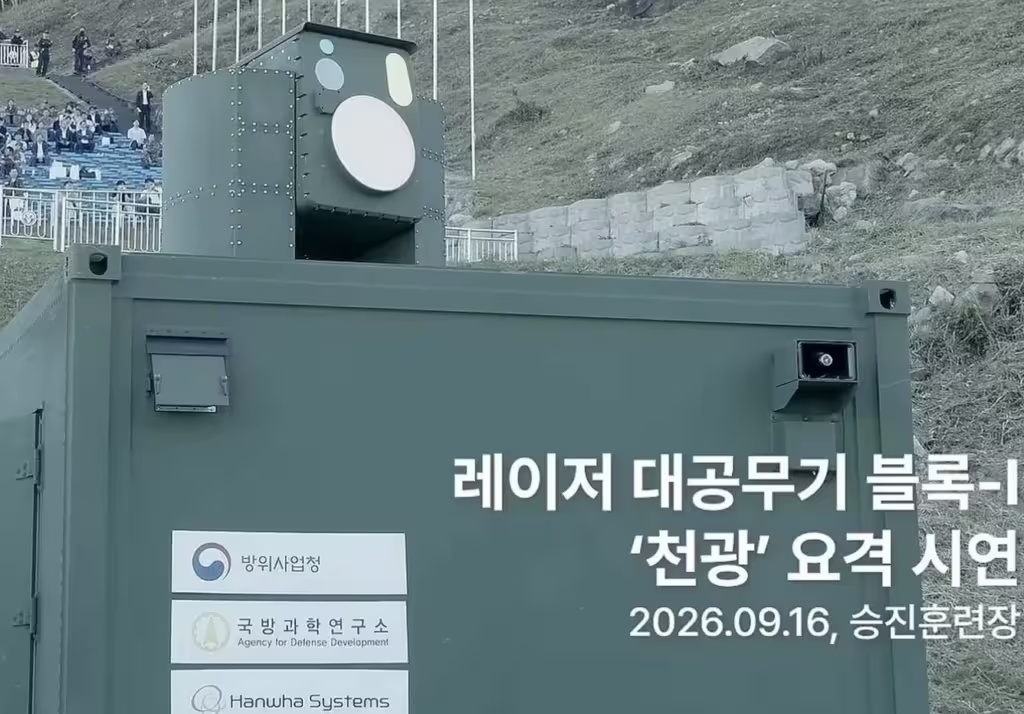
- The track record: September and October 2026 produced nine successful laser interceptions. On September 16 at the Seungjin training area in Pocheon, the Cheongwang consecutively destroyed four drones and two larger UAVs, which Hanwha Systems reported as a 100% interception rate at the Defense Drone Technology Exhibition.
- The origin: The Cheongwang began as a 2019 DAPA programme led by the Agency for Defense Development with Hanwha Systems. Trials ran through 2022-2023, a public interception followed on July 31, 2024, and the weapon entered service in December 2024, including deployment near government and defence facilities in Seoul’s Yongsan district.
- The driver: The programme’s principal purpose is point defence, addressing vulnerabilities exposed when five North Korean drones entered South Korean airspace on December 26, 2022, and South Korean aircraft failed to intercept them. Five installations were operational by June 2026, with ten more planned, including at the National Assembly.
- The upgrade: DAPA announced on June 1, 2026 that ADD and Hanwha Systems had developed a domestic laser oscillator replacing a German-origin component, improving output and other principal characteristics by more than 50%. Destructive exposure against rotary-wing FPV drones fell from 2-4 seconds to 1-2, and fixed-wing interception times from more than ten seconds to several.
- The limits: The 20 kW-class fiber laser engages small multicopters, FPV drones and fixed-wing UAVs at 2 to 3 km. A single beam director must irradiate separated targets sequentially, and fog, rain, dust and atmospheric turbulence all reduce beam effectiveness. Neither demonstration established target speeds, atmospheric conditions or interceptions per minute.
- The next weapon: Hanwha is separately developing a 50 kW laser integrated with the Tigon 8×8 armoured personnel carrier, shown at MSPO in Kielce, Poland, in September 2026. Prototype work is under way with serial production targeted for late 2027 and prospective customers in Europe, Asia and the Middle East, though no foreign orders are confirmed.
- The money: Seoul’s proposed 2027 defence budget allocates 73.28 trillion won, up 8.2%, including 8.06 trillion won for drone and counter-drone programmes, an 18.8% increase. High-power laser hard-kill research takes 121 billion won. Cheongwang development cost 87.1 billion won through April 2023, with localisation now reported at 90% by value.
- The cost pitch: Hanwha reports a firing expenditure of 2,000 won per shot, equivalent to $1.50 at the manufacturer’s quoted conversion rate, implying 2 million won for 1,000 firings. That figure excludes procurement, electricity, cooling, maintenance and personnel costs.
Background:
Five North Korean drones crossed into South Korean airspace in December 2022 and were not intercepted, exposing a gap in low-altitude defence. The Cheongwang programme, already running since 2019, became Seoul’s answer for protecting fixed government and military sites in the capital region.
Between the lines:
Nine interceptions across two demonstrations establish that the weapons work against single targets presented sequentially, not that they resist saturation. With engagement ranges of 2 to 3 km and one beam director per system, reaction windows against approaching drones are measured in tens of seconds, which is why the October drill paired lasers with jamming and K21 gunfire rather than testing them alone.
What’s next
Serial production of the Tigon-mounted 50 kW laser is targeted for late 2027. Watch the 2027 defence budget’s passage, the ten additional Cheongwang installations including the National Assembly site, and mobile Block-II development.