Key Points
- Bahri signed a $451 million contract for three very large crude carriers built in Saudi Arabia.
- Each vessel carries 320,000 deadweight tons, with deliveries staggered across 2029 and 2030.
- The order lifts Bahri's locally built orderbook to nine ships under Vision 2030 localization goals.
The latest:
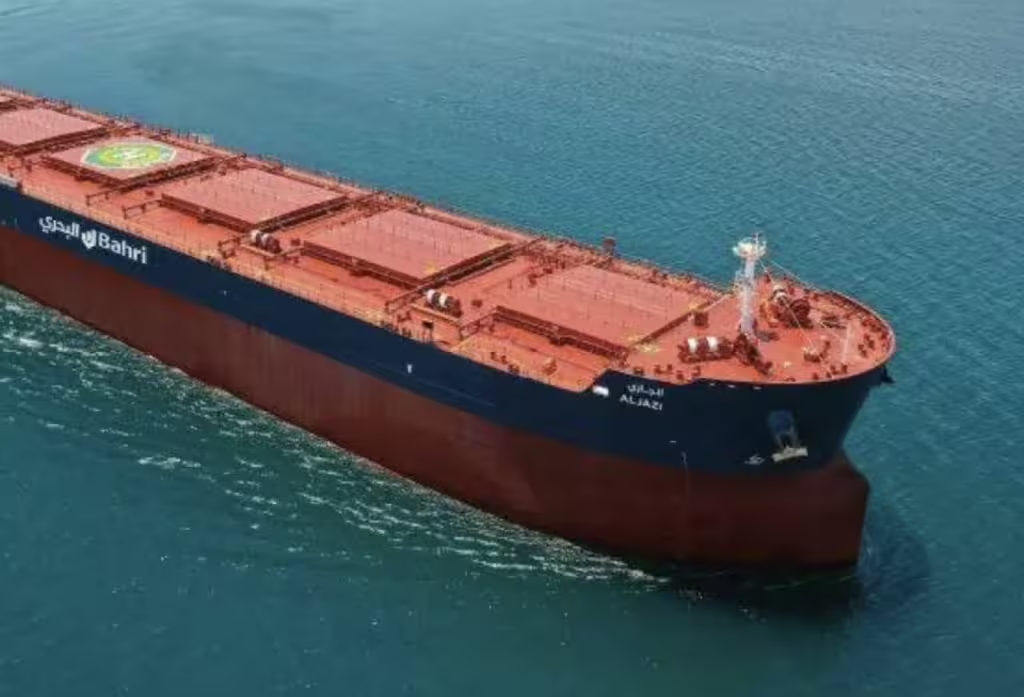
Saudi Arabia’s national shipping company, Bahri, has ordered three very large crude carriers from International Maritime Industries for roughly $451 million, or 1.692 billion riyals. Each tanker will carry 320,000 deadweight tons. The company said deliveries will arrive in batches during 2029 and 2030, with the contract running until the final vessel is handed over.
Details:
- The numbers: Bahri valued the contract at about $451 million, equivalent to 1.692 billion riyals, covering construction and delivery of three very large crude carriers. Each unit is rated at 320,000 deadweight tons, placing the vessels in the largest class of crude tankers operating in global oil trade routes.
- The disclosure: The announcement was filed through Tadawul, the Saudi stock exchange platform, as a market disclosure. Bahri said the financial impact of the agreement will only appear in its statements once the tankers are received and enter commercial operation, rather than at the signing stage.
- The timeline: The three carriers are scheduled for delivery in stages across 2029 and 2030. The company said the contract term expires with the handover of the final tanker, and did not publish a month-by-month delivery schedule for the individual vessels.
- The financing: Bahri said it will cover the cost of the contract through a mix of internal cash resources and bank facilities. The company did not break down how much of the $451 million will come from borrowing versus its own liquidity, nor did it name the lenders involved.
- The builder: The counterparty is International Maritime Industries, the shipyard operating in Saudi Arabia. Bahri holds a 19.9 percent stake in the yard’s capital, making the deal an order placed with a company in which the buyer is itself a significant shareholder.
- The overlap: Ahmed bin Ali Al-Subaey, Bahri board member and chief executive, also sits on the board of International Maritime Industries, according to the company’s own disclosure. Bahri did not detail any governance procedure applied to the related-party aspect of the contract.
- The orderbook: With this agreement, the number of vessels under construction in Saudi Arabia for Bahri rises to nine. The total comprises six bulk carriers and three very large crude carriers, consolidating the company’s newbuild program inside the kingdom rather than at foreign yards.
- The strategy: Bahri framed the order as part of a fleet modernization plan aimed at expanding long-term operating capacity and keeping pace with shifting demands in global energy and maritime shipping markets. The company set no target date for completing the wider modernization program.
- The policy link: The company tied the contract to national efforts to build a globally competitive maritime sector by localizing shipbuilding capability and the supply chains attached to it, describing the move as aligned with the targets of Saudi Vision 2030.
Between the lines:
The deal concentrates several roles in a narrow circle: Bahri is buyer, 19.9 percent shareholder in the yard, and shares a senior executive with the builder’s board. That structure helps explain how nine hulls ended up in Saudi yards rather than Asian ones, and it makes the localization target and the commercial order difficult to separate.
What’s next
Watch Bahri’s coming quarterly filings for financing terms and any related-party treatment, and the first scheduled 2029 handover as the test of whether the local yard meets its delivery window.