Key Points
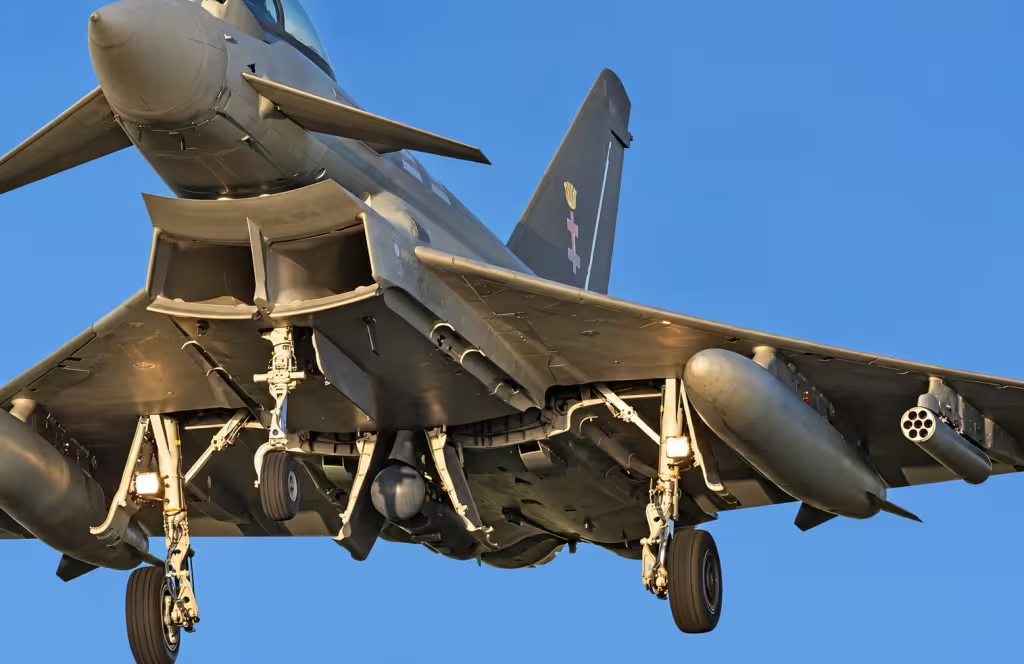
- Britain will deploy RAF Typhoon fighter jets to defend Saudi cities and critical infrastructure.
- London says the jets are strictly defensive and will not strike Houthi targets.
- The deployment deepens UK involvement after attacks forced Riyadh to postpone its flagship investment conference.
The latest:
Royal Air Force Typhoon fighter jets will be deployed to shield Saudi cities and critical infrastructure from Houthi missile and drone attacks, Britain’s Ministry of Defence announced Tuesday. Defence Secretary Wes Streeting said the intensifying campaign against the kingdom prompted London to approve the additional support. The ministry stressed the jets would operate in a defensive role only.
Details:
- The package: Alongside the Typhoons, the UK will send an Atlas A400M transport aircraft to move heavy equipment around the kingdom, plus British military advisers to support Saudi staff officers, according to the Ministry of Defence. Britain had already supplied air-defence equipment and advisers to help counter missile and drone attacks.
- The limits: The MoD said British fighter jets “will not conduct offensive strikes against the Houthis”, confining their mission to defence of Saudi airspace. The ministry did not set out how long the Typhoons would remain in the kingdom or where they would be based.
- The trigger: Streeting said the attacks on Saudi Arabia were absolutely despicable, singling out the strike on the airport in Riyadh as evidence of how far the Houthis were willing to go to escalate the situation across the region.
- The precedent: The deployment builds on Prime Minister Andy Burnham’s decision last month to send an RAF Voyager refuelling aircraft to Saudi Arabia for defensive air-to-air refuelling. Burnham played down the length of that mission, signalling it was for a limited period thought to be a matter of weeks.
- The domestic case: Burnham tied his approval of Riyadh’s request for British military support to his government’s push to control the cost of living at home and keep oil supplies flowing, framing the intervention as an economic question as much as a security one.
- The economic cost: Saudi Arabia was forced on Monday to postpone its flagship Davos in the Desert investment conference in Riyadh, due to begin next week, after Houthi attacks on the country’s airports. No new date for the gathering was announced.
- The latest strike: The Saudi coalition intercepted a ballistic missile launched by the Houthis towards Riyadh on Tuesday, military spokesman Major General Turki al-Maliki said. The Houthis struck King Khalid International Airport in the capital earlier this month.
- Who reported it: Bloomberg first reported the expansion of Britain’s involvement in the conflict on Tuesday, ahead of the Ministry of Defence announcement.
Background:
The Houthis, described by Britain as a militant group backed from within Yemen, have intensified missile and drone attacks on Saudi territory in recent weeks, striking airports and critical infrastructure deep inside the kingdom, including in the capital.
Between the lines:
The defensive-only caveat is doing heavy lifting. London is committing combat aircraft to an active conflict while insisting it is not a combatant, a distinction that protects Burnham from charges of entering a war he has justified at home on cost-of-living and oil-supply grounds rather than security ones. The postponed Riyadh conference shows the attacks are already imposing economic costs the deployment is meant to contain.
What’s next
Watch for a rescheduled date for the Riyadh investment conference, confirmation of how long the Typhoons and the earlier Voyager aircraft will remain deployed, and whether further Houthi missiles reach the Saudi capital.