Key Points
- The American University of Sharjah signed a UNESCO deal creating a chair on Arabic, AI and digital heritage.
- UNESCO said Arabic is used daily by more than 500 million people worldwide.
- The chair will digitize endangered Arabic dialects and build open-access research tools regionally.
The latest:
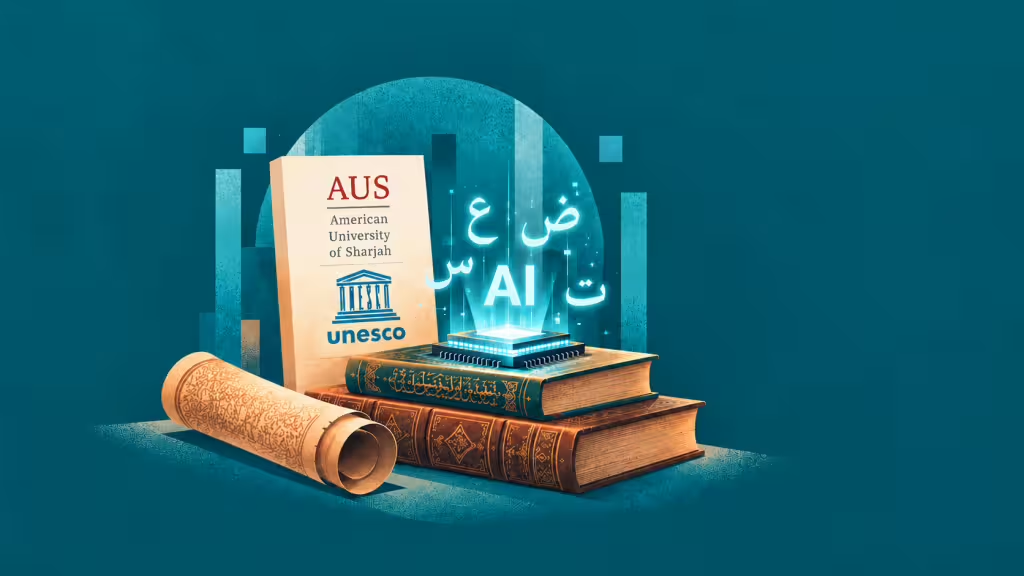
The American University of Sharjah has signed an agreement with UNESCO to establish a chair in Arabic Language, Artificial Intelligence and Digital Heritage, making it the only institution worldwide hosting a chair of this kind, state news agency WAM reported. The agreement was concluded under the patronage of Sheikha Bodour bint Sultan Al Qasimi, the university’s president and chair of its board of trustees.
Details:
- The mandate: The chair is tasked with preserving cultural heritage through advanced technical solutions that widen access to the Arabic language and Arab heritage, strengthen scientific research, develop skills and deepen community participation, according to WAM.
- Endangered dialects: Among its stated objectives is collecting, digitizing and organizing heritage materials, including Arabic dialects at risk of disappearing, relying on innovative digital tools and multilingual metadata standards. No timeline was announced for that work.
- The university’s case: Tod Laursen, chancellor of the American University of Sharjah, said Arabic carries the memory of an entire region through its ideas, poetry and everyday voices. He added that when archives stay offline and dialects remain undocumented, heritage becomes harder to reach and more likely to be lost.
- Research design: Laursen said the chair combines rigorous Arabic-language scholarship, responsible use of artificial intelligence and digital humanities to preserve and organize Arab cultural and linguistic heritage, while training specialists capable of continuing the work in future.
- UNESCO’s framing: Irakli Khodeli, head of social transformations management and foresight at UNESCO’s science sector, said language plays a central role in how technology reshapes societies, particularly with the rapid spread of large language models.
- The scale figure: Khodeli said Arabic, used daily by more than 500 million people, must both contribute fully to these transformations and benefit from them. He linked the new chair to UNESCO’s Prince Sultan bin Abdulaziz Al Saud programme for supporting the Arabic language.
- Training platform: The chair will build regional capacity through a training platform offering workshops, certificate programmes and opportunities for early-career researchers, media professionals and cultural-sector workers to develop skills and exchange research. Participating institutions were not named.
- Cross-region reach: Plans include open, accessible digital projects with institutions in Arab states, Africa and the Asia-Pacific region in cooperation with UNESCO networks, plus youth and community involvement in digital storytelling and heritage preservation initiatives.
- Institutional base: The chair draws on the university’s existing work in Arabic and cultural studies, aligning with its Center for Arab and Islamic Civilization Studies and its Department of Arabic Language Studies and Translation, which covers Arabic linguistics, literature, Islamic studies, translation and interpreting.
Background:
UNESCO chairs are hosted at universities worldwide under the organization’s university twinning programme, linking institutions on shared research and training agendas. The Sharjah chair will work with other UNESCO chairs and those networks on related programmes and activities.
Between the lines:
The pairing of endangered dialect documentation with large language models points to a gap both sides named: Arabic is spoken daily by more than 500 million people, yet much of its archival and spoken record sits outside the digital space that trains those models. Positioning the chair as a producer of open-access resources suggests the aim is supplying usable data, not only preserving it.
What’s next
Watch for the launch of the chair’s training platform and the first named partner institutions in Arab states, Africa and Asia-Pacific, along with any announced timeline for the dialect digitization work.