
The latest:
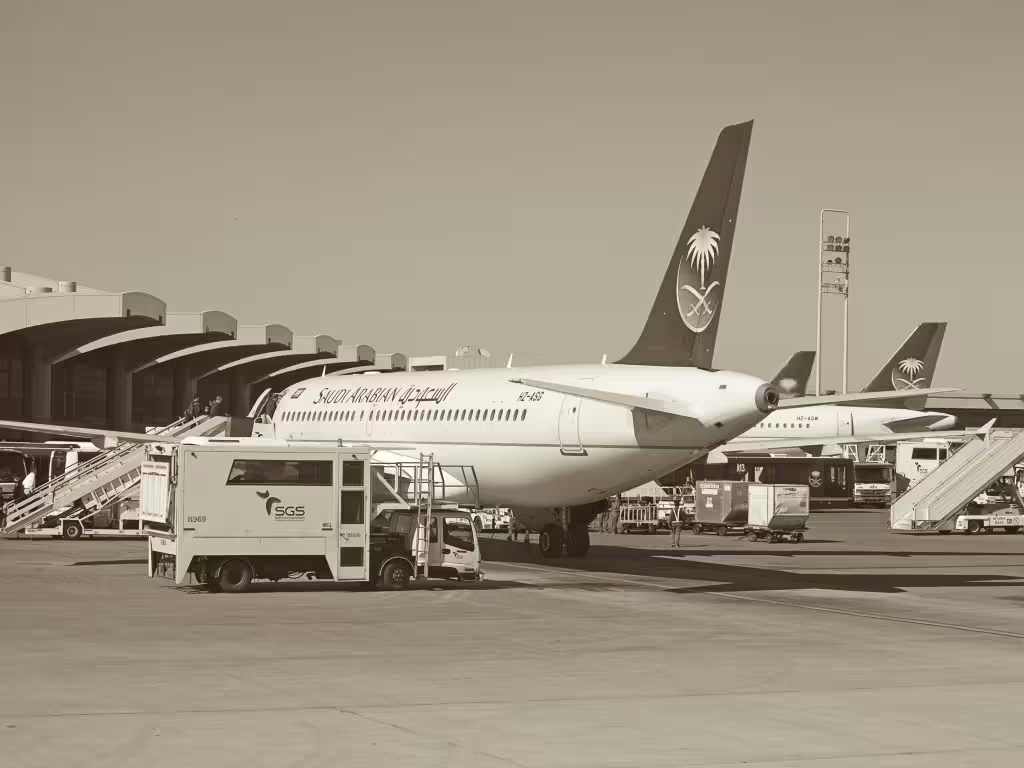
A powerful explosion was heard at King Khalid International Airport in Riyadh, and Saudi authorities began evacuating the facility, AFP reported, citing witnesses. Three witnesses told the agency people were being moved out while officials urged travellers to check flight status before heading there. Saudi Arabia’s government media office and the civil aviation authority did not immediately respond to requests for comment.
Details:
- The evacuation: Three witnesses told AFP people were being cleared from King Khalid International Airport after the blast. The airport issued a notice on Saturday telling passengers to contact airlines directly and verify flight status before travelling, without explaining the reason for the advisory.
- The casualties: Saudi Arabia’s General Authority of Civil Aviation said on Friday that three Saudi citizens were killed and several injured in two attacks on the airport on Thursday. Reuters reported the missile strikes this week left four dead and caused severe damage to a passenger aircraft.
- Houthi claim: The Houthis said on Thursday they struck the capital’s airport with two cruise missiles, and renewed threats against airlines flying to Saudi Arabia. The group declared Saudi airspace a military operations zone and told civilian aircraft to avoid it, after a Saudi-backed Yemeni government offensive earlier this month.
- The regulator: The European Union Aviation Safety Agency said on Friday it had widened the Saudi airspace it advises airlines to avoid, adding an area in the northwest. Updating a conflict-zone bulletin first issued on 30 September, it said the attacks showed Houthi capability and intent to hit deep inside the kingdom.
- The risk cited: EASA warned that repeated missile and drone attacks, combined with the activation of air defence systems, create a heightened risk of civil aircraft being misidentified, alongside hazards from missile and drone overflight, interception activity and falling debris.
- Industry warning: OPSGROUP, a membership body of roughly 10,000 aviation professionals that shares flight-risk information, issued a do-not-fly advisory on Friday. A note shared with Reuters said: “We now recommend avoiding operations in Saudi Arabia entirely, including the use of Saudi airports as en-route alternates.”
- Airlines pull out: Lufthansa suspended Riyadh flights until 16 October, while Etihad cancelled six Abu Dhabi–Riyadh flights on Friday and two more on Saturday, citing operational disruption. Flydubai cancelled flights to Riyadh and Yanbu through 10 October and to Abha through 11 October. Three Indian carriers also suspended services.
- The scale: King Khalid International is Saudi Arabia’s second-busiest airport after Jeddah, handling 296,800 flights in 2025 — roughly 813 a day — according to the kingdom’s General Authority for Statistics. Flightradar24 showed 131 Riyadh flights cancelled by 13:05 GMT on Friday, after hundreds the previous day.
- Conferences proceed: Organisers of the World Petroleum Congress, running Sunday to Thursday, told delegates by email it will go ahead with foreign leaders and ministers attending, pointing to alternative routes including a four-hour drive from Dammam. The Future Investment Initiative said it will proceed as planned from 26 to 29 October.
- Guest list strain: Italian Energy Minister Gilberto Pichetto Fratin said on Friday he will attend the International Energy Forum ministerial by video link instead of travelling. Britain, France and Germany have warned citizens to avoid Riyadh. Saudi Arabia struck Houthi missile launch sites in response, saying it intercepted numerous ballistic missiles.
Background:
Saudi Arabia has been hit dozens of times in recent weeks as its war with the Iran-backed Houthis in neighbouring Yemen escalates. Riyadh has continued hosting global events and courting foreign investment throughout, treating the conference calendar as a test of normalcy.
Between the lines:
The gap between official posture and operational reality is widening. FII’s chief executive Maha Al Saud said safety remains the top priority and promised comprehensive security at Riyadh airports, conference venues and hotels — at the same airport now being evacuated, under a do-not-fly advisory, with 131 flights cancelled in a single day. An airport handling 813 daily flights cannot absorb that disruption while delivering thousands of delegates.
What’s next
Watch whether the World Petroleum Congress opens on Sunday as scheduled, whether EASA widens its airspace warning further, and whether more carriers extend cancellations beyond Lufthansa’s 16 October suspension.