Key Points
- Apple is developing a MacBook Pro with an OLED touchscreen and a noticeably lighter chassis, Bloomberg reported.
- macOS is being rewritten to accept touch input, ending Apple's long separation between Mac and iPad interaction.
- A new iPad mini with Apple's first OLED screen is expected between late October and November.
The latest:
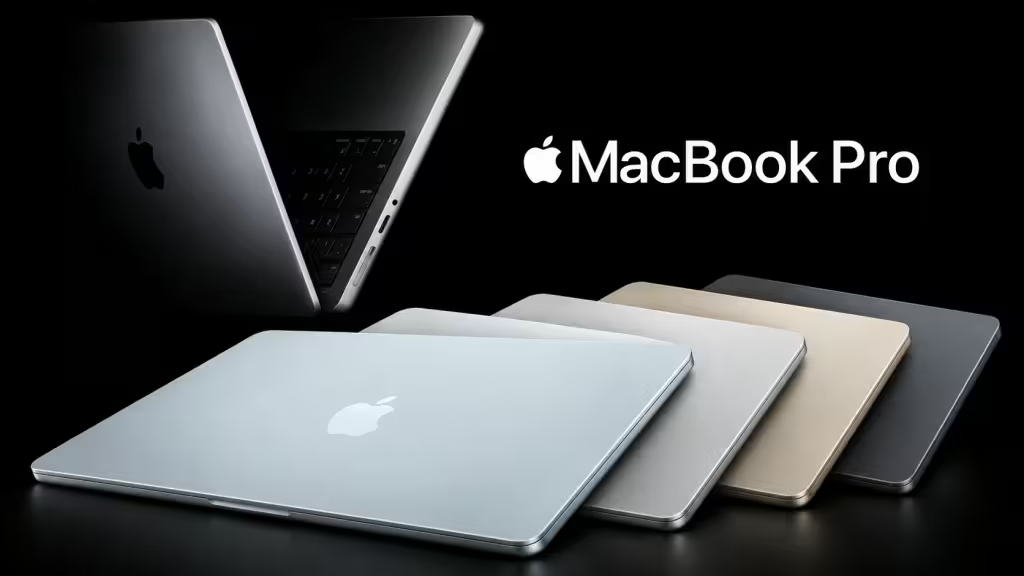
Apple has re-engineered the internals of its next MacBook Pro to cut weight significantly and is fitting it with an OLED panel that responds to touch, Bloomberg reported. The machine keeps its keyboard and trackpad, with the display added as a second input method. Apple is developing the laptop under the internal codenames K114 and K116.
Details:
- The weight change: Bloomberg reported Apple shrank and rearranged internal components inside the chassis, allowing a marked reduction in weight. The final figure has not been disclosed. The cut would matter most on the 16-inch model, which currently weighs about 4.8 pounds, or roughly 2.18 kilograms, against about 3.3 pounds for the 15-inch MacBook Air.
- The display: The shift to OLED is among the most significant changes in the new generation. The technology delivers higher contrast and deeper blacks than the panels currently used in MacBook Pro, because each pixel emits light independently rather than relying on a uniform backlight.
- The software work: According to Bloomberg, a macOS build referred to as Golden Gate carries changes built specifically for touch input, and Apple is testing the new MacBook Pro machines on macOS 27.2. The interface was historically designed around a cursor driven by a mouse or trackpad.
- The hinge: Bloomberg previously reported Apple is working on stronger display hinges to absorb the pressure of a user pressing the screen and to limit wobble during use — a mechanical problem that does not arise on a laptop operated only by trackpad.
- Not a hybrid: Apple is not turning the MacBook Pro into a convertible laptop-tablet device, and is not removing conventional controls. The keyboard and trackpad stay in place, with the screen serving as an additional way to interact with apps and the system.
- The camera housing: Apple is also redesigning the top of the MacBook Pro display, dropping the notch used in current generations in favor of a Dynamic Island layout. Whether the Mac version offers the same interactive functions as on iPhone has not been established.
- The iPad mini: Bloomberg expects the new iPad mini between late October and November, with the move from LCD to OLED the headline change for the smaller tablet. Apple began expanding OLED across its tablet line with the iPad Pro before extending it to the mini.
- Other mini upgrades: The new iPad mini is also set to get a faster processor, and Apple intends to move the front-facing FaceTime camera to the horizontal edge, a better position for landscape use. The company has already adopted that change elsewhere in the iPad family.
Background:
Bloomberg first reported in January 2023, citing people familiar with the work, that Apple engineers were developing touchscreen Macs. The agency added details on the new MacBook Pro generation in October 2025. Apple unveiled the M5 MacBook Pro on 15 October 2025.
Between the lines:
The combination of a touch-ready macOS build and retained keyboard and trackpad suggests Apple is borrowing an iPad interaction method rather than merging the two platforms. The hinge reinforcement and the Dynamic Island redesign both indicate hardware and software changes are being planned together rather than bolted on late.
What’s next
The nearest trackable signal is the iPad mini launch window between late October and November. For the MacBook Pro, watch the macOS 27.2 test builds and any further detail on the K114 and K116 prototypes.