Key Points
- Washington is sending more than 7,000 sailors and 2,000 Marines toward the Middle East.
- Three carrier groups could overlap as Trump considers further strikes and diplomacy remains unresolved.
- The buildup expands US options while heightening risks to shipping, aviation and regional energy infrastructure.
The latest
The United States is moving roughly 9,000 additional troops toward the Middle East aboard the USS Theodore Roosevelt carrier strike group and USS Makin Island amphibious ready group, reinforcing its forces as President Donald Trump considers renewed strikes on Iran. The deployment, comprising more than 7,000 sailors and 2,000 Marines, could put three American aircraft carriers in the region by late October while diplomacy over the war and reopening the Strait of Hormuz remains unresolved.
Details
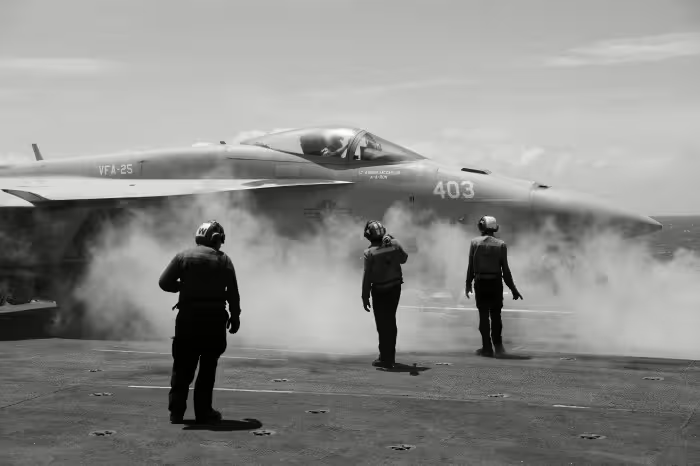
- Carrier overlap: The Theodore Roosevelt is joining the USS George H.W. Bush and USS George Washington in the broader Middle East. If all three groups overlap, the regional deployment would exceed 20,000 sailors and Marines and include hundreds of aircraft. The Navy previously operated three carrier groups there in April, its first such concentration since 2003.
- Deployment schedule: The Roosevelt left San Diego on September 27 for an expected extended deployment under US Central Command. It is ultimately expected to relieve the Japan-based George Washington, allowing Washington to sustain operations while rotating crews and ships.
- Operational scope: The added forces give Washington greater flexibility for air strikes, maritime protection, missile defense and possible operations around Hormuz. The buildup follows an unusually large naval presence maintained during operations against Iran.
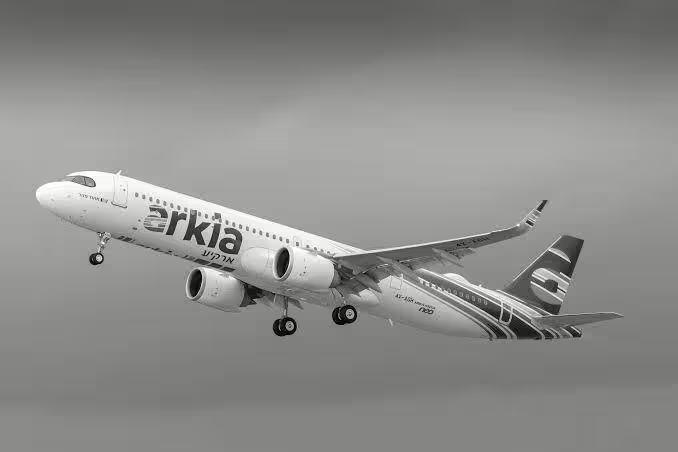
- Flight investigation: Investigators are examining an incident aboard a FlyDubai flight from the UAE to Israel carrying 182 people. The aircraft made an emergency landing in Saudi Arabia after the Omani co-pilot allegedly stabbed the Indian captain, with passengers and crew helping regain control during a rapid descent. Trump said an Iranian connection was possible, offered no evidence and said Tehran would be hit “very hard” if responsible. The investigation has not established an Iranian role; Saudi, Emirati, Israeli, Omani and US officials are examining terrorism and other possible motives.
- Hormuz pressure: Trump said Iran offered to reopen Hormuz in its latest proposal, but he rejected the broader terms as insufficient. Brent crude rose more than 4% on Thursday to settle above $102 a barrel as markets weighed renewed action and supply disruption.
- Regional exposure: For Gulf states, US forces strengthen deterrence around infrastructure and shipping. Renewed escalation could also increase threats to airspace, ports, energy facilities and commercial routes, while exposing Israel and the Gulf to attacks and disruption across aviation and shipping.
Background
Seven months into the war, the deployment underscores the shift from Trump’s initial expectation of a relatively short campaign. Iranian officials have confirmed receiving a US response to their latest proposal, while Washington maintains military operations and diplomatic channels.
What’s next
Late October will show whether the Theodore Roosevelt overlaps with the two carriers already operating in the region. Further decisions are expected after the November 3 midterm elections, alongside the multinational FlyDubai investigation and negotiations over Iran’s proposal to reopen Hormuz.