Key Points
- The US military deployed two additional Patriot batteries to protect Saudi oil and Qatari gas facilities.
- Trump said Thursday he is weighing resuming the campaign against Iran within weeks.
- Riyadh and Doha fear Iranian retaliation on energy infrastructure if large-scale fighting restarts.
The latest:
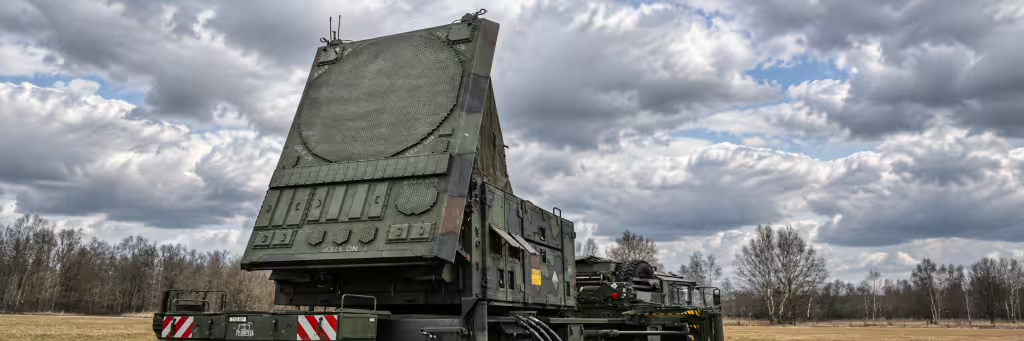
Two additional Patriot air defense batteries have been moved into Saudi Arabia and Qatar in recent weeks to shield oil and gas facilities, two senior US officials and a regional source told N12. The deployments are intended to reassure both allies that Washington will defend their energy infrastructure if President Donald Trump orders a resumption of large-scale operations against Iran.
Details:
- The deployments: The US military sent one Patriot battery to Saudi Arabia last month to protect a major oil facility, and a second to Qatar to cover a natural gas facility, according to two senior US officials and a source in the region. US Central Command spokesperson Captain Tim Hawkins declined to comment.
- Trump’s position: Trump said Thursday he was considering resuming the campaign against Iran in the coming weeks, framing the choice as Iran either signing an agreement or ceasing to exist. He did not set a date or describe what renewed operations would involve.
- The August turn: In early August, as Trump weighed an offensive that included strikes on Iranian energy infrastructure, the leaders of Saudi Arabia and Qatar pressed him against it, warning Tehran would retaliate against their installations. Senior US officials said those appeals were a major reason he shifted to economic pressure instead.
- The airspace problem: Washington would need Saudi permission to use the kingdom’s airspace if large-scale fighting resumed. Senior US officials assess Riyadh is unlikely to grant it while judging its oil facilities inadequately defended, making the Patriot deliveries a precondition for any renewed air campaign rather than a symbolic gesture.
- The carrier buildup: A senior US official said the USS Theodore Roosevelt and its strike group departed San Diego on Sunday, expected to reach the region around mid-November. It would join the USS George H.W. Bush, deployed since March, and the USS George Washington, sent from Japan over the summer.
- Firepower, with caveats: One senior US official said the deployments could put up to three carrier strike groups in the Middle East, describing it as “a lot more firepower.” Another said no decision had been made on whether the Roosevelt would replace a carrier already stationed there or add to them.
- The Marines: The Makin Island Amphibious Ready Group, three amphibious ships carrying thousands of Marines from the 13th Marine Expeditionary Unit, left for the region on Monday, a senior US official said. It is expected to arrive by the end of November and join another amphibious group deployed in recent months.
- The strain: Patriot batteries and their interceptor missiles have become highly sought-after since the war with Iran began. The US military has pulled batteries and interceptors into the Middle East from other regional commands, raising concerns about readiness elsewhere in the world.
Background:
Saudi Arabia and Qatar sit within range of Iranian missiles and drones, and their oil and gas facilities are the backbone of both economies and of global energy supply. That exposure has repeatedly shaped how far Washington can push militarily against Tehran from Gulf territory.
Between the lines:
The sequence suggests the air defense deployments are less about deterring Iran than about buying Gulf consent. Riyadh blocked an offensive in August over exactly this vulnerability, and Washington needs Saudi airspace to run a large campaign. Hardening the facilities removes the stated reason for a Saudi veto, making the Patriot batteries a political instrument as much as a military one.
What’s next
Watch the Theodore Roosevelt’s arrival around mid-November and whether it joins or replaces a carrier already deployed, the Makin Island group’s arrival by month’s end, and any Saudi signal on airspace access.