The latest:
A lightning Houthi offensive along Yemen’s Red Sea coast early this month disrupted global oil markets and has since pushed inland, reigniting a war analysts describe as fully restarted. Analysts and officials told The Washington Post the escalation is directly tied to the US-led war on Iran, with the Iran-backed group moving to tighten its grip on the Bab al-Mandab strait.
Details:
- The analyst read: Adam Baron, a researcher at New America’s Future Security program, said the war has returned by every definition and that Yemen’s internationally recognized government sees the fight as existential. The previous civil war ended in a fragile truce leaving the Houthis holding Sanaa and the government most of the south.
- Why now: Nadwa Dawsari, a non-resident scholar at the Middle East Institute, said that while the Houthis hold grievances against Saudi Arabia, the timing and force of the assault were designed to strengthen Iran’s position against the United States as Tehran’s leverage over the Strait of Hormuz erodes.
- Washington’s retreat: April Longley Alley of the Washington Institute said the US set Yemen aside militarily and diplomatically after Operation Rough Rider, the air campaign that ended with a truce in May 2025, hoping to shift the burden onto Saudi Arabia while the Houthis grow stronger. The special envoy post was eliminated and no permanent ambassador named.
- The aid collapse: US foreign assistance to Yemen fell to roughly $53,000 last year, down from $763 million in 2024. Dawsari said displaced families now lack the basics needed to survive this wave of violence.
- US support, limited: Two American officials, speaking on condition of anonymity, said dozens of US troops are deployed in Saudi Arabia assisting an expanded effort against the Houthis. One said the support stops short of strikes and covers targeting intelligence and logistics, overseen at least partly by the Marine Corps. US Central Command declined to comment.
- Sanaa’s appeals: Yemeni officials said requests for US airstrikes have gone unanswered, with American diplomats emphasizing intelligence support while little tangible help arrives. Abdullah al-Alimi, vice president of the Presidential Leadership Council, told reporters at the UN General Assembly his government values Washington’s steps but needs more military and security backing.
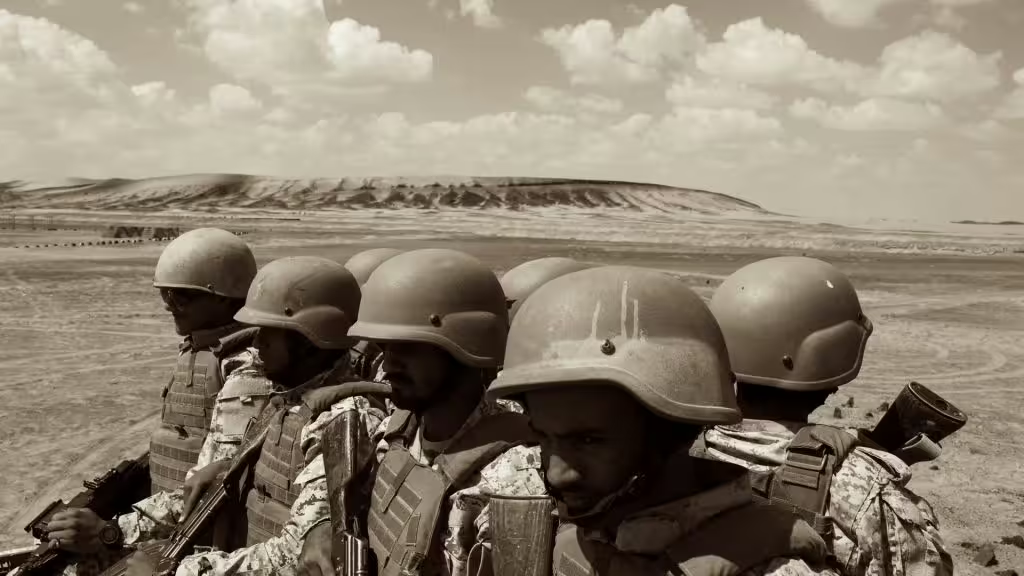
- The battlefield: Yemeni American risk consultant Mohammed al-Basha said more than 500 Houthi fighters, including commanders, have been killed in recent weeks in battles over the Kahboub mountains and resource-rich Marib. He said the Saudi-backed coalition, initially paralyzed, is now mounting far stiffer resistance.
- Displacement: The United Nations said more than 120,000 Yemenis were displaced within three weeks, with thousands fleeing across the Red Sea to Djibouti, Somaliland and Puntland. UNHCR representative Sandrine Dessamour said the first arrivals in Djibouti were fishermen in small boats, followed by more organized waves of women and children, many malnourished.
- Health system: ICRC Middle East spokesman Hashem Osseiran said Yemen’s health system is on the brink of collapse, with more than 40% of facilities already partly or fully out of service and too few staff for the influx of wounded. Maternity wards are being converted into emergency rooms.
- Casualty toll: Mark Schakal, head of Doctors Without Borders programs in the Middle East, said hospitals have been damaged and that Aden’s hospital received 25 bodies in two days. The hospital in Mocha, seized by the Houthis on September 10, still functions but with fewer patients after mass displacement.
Background:
The Houthis emerged as an irregular militia in northern Yemen in the 1990s and have long sought to push Saudi Arabia out of the country, accusing Riyadh of imposing a blockade. Saudi Arabia backed the coalition government through the 2015-2022 civil war.
Between the lines:
The analysts converge on one reading: Yemen is a secondary front being used to compensate for pressure elsewhere. Dawsari ties the offensive’s timing to Iran’s lost leverage at Hormuz; Alley ties Washington’s absence to a deliberate handoff to Riyadh. Al-Basha’s battlefield picture points to entrenched fragmentation rather than a decisive outcome.
What’s next
Watch whether Washington upgrades its Saudi-based support to direct strikes, the battle for Marib and the Kahboub mountains, and displacement flows to Djibouti and Somaliland.