The latest:
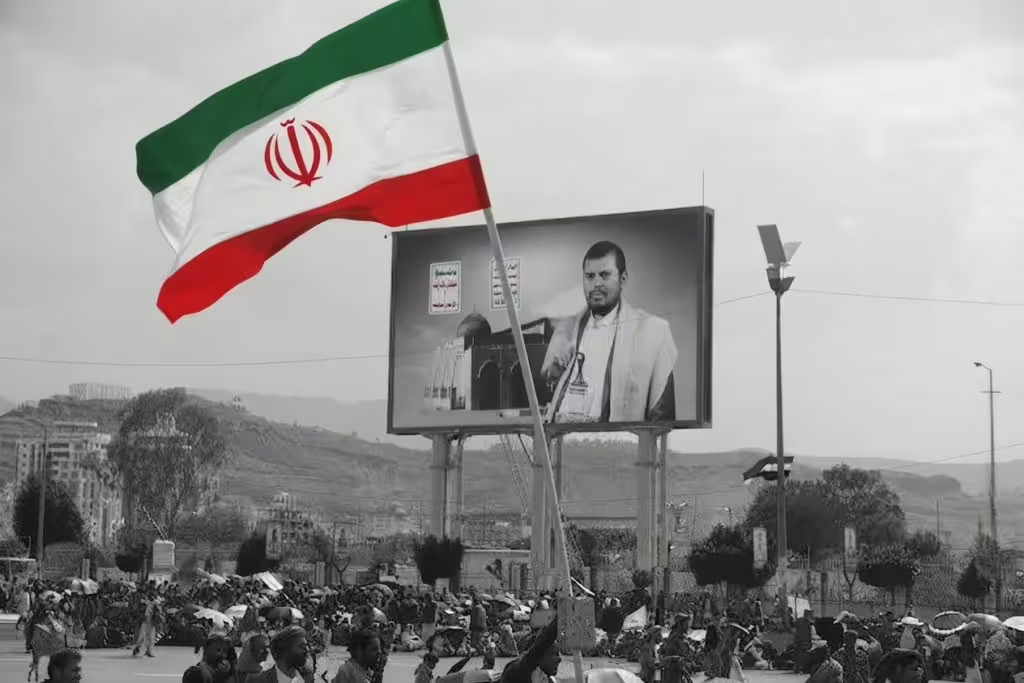
It took Houthi fighters less than 48 hours to strip Yemen’s Red Sea coast from pro-government forces, and they did not do it alone. Iranian Revolutionary Guard advisers were in the field helping direct the battle, people familiar with the offensive told the Associated Press — the most direct Iranian intervention for its Yemeni ally since the civil war began in 2014.
Details:
- The offensive: The Houthi push covered 115 kilometers (75 miles) and exploited divisions among forces aligned with the internationally recognized, Saudi-backed government. The rebels penetrated the internal communications of the National Resistance, a main pro-government faction, allowing them to track its movements, officials said.
- The fall of Mokha: On September 9 the Houthis advanced south through a narrow mountain valley, seized the mountain road and a nearby base, and cut supply lines. Residents fled overnight and the rebels entered Mokha unopposed on September 10. A Houthi official said the city was empty when they arrived.
- Iran’s role: A Houthi official said Iranian advisers had previously focused on strategic planning, but during the latest escalation were “present at all levels,” including tactical maneuver planning and work with frontline commanders. Two regional officials said Iran also provided direct support that aided the rapid advance.
- The capabilities gap: Analyst Mazham al-Saloum, who has tracked Iran-backed groups for nearly a decade and now runs a private intelligence firm, said Iranian advisers handled communications analysis and satellite intelligence the Houthis lacked. He said Tehran began intensive training last year on more advanced missiles, drones and attack boats.
- The bombardment: Over a month, Houthi forces struck National Resistance positions with 130 ballistic missiles and 145 suicide drones, said spokesman Maj. Gen. Sadiq Duwaid. Its roughly 30,000 fighters were spread across 170 kilometers (100 miles) facing an estimated 75,000 Houthi fighters.
- The rivalries: The Giants Brigade briefly helped repel the rebels in early September but did not coordinate with the National Resistance, angering its field commanders, a government official said. The two carry a rivalry rooted in the earlier Saudi-Emirati contest over the anti-Houthi movement, which preceded the UAE’s abrupt January withdrawal.
- The collapse: National Resistance commander Lt. Gen. Tareq Saleh fled and took refuge in Saudi Arabia. When thousands of fighters ordered to pull back began arriving in Mokha, troops there assumed a major assault was imminent and started fleeing, two National Resistance fighters said. Tens of thousands of residents joined the exodus.
- The losses: Two government officials said the Houthis captured armored vehicles, missiles, artillery shells and ammunition, mostly Saudi supplied, and displayed some of it in a televised parade. The National Resistance said it lost 500 fighters; the Houthis have not announced their casualties.
- The Saudi silence: A senior Yemeni military official said commanders were stunned that Saudi warplanes did not bomb the Houthis as they advanced on Mokha. The Saudi government media office did not respond to a request for comment, and Iran’s UN mission did not respond either.
Background:
The Houthis had mounted no major coastal campaign since 2017, when government forces expelled them. A truce took hold in 2022, and the group began attacking Red Sea shipping in 2023 over the Gaza war until a US bombing campaign in 2025. The Houthis largely stayed neutral after February’s US and Israeli strikes on Iran.
Between the lines:
The coastal seizure and the closure of a major Saudi pipeline give the Houthis the ability to choke Saudi oil exports, pushing global fuel prices up and handing Tehran added leverage. The captured islands extend that reach over Red Sea shipping. Washington’s apparent reluctance to assist Riyadh, alongside the UAE’s January withdrawal, leaves the anti-Houthi camp without unified command.
What’s next
Watch whether Saudi airpower enters the fight, how far Houthi defenses around the captured coast harden, and whether pro-government factions rebuild a single command structure after Tareq Saleh’s flight to Saudi Arabia.